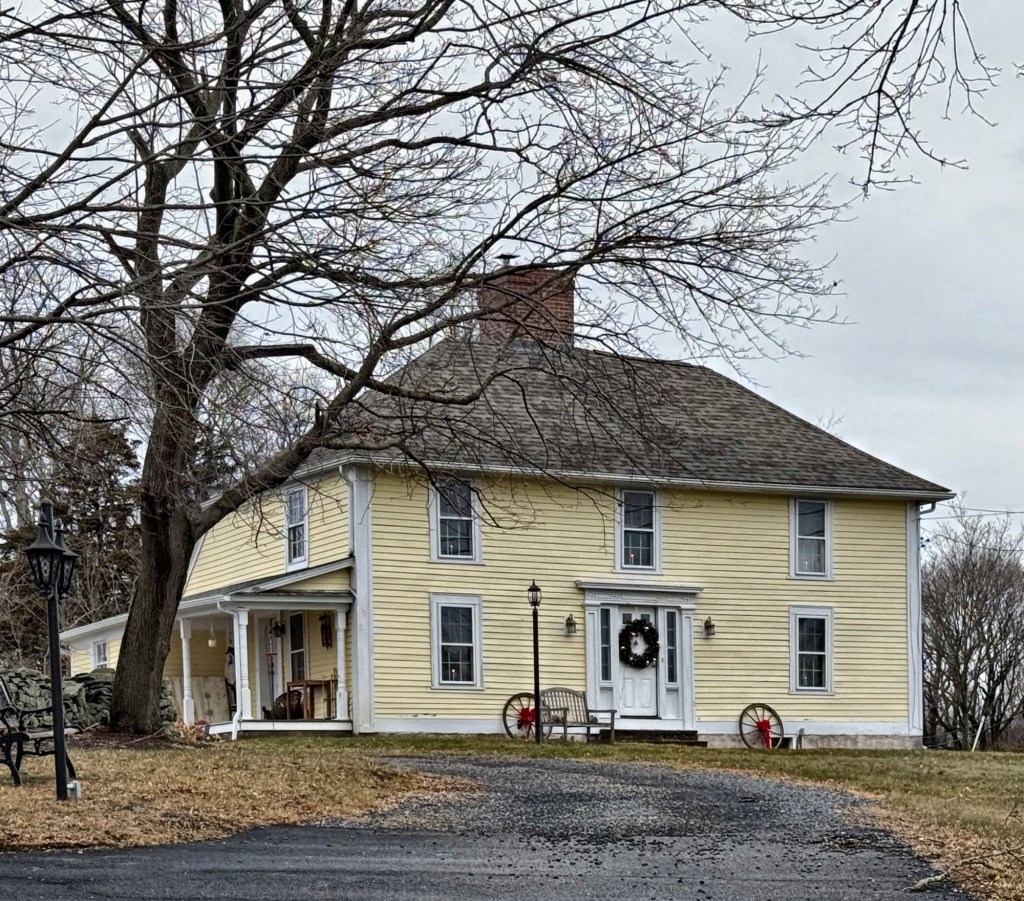
Possibly the oldest building in Warren, Rhode Island, this historic farmhouse on Market Street, near the state line, has framing that possibly dates to the 1680s! After Sachem Massasoit and his oldest son, Wamsutta, sold land to Plymouth Colony settlers what is present-day Warren, Barrington, Swansea and Rehoboth, Massachusetts, the town of Swansea was established in 1667. Obadiah Bowen (1627-1710) was an original proprietor of Swansea and was listed as number 23 in the order to draw lots for the meadows on the northside of town. By 1679, he received a ten-acre house lot of uplands and salt meadow, reaching from the Palmer River inland and across Market Street to the Birch Swamp. He built a farmhouse on the rocky highland where he farmed the property until his death. His son, Thomas Bowen (1664-1743), later purchased the farm and added to it another 70 acres making the property a total of 170 acres. The old Bowen property was sold to Richard Haile in 1708 and remained in the Haile family until the late 19th century. After successive ownership in the Haile Family, the property became known as the “Judge Haile farm,” after owner, Levi Haile (1797-1854), a justice of the Supreme Court of Rhode Island, he served on the court that tried Thomas Dorr, the leader of the Dorr Rebellion, a struggle to extend voting rights in Rhode Island to non-property owners. Levi Haile made improvements on his house and farmed the land, as did his two sons. The property sold out of the Haile family in the late 19th century and remained a farm until the 1980s, when part of the property was subdivided for development and part donated to the Warren Land Trust, who maintains the property as the Haile Farm Preserve. While the farmland is protected, the old farmhouse is not protected as a town landmark nor through the community’s demolition delay bylaw.
 Buildings of New England