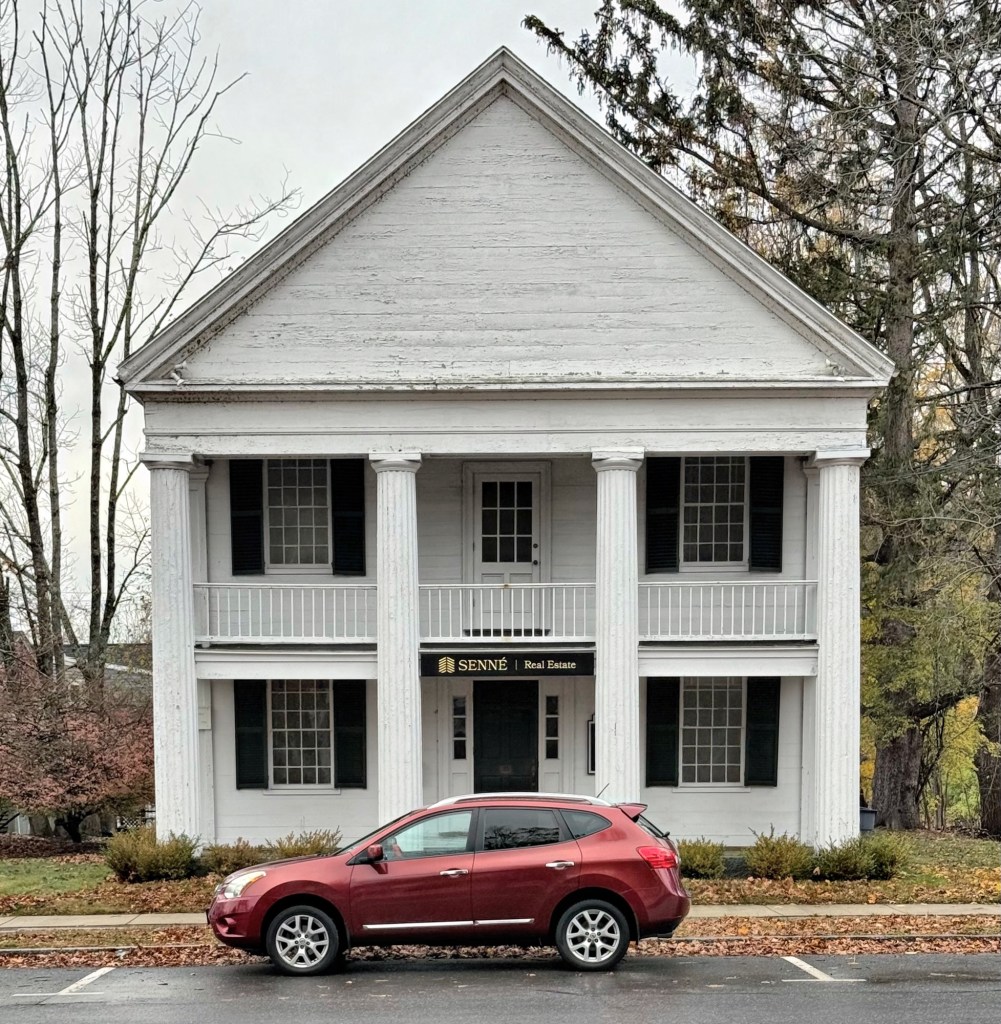
Old Wayland Town House – Lovell’s Market // 1841

The Old Wayland Town House on Cochituate Road is an imposing Greek Revival temple-front building that has served various uses for the community. The structure was built in 1841 to serve as Wayland’s first municipal building and it was referred to as the Town House, with a large classroom and a small entry space on the first floor and a town meeting hall on the second. In 1850, the Wayland Free Public Library was opened in the building, in a small room in the front of the building. The small building was quickly outgrown for its civic uses, and in 1878, Wayland built a new, large Stick style town hall (demolished in 1958). The old Town House was sold to Lorenzo Knight Lovell (1837-1909), who soon after converted the Town House into a dry goods and grocery store known as Lovell’s Market. Following Lorenzo Lovell’s death, his son William S. Lovell ran the store until about 1922 when he leased the building to Lawrence Collins, who remained here for nearly 60 years operating his own store. Collins Market was eventually purchased in the late 1980s and converted to office space, which remains today.
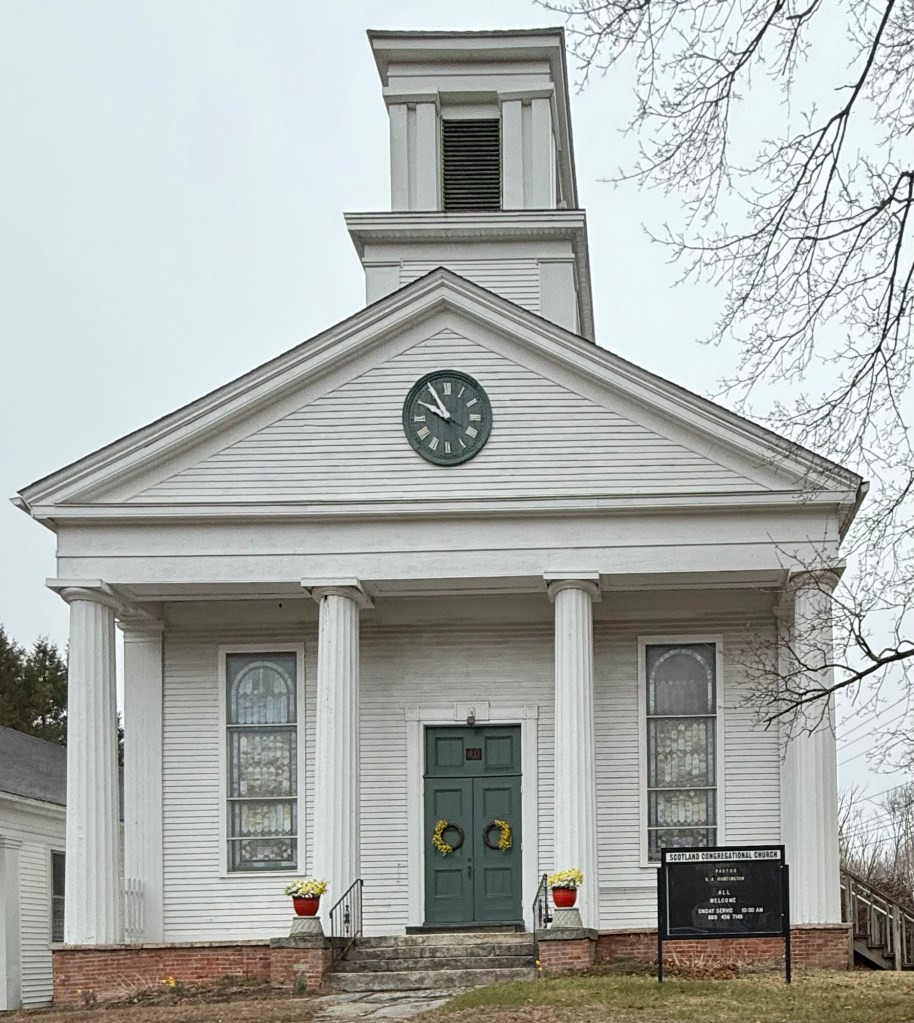
Scotland Congregational Church // 1842

The main visual anchor of the charming town green of Scotland, Connecticut, is this building, the Scotland Congregational Church. Built in 1842 as the congregation’s third building, this Greek Revival style edifice features stately proportions, temple-front with four large Doric columns supporting the portico, and a two-stage belfry. The chapel (some say it was converted from the original town hall) was acquired by the congregation in 1867, and has remained in its new location ever since. Later alterations include the stained glass windows and clock in the pediment, which dates to the early 20th century.

Liberty Street School // 1847

The Liberty Street School building in Warren, Rhode Island, was built in 1847 and beyond its clear architectural significance, it is significant as the third high school building constructed in the state, and is the oldest survivor of its type. Architect Thomas Alexander Tefft, one of the nation’s first professionally trained architects, designed the school when he was just 21 years old! The young architect would later take an excursion around Europe in the mid 1850s, but would fall ill with a fever in Florence, Italy and he died there in 1859. He was just 33 years old when he died. The Liberty Street school building was eventually closed and has sat largely vacant for years. A recent proposal to restore the building and add onto the rear for condominium units has been a site of contention for the town in recent years.

Pettee Stone Barn // c.1840

Built adjacent to the stone cottage, this stone barn was also constructed in around 1840 by Otis Pettee (1795-1853) as part of his business venture. Pettee was a major mill owner in the Upper Falls Village of Newton and was a major silk manufacturer in the area. The stone barn was used as a warehouse and later as the location for raising silk worms for the silk mills down the street. As with the adjacent stone cottage/shop, Pettee likely built the barn of mostly stone on the site as a fireproof design to protect his valuable product. It is now home to Danish Country & Modern, an amazing furniture shop which sells Scandinavian furniture and accessories.