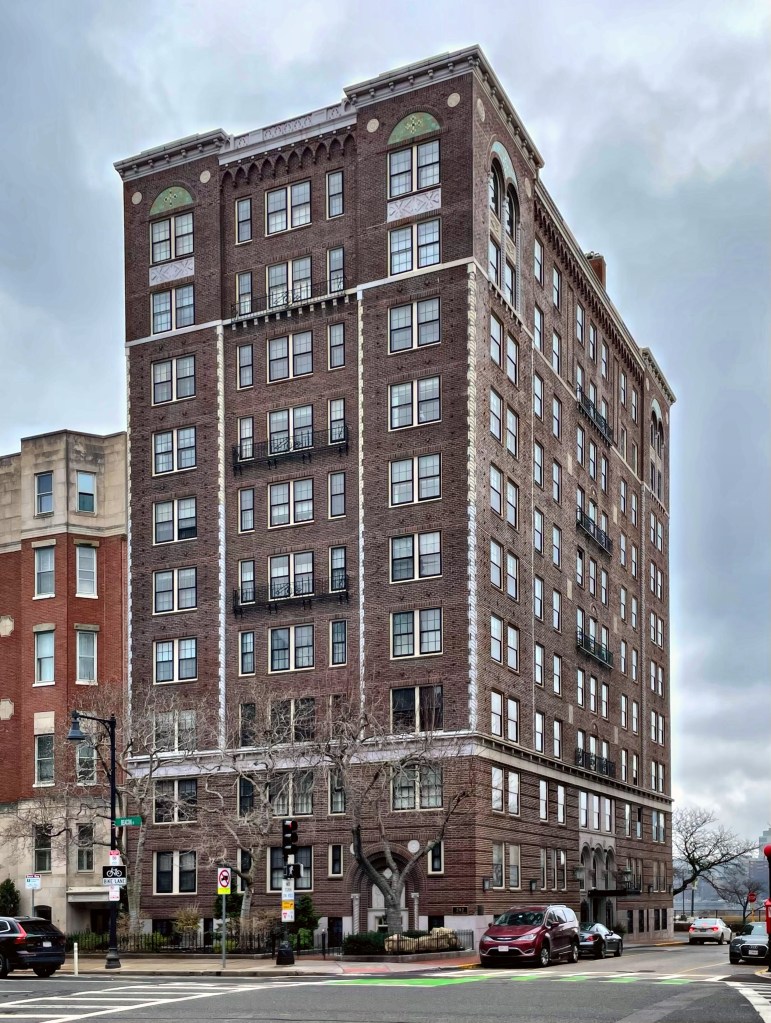
One of the finest apartment-houses in Boston is this towering building at the corner of Beacon and Exeter streets in the Back Bay neighborhood. In 1926, real estate dealers Elliott Henderson and Roger B. Tyler purchased two townhouses on small lots and demolished them for the present structure. They hired the architectural firm of Blackall and Elwell furnished the plans for the 11-story Renaissance Revival style residence which included ten large apartments. The design is unique to the Back Bay with amazing cast stone details at the entries with rounded arch windows, fanciful brickwork, and spiral columns!
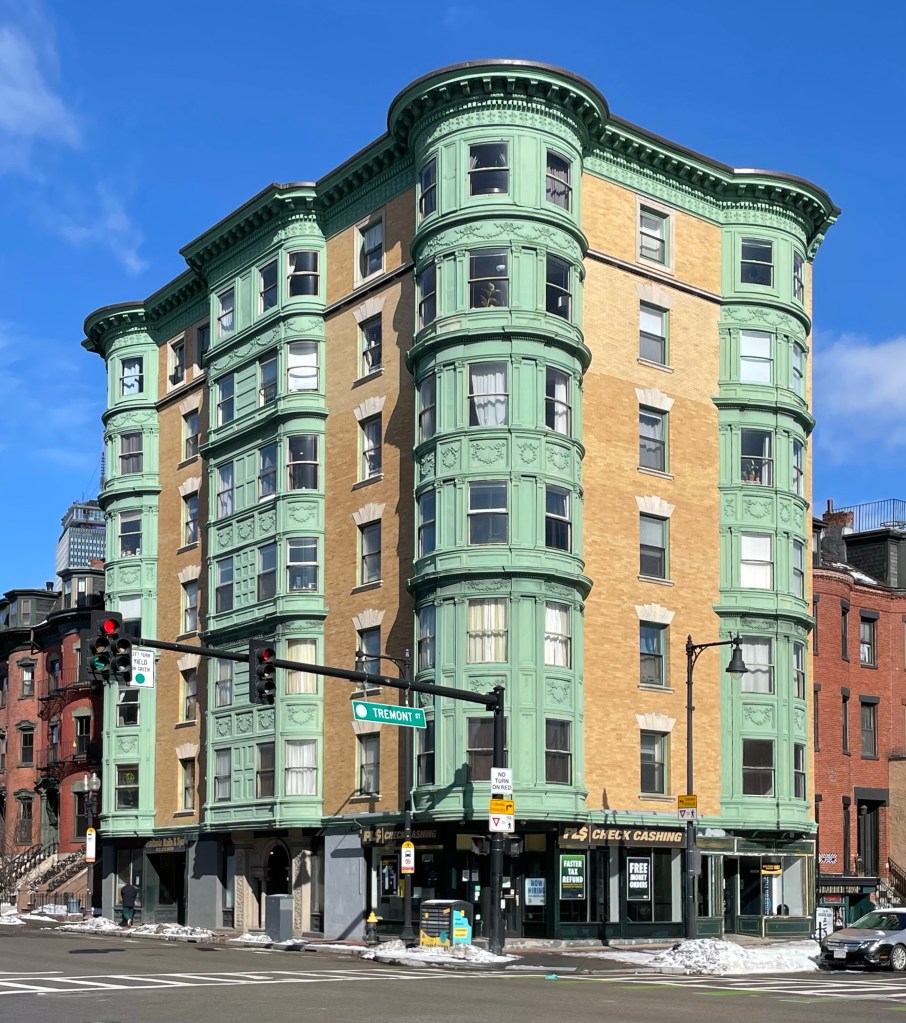
Located at the prominent corner of Mass Ave and Tremont Street in Boston’s South End neighborhood, this beautiful apartment building has long caught my eye, but I finally got around to looking up its history! The building was constructed in 1896-7 by Albert Geiger, a real estate developer who sold the completed building to a Josiah P. C. Marshall. The building is Classical Revival in style and had eleven suites for rental. The blond brick building with Indiana limestone trim are gorgeous, but the showstoppers are the metal bay windows with decorative wreaths and garlands.
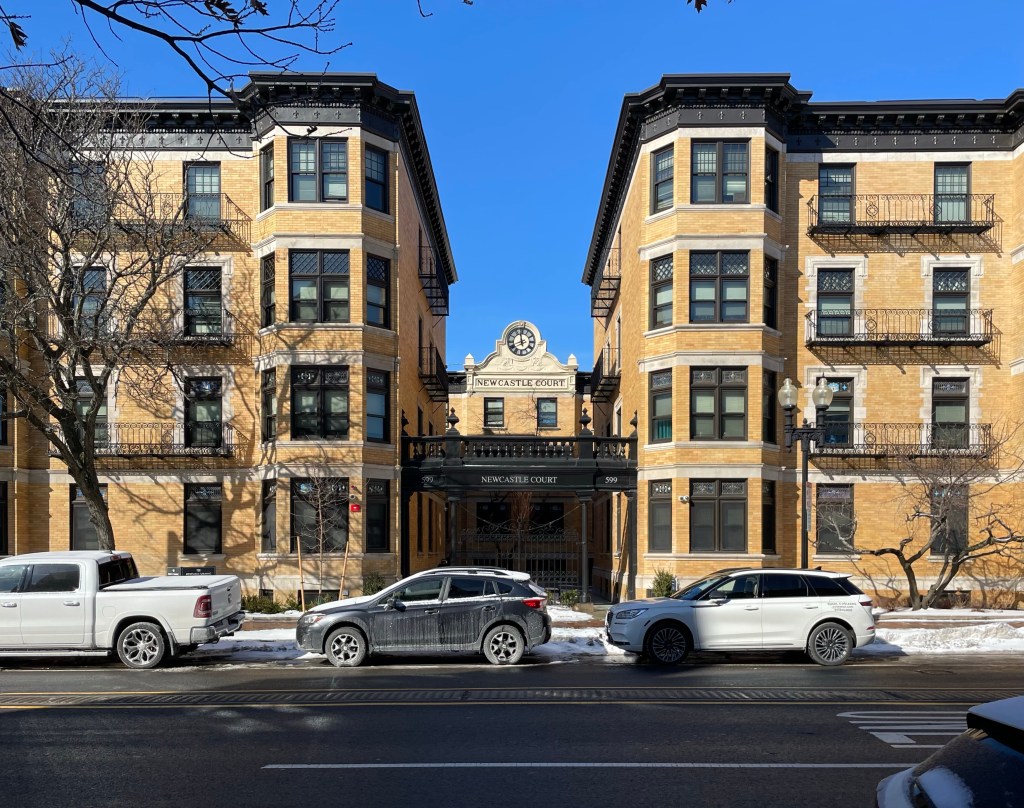
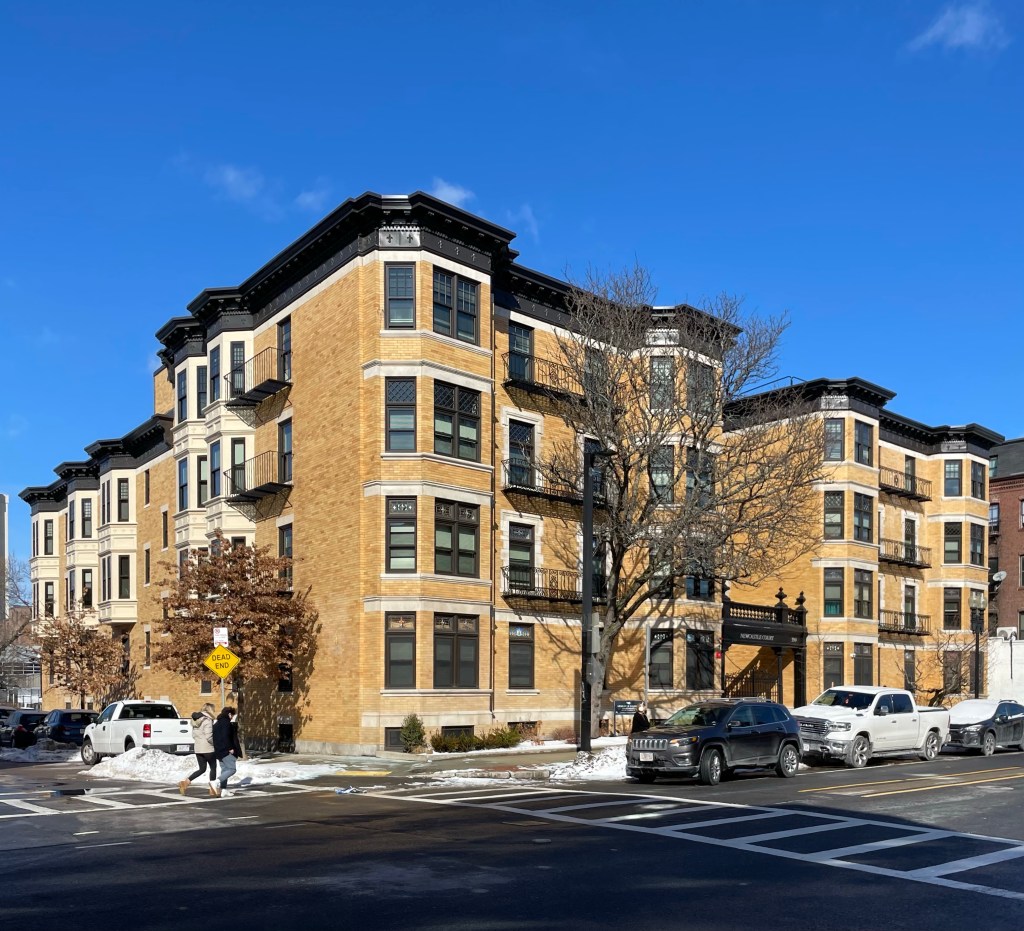
Newcastle Court in Boston’s South End/Lower Roxbury neighborhoods is one of the finest apartment buildings in the city built in the early 20th century. The complex is U-shaped with a central courtyard off Columbus Street, to provide air and natural light in all bedrooms and units of the building. Newcastle Court was built by builder/developer Israel Nesson, who was credited as building the first fireproof apartment building in the city. Nesson and his family built and owned apartment buildings all over Boston and Cambridge, and operated many of them as landlords with massive real estate holdings. Newcastle Court stands out for the garden courtyard set behind the gate. At the back of the courtyard, the building has a raised parapet at the roof, which encompasses a clock. Many of the units retain the original stained glass windows, which are AMAZING!
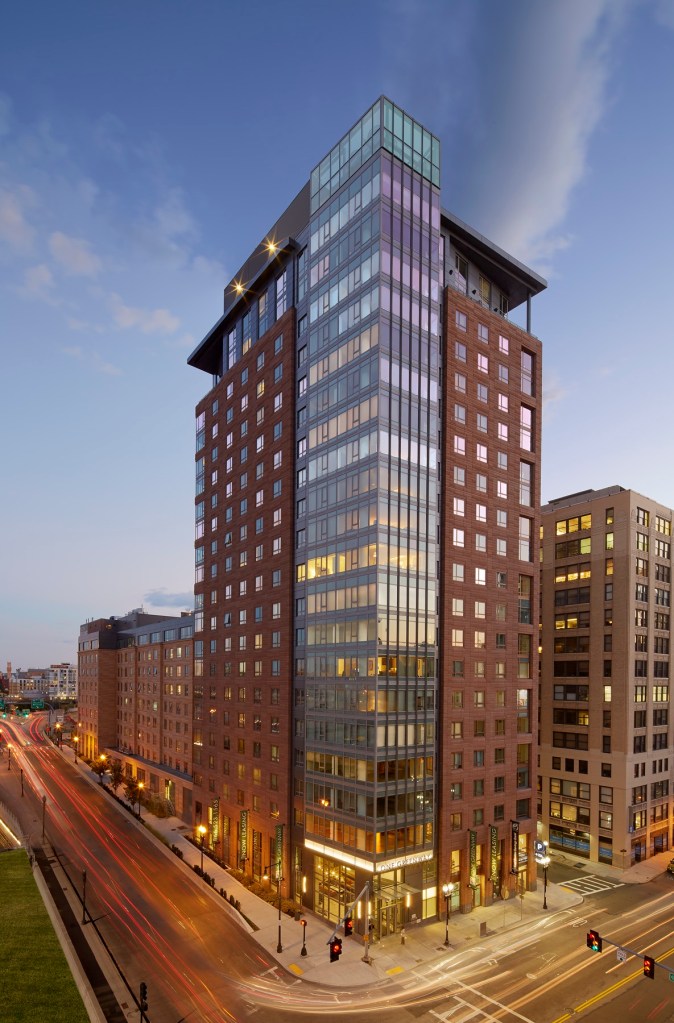
Replacing a vacant lot bordering I-93 at Kneeland Street, the One Greenway development provides much needed housing and design as one of the gateways into the Chinatown neighborhood of Boston. A result of community engagement, One Greenway is one of the largest new affordable housing projects in recent memory. The project restores the urban fabric that was lost half a century ago to the construction of major highways, which cut through the community and provides much-needed affordable housing in one of the nation’s oldest and largest immigrant communities. When the elevated highway was moved underground and the Rose Kennedy Greenway was laid out, parcels adjacent were available for reuse, and this was one of the last to be redeveloped. The building mixes 217 market-rate apartments and 95 affordable apartments, to create a mixed-income development, hopefully the future, as to not segregate affordable housing to less-desirable parts of cities. Designed by the firm Stantec, the building creates a solid street wall at the corner, and provides amazing open space at the rear in the form of a well-designed park designed by Crosby, Schlessinger, and Smallridge. The use of beige terracotta panels makes the large building more inviting, compared to the cold and sterile new apartment buildings going up all over the city and region.
One of the most grand apartment hotels in Boston, The Charlesgate, serves as one of many architectural anchors for the Back Bay neighborhood from Kenmore Square. The apartment hotel was constructed in 1891 and so named after the Charlesgate Park which was created by landscape architect Frederick Law Olmsted as part of the glorious Emerald Necklace park system. The Back Bay Fens was the first park designed by Olmsted for the City of Boston. Creating the Back Bay Fens was as much a sanitary as an aesthetic project, because the water was heavily polluted and often stagnant; Olmsted envisioned Charlesgate as the meeting point of the Back Bay Fens with the Charles River. The apartment hotel was actually designed and was financed by the architect, John Pickering Putnam, and members of his family. The basement and first story are constructed of Indiana limestone with the remainder of brick, with limestone trimmings. A picturesque effect is obtained by grouping the bays in pairs, and surmounting each pair with gables in the Queen Anne style, and by relieving these features against a high roof of green slate. The building originally featured 30 apartments and has since been reconfigured into over 50. The architectural landmark is one of the best statement-pieces in the neighborhood, and shows that apartment design can be done very very well!
One of the most photographed buildings in North End is arguably this tenement block, built in 1895 at the corner of Prince and Salem Streets. As the North End continued to redevelop into a diverse immigrant community, tenement houses were constructed by those with the means, providing housing at low cost to those who arrived to Boston in the late 19th and early 20th centuries. Max and Etta “Ethel” Lebowich, Russian Jews, immigrated to Boston, settling in the Jewish quarter of the North End and opened up a dry goods store at the corner. The business did well, and the couple redeveloped their land and hired Swedish-born architect Charles A. Halstrom, to design the prominent apartment house. The Renaissance Revival building features massive pressed metal oriels and brick and stone construction. I am unsure if the oriels are truly copper, which would have been fairly expensive for a tenement building, or if they are pressed tin. Any insight would be much appreciated.


 Buildings of New England