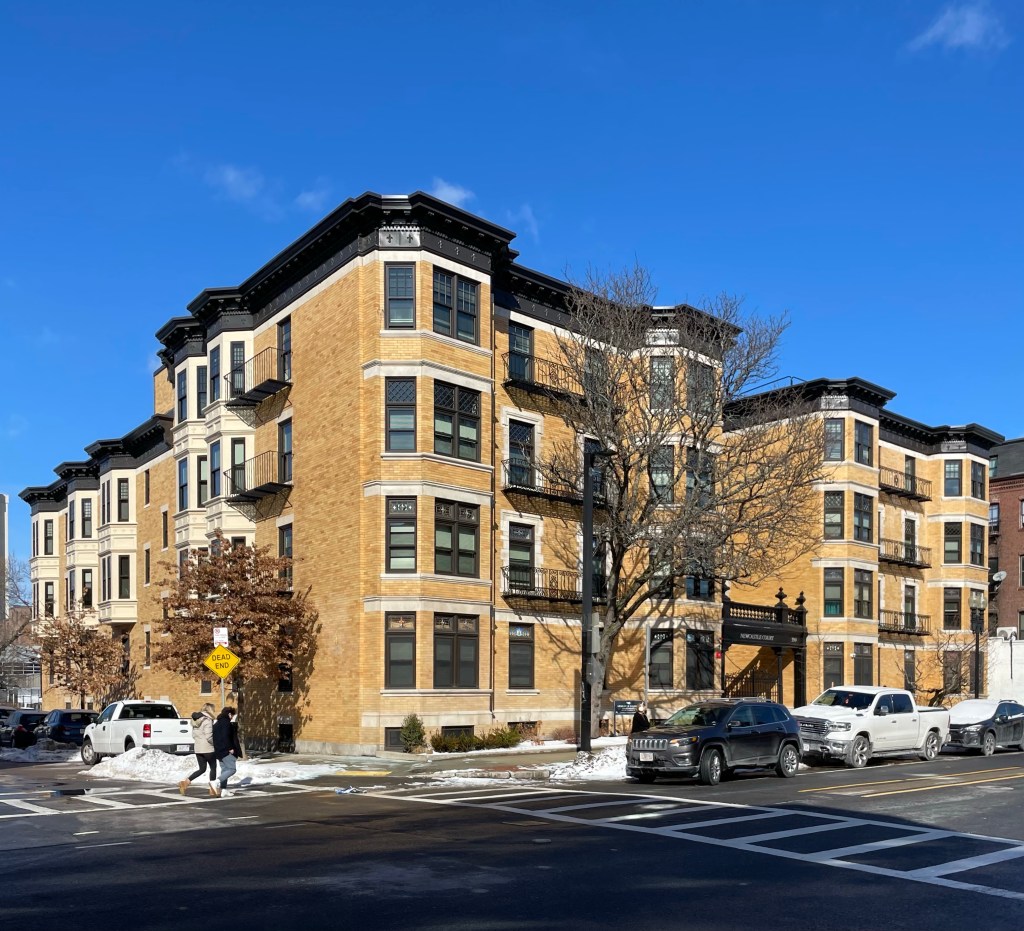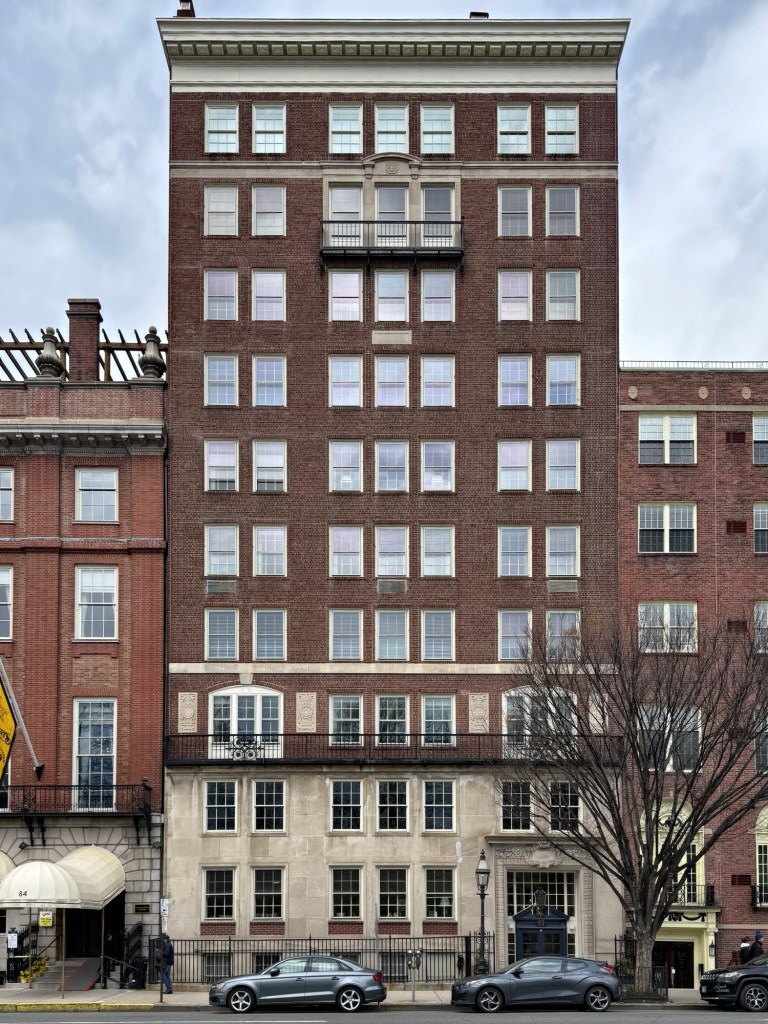
Ripley Apartments // 1925

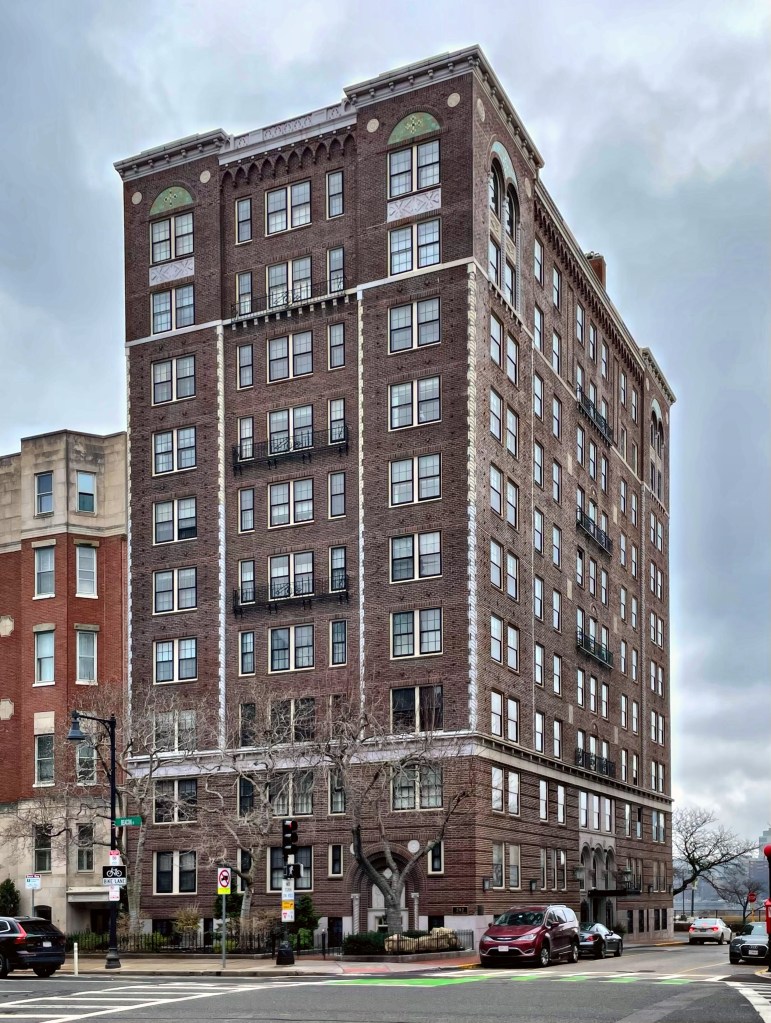
One of the taller apartment buildings constructed on Beacon Hill in the inter-war period stands at 81-82 Beacon Street, providing residents with sweeping views of the Boston Common, Public Garden, and the ever-growing city of Boston. The ten-story building replaced two, four-story townhouses formerly on the site owned by members of the Thacher family. The two parcels were purchased by James H. Ripley of the New York-based real estate firm of Goggin & Ripley, who then hired Boston architect, Joseph Daniels Leland, who founded the firm of J. D. Leland & Company. The building was originally planned as a seven-story co-op but was later expanded to a ten-story tower with one apartment on each floor, making the building a luxury residence for its residents. The two-story limestone base with side entrance, flemish bond brickwork, iron balcony, and traditional double-hung windows all showcase how the Colonial Revival style works well with multi-family housing.
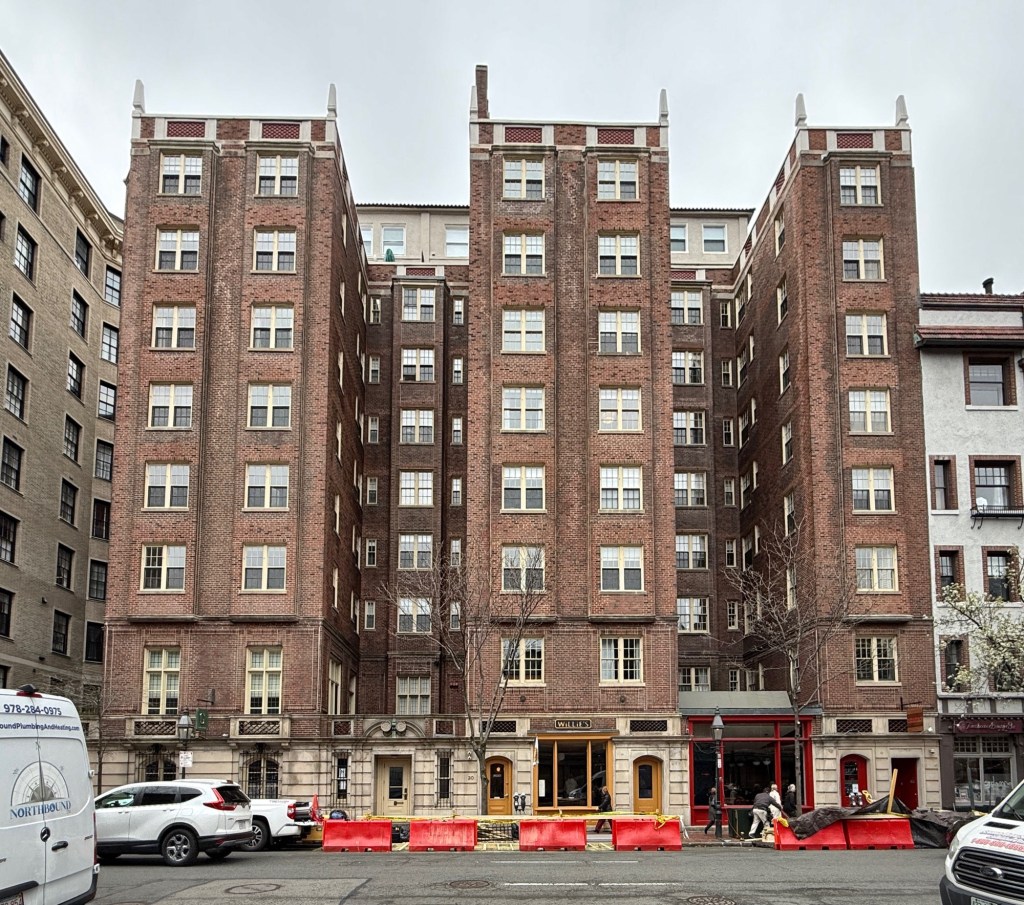
Hotel Lincolnshire // 1924

The Hotel Lincolnshire is a stunning eight-story apartment building on the west side of Charles Street in Boston’s Beacon Hill neighborhood. The building was developed in 1924 by William Coombs Codman, a real estate developer and member of the Beacon Hill Associates, a group of preservationists who bought and resold properties in the neighborhood with the aim to limit unsympathetic development. The group helped the Beacon Hill Flat area, which was a higher concentration of former stables west of Charles Street, a gentrified artist and residential enclave. The Hotel Lincolnshire was marketed as a residential apartment hotel, with furnished and unfurnished apartments with greater amenities than a traditional apartment building. Beacon Hill resident and architect, Richard Arnold Fisher, was responsible for designing the building, where he employed the use of courtyards (similar to his design nearby at 101 Chestnut Street) and walls of brick with cast-stone details. Of special interest is the use of perforated terracotta panels laid in half-round forms and the stone pinnacles at the parapet.

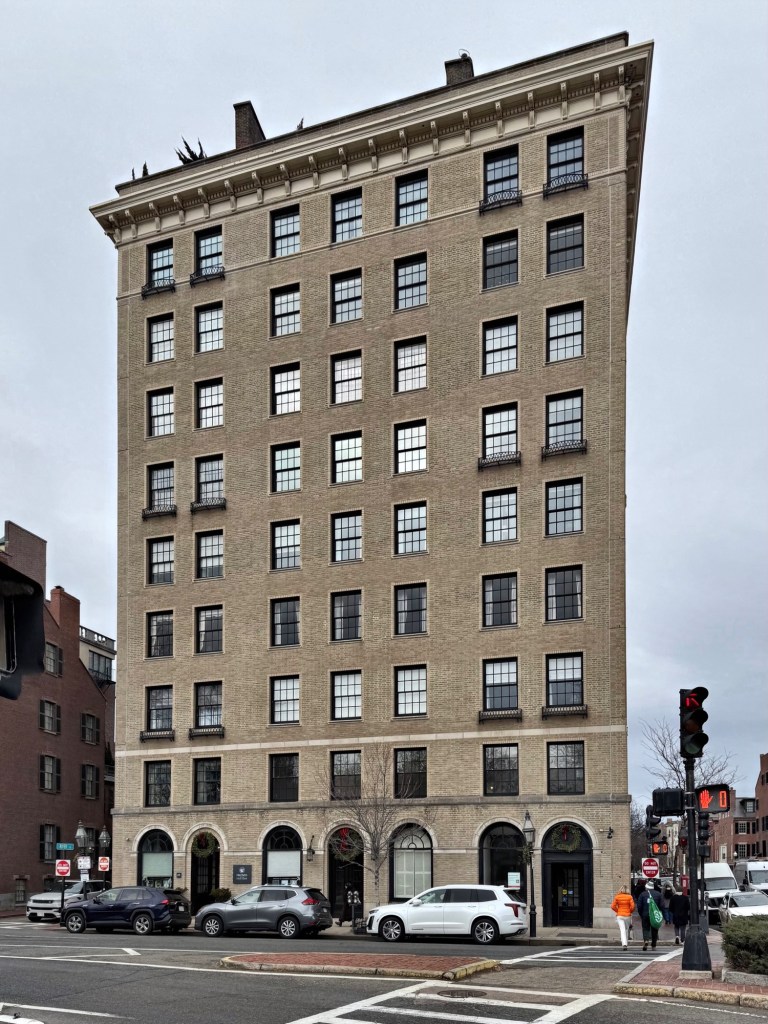
Public Garden Apartments // 1917

Located on the prominent corner of Beacon and Charles streets in Beacon Hill, the aptly named Public Garden Apartment Building overlooks one of the best shopping streets and public parks in the country. The handsome nine-story apartment building was constructed in 1917, replacing four townhouses previously on the site, and was developed by the legendary newspaper magnate, William Randolph Hearst (1863-1951), who had acquired three Boston-area newspapers in the early 20th century and for some reason, engaged in Boston real estate development, though he spent most of his time in New York and California. The building originally included a 15-room penthouse apartment on the top floor of the building, with the other floors divided into two apartments per-floor, suggests that Hearst may have thought to make it his Boston residence, though it is not clear if he ever did. Hearst hired architect, Harold Van Buren Magonigle, who apprenticed under Calvert VauxRotch & Tilden, and McKim Mead & White, before opening his own practice in 1903, to design the Public Garden Apartments. The apartments inside were rented to upper-class residents, typically small, older families including widows and their unwed children almost all of whom, according to census records, employed between one and four live-in domestic servants to maintain their homes. The handsome multi-family building has walls of buff-colored brick masonry and sits upon a granite foundation with arched openings on the ground floor and bracketed cornice. Today, the building is a co-op and rents out space to the Friends of the Public Garden, one of the oldest public-private partnerships in the nation established in 1970, that takes care of, and advocate for the Boston Common, Public Garden, and Commonwealth Avenue Mall for everyone to enjoy. 

Studio Building, Beacon Hill // 1914

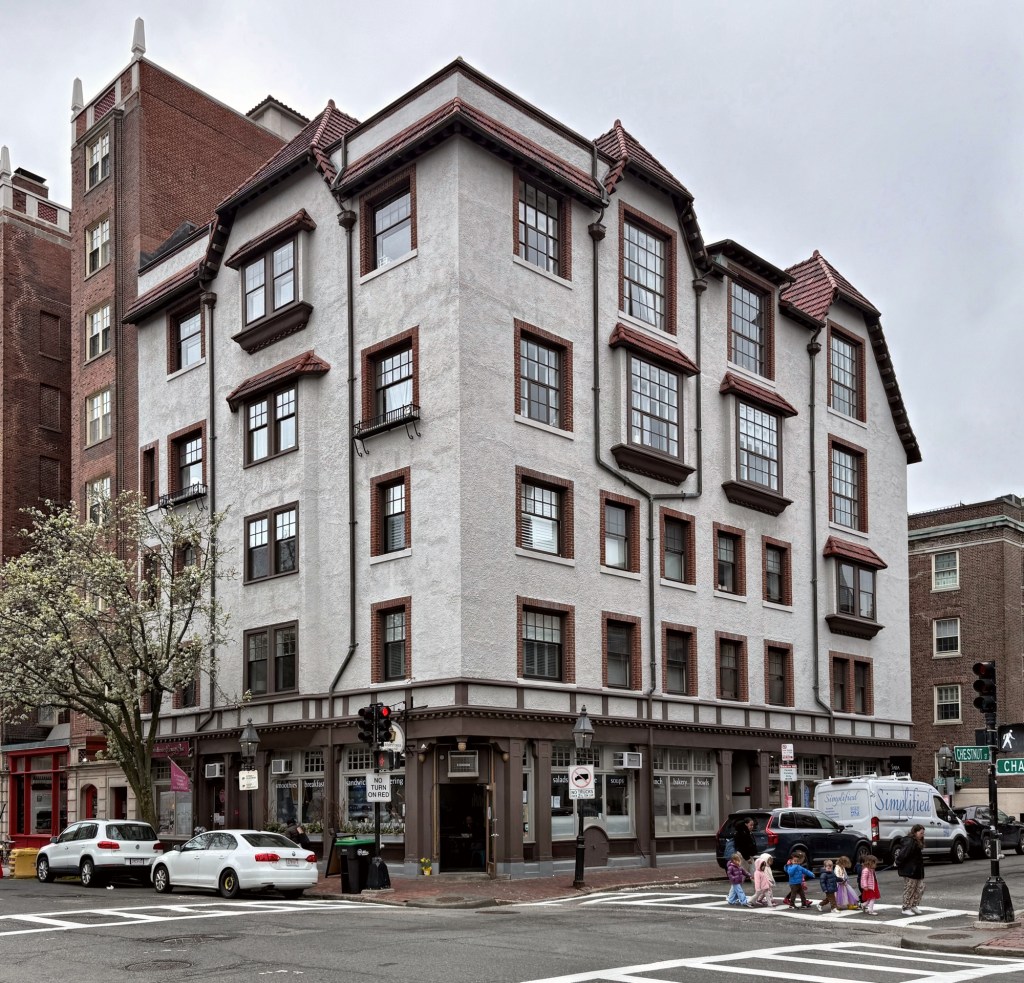
The Studio Building on Charles Street in Boston’s historic Beacon Hill, is a unique, Arts and Crafts style building constructed of brick with stucco walls and a red tile roof. Built in 1914 by William Coombs Codman, a real estate developer and member of the Beacon Hill Associates, a group of preservationists who bought and resold properties in the neighborhood with the aim to limit unsympathetic development. The group helped the Beacon Hill Flat area, which was a higher concentration of former stables west of Charles Street, a gentrified artist and residential enclave. Codman hired the young architectural firm of Loring & Leland, to design the Studio Building, which in its original configuration, contained three stores at the ground-level, two dwellings, offices and artist studios with oversized windows. Just years after the building was completed, Charles Street was widened in 1920, chopping ten feet off the facades of all buildings on the west side of Charles Street, including this building. Charles G. Loring was retained by Codman to oversee the renovations to the new facade and storefront, likely replicating what was once there. After 1920, the building was largely occupied by apartments for single women of means and remains one of the neighborhood’s most iconic and enchanting buildings.

Blenheim Apartments // 1898

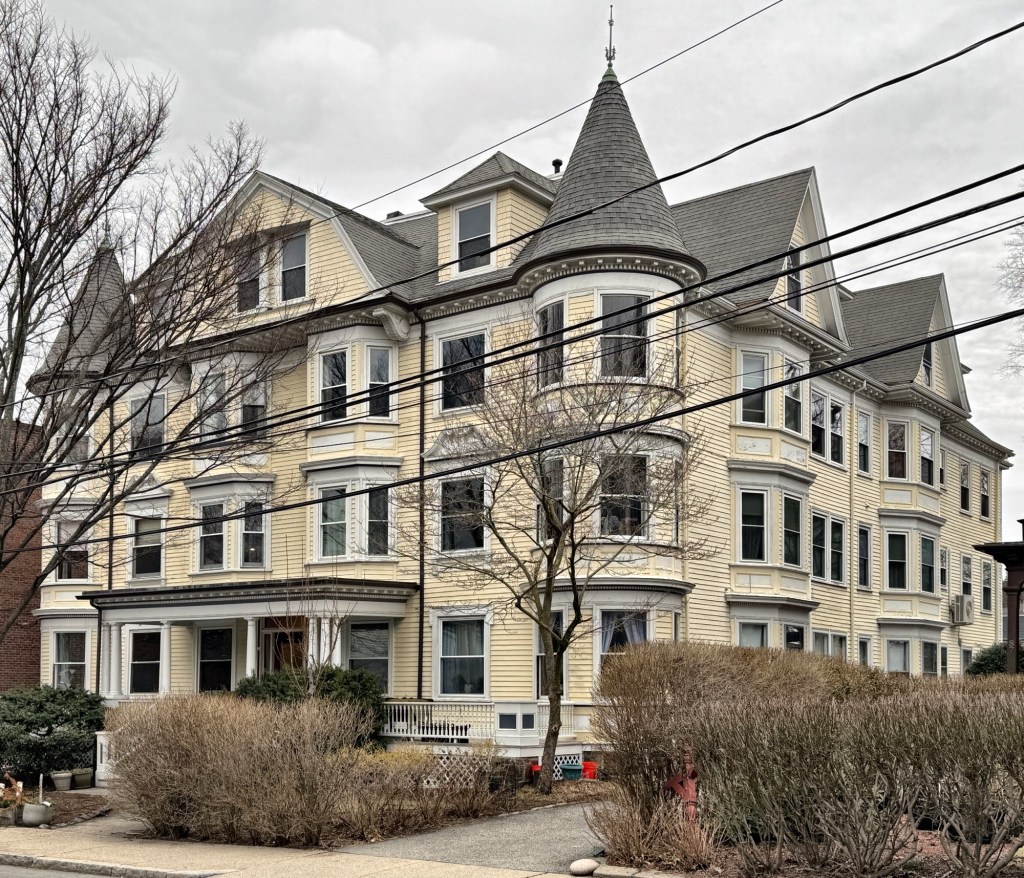
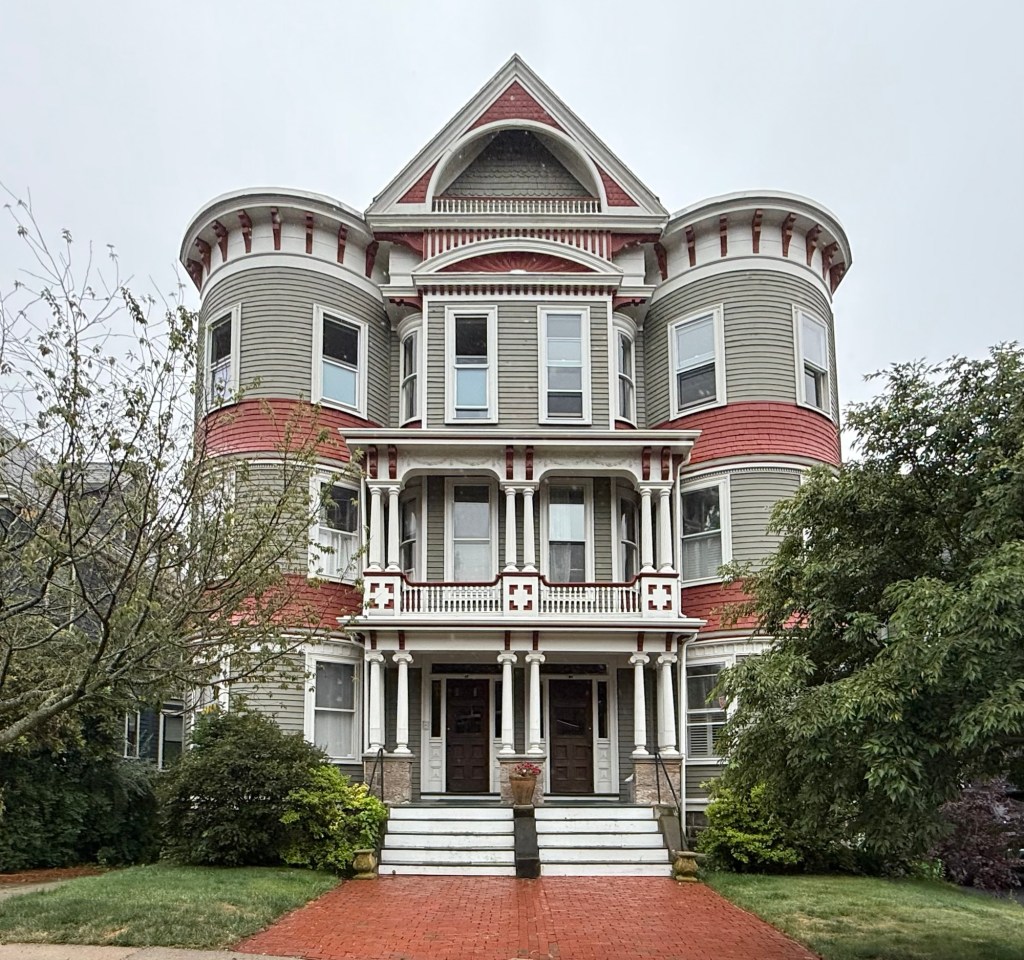
As Brookline, Massachusetts, saw rapid development in the late 19th and early 20th centuries, developers redeveloped lots formerly occupied by single-family residences and built large, multi-family triple-deckers and apartments, specifically in neighborhoods in close proximity to train stations into Boston. This building, constructed in 1898 by local builder, John H. Pineo, for owner, Walter H. Whittemore as an investment property. The building contained six apartments as a double triple-decker with two units on each floors accessed by a central entry and stairwell. The building has been known as the Blenheim Apartments and blends Queen Anne and Colonial Revival styles into a single, eclectic composition. The large massing is broken up by both the undulating facades and roof with projecting bays, dormers and corner towers, along with the applied ornament of panels, dentils, corbels and broken pediment motifs. If all multi-family housing looked like this, people would not complain about density as much!

Steuer Apartments // 1913

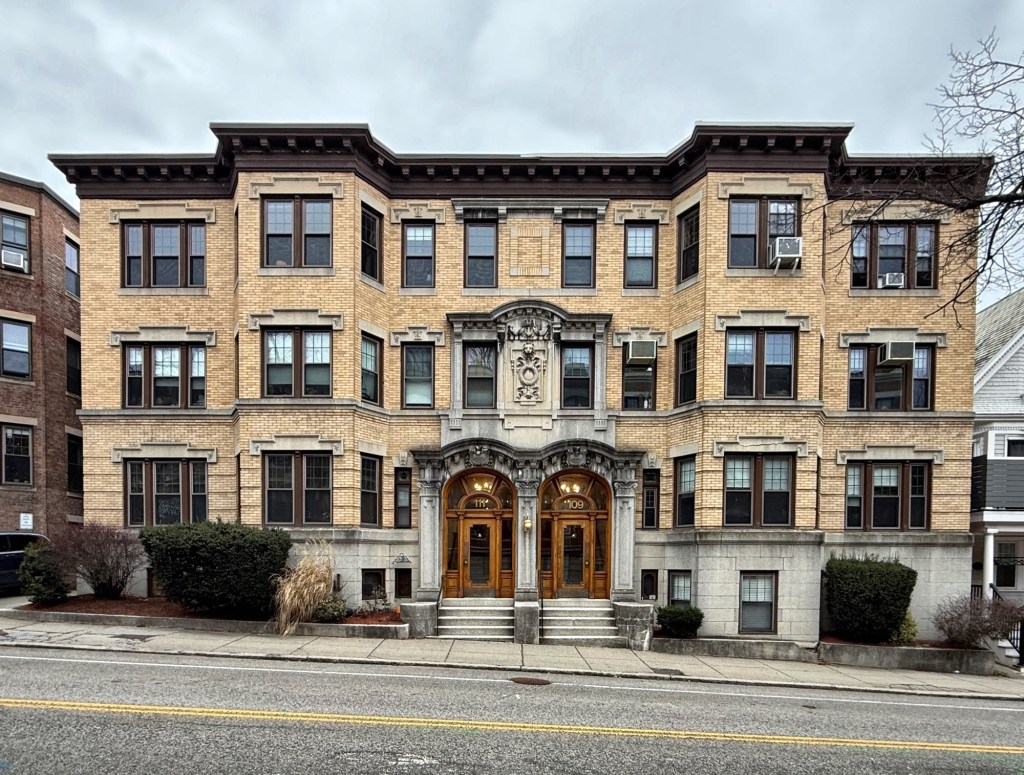
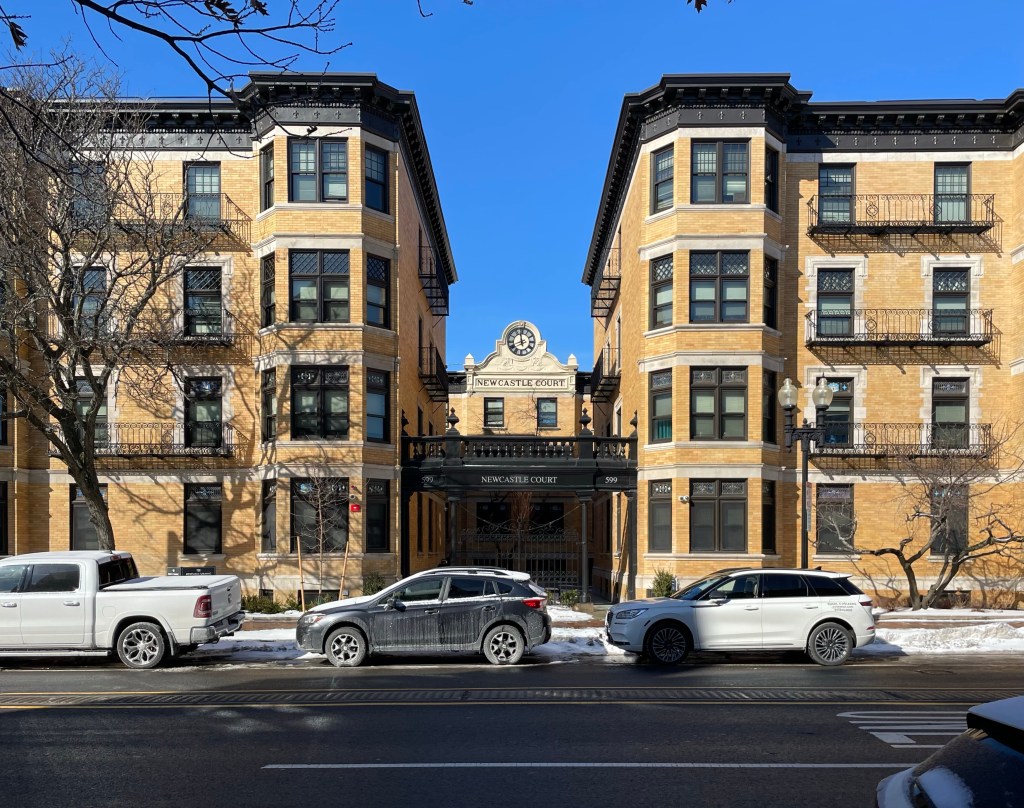
In the early 20th century Brookline, Massachusetts, saw an immense increase to its population, spurred by the streetcar system and a suburbanization of greater Boston. As land is finite, developers eyed the large estates near commuter lines and built apartment buildings to supply housing to middle-income residents. Not all residents welcomed the change as density and the destruction of old estates caused concerns for many wealthy and older residents in Brookline who enjoyed the bucolic suburbs to dense city life. As a result, many Brookline developers hired known architects to design apartment buildings with high-quality materials and finishes to contribute to the rich architectural streetscapes and established neighborhoods. This apartment building, one of two at the corner of Longwood Avenue and St. Paul Street, was built in 1913 from plans by Gay & Proctor, an established local architectural firm. The developer, Bernard Steuer (1859-1921), was an Austrian-Jew that emigrated to the United States and worked in real estate and building in Brookline and Boston. The building features a heavy cornice with modillons, three-story polygonal bays that break up the massing, and cast stone detailing with Beaux Arts style entries.

Tudor Apartments // 1887

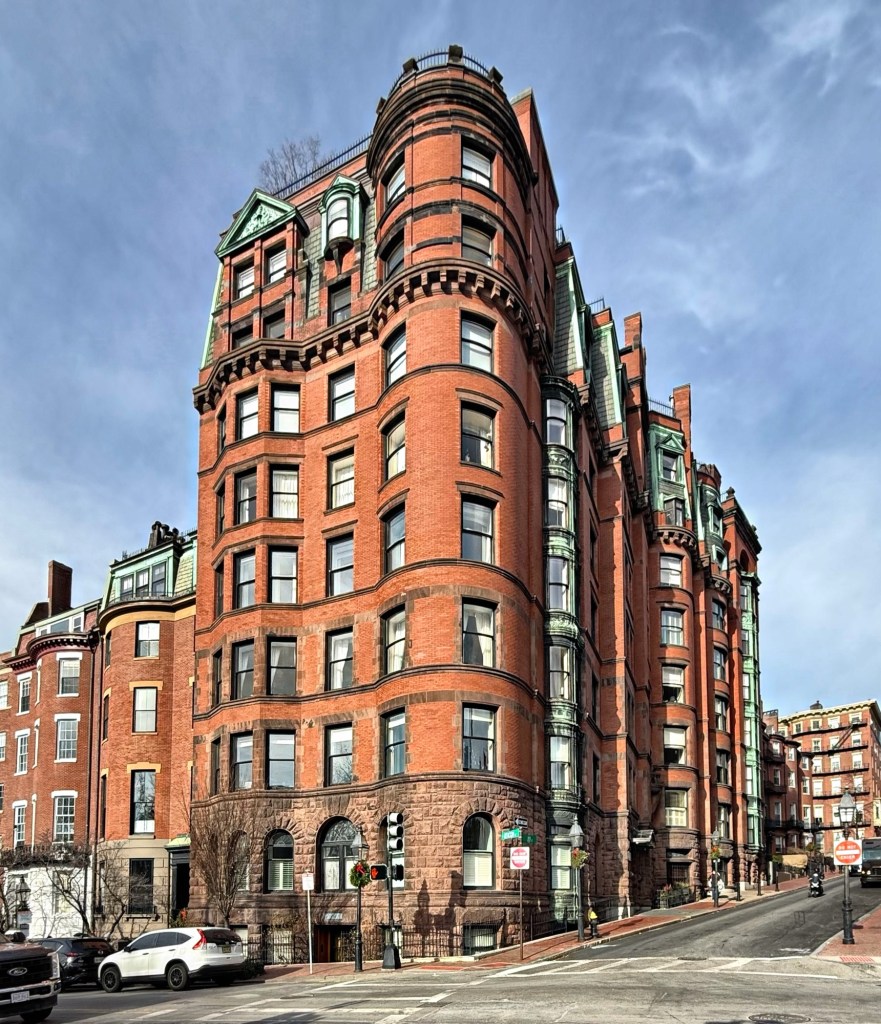
Frederic Tudor (1783-1864) was a businessman and merchant known as Boston’s “Ice King” having founded the Tudor Ice Company and becoming a pioneer of the international ice trade in the early 19th century. Frederic Tudor lived in a house at the corner of Beacon and Joy streets in Beacon Hill, Boston, and after his death, the property was inherited by his widow, Euphemia Fenno and their children. By 1885, the old Tudor House was demolished and replaced by The Tudor Apartments, which was built between 1885 and 1887 to house twelve upper-class families who sought smaller living space as opposed to the typical townhouses in Beacon Hill. Designed by architect, Samuel J. F. Thayer, the nine-story Queen Anne/Romanesque Revival building features a brownstone base with brick walls above, combining the traditional Boston bowfront with late 19th century flair at the upper floors with the partial mansard roof punctuated with dormers and oriel windows. Thayer designed the Joy Street elevation with cascading bays to provide interiors with views of the Boston Common and ample natural light.


Hotel Mellen // 1894

While Ashmont Hill in Dorchester is known for large, single-family Victorian houses, there are a number of grand apartment houses and three-deckers dispersed throughout the area, showing the evolution of housing in desirable neighborhoods in the late 19th and early 20th centuries. This is the Hotel Mellen, located at 18-20 Mellen Street, a multi-family building that architecturally blends in with its surroundings, not like many uninspiring boxes being built all over the region today. The property was developed by Louis Pfingst, a German streetcar designer and mechanic who was also active in the local Dorchester Gentlemen’s Driving Club. The building was designed by local architect Alexander B. Pinkham, who specialized in multi-family housing designs around Boston. The rounded bays, recessed porch in the gable, varied siding, and applied ornament, make the building stand out, while fitting well within its context of surrounding homes.

George Robert White Health Unit No. 2 // 1923

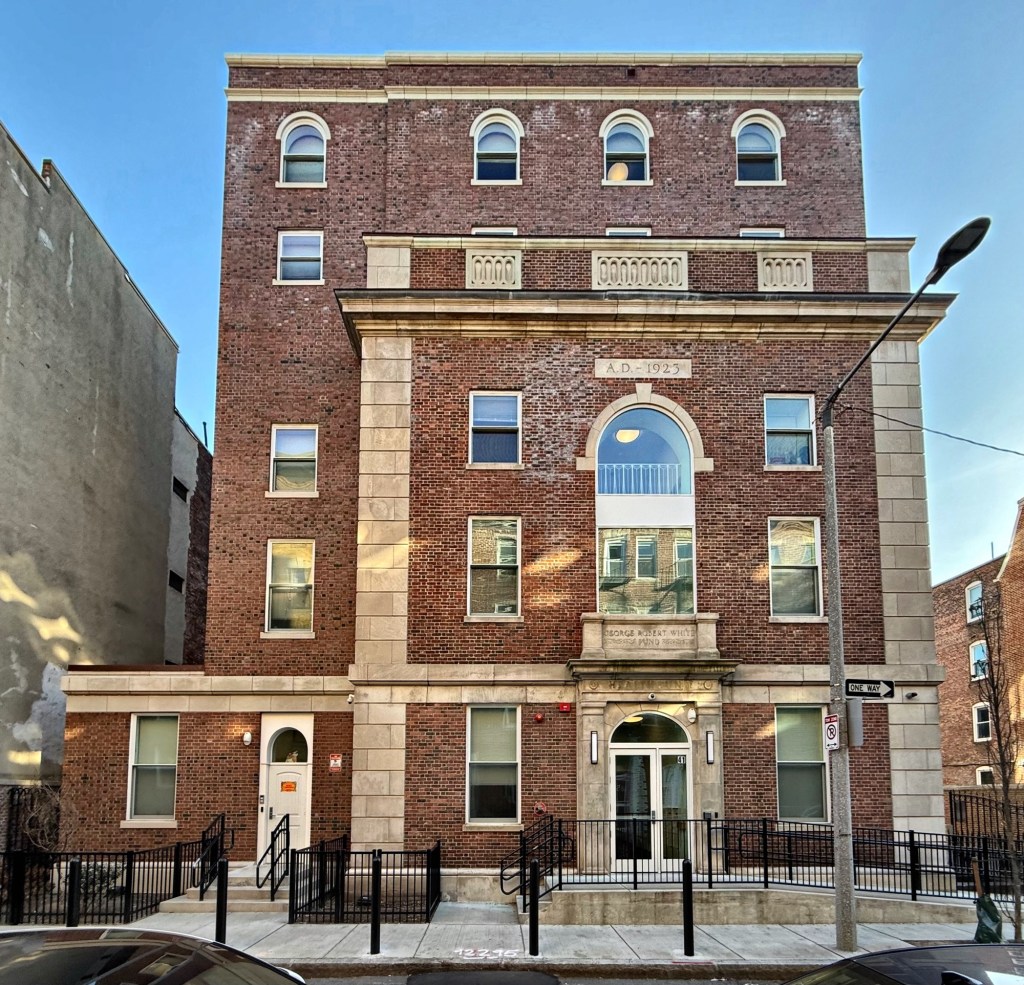
Originally known as the George Robert White Health Unit Number 2, this Colonial Revival style building is located on North Margin Street in the North End of Boston, and is significant as an early health center providing health and education services for some of Boston’s most underserved residents. The building was constructed in 1923 as one of the neighborhood-based health centers built in Boston in the 1920s and early 1930s from funding by the George Robert White charitable trust. George Robert White (1847-1922), a longtime resident of Boston, worked in the office of the Potter Drug and Chemical Company as a boy, eventually becoming president and an owner of the corporation. He was an investor in real estate and reportedly was known for many years as the largest individual taxpayer in Boston. Upon his death, his will specified that his bequest to the city, about $5 million in 1922 (approximately $93 Million valued today), would be held in a permanent charitable fund “to be used for creating public utility and beauty and for the use and enjoyment of the inhabitants of Boston.” The North End Health Unit was the second built (the first was in the West End), and designed in the Colonial Revival style from plans by Coolidge and Shattuck, later known as Coolidge, Shepley, Bulfinch & Abbott. Since the 1970s, the building was occupied by the Knights of Columbus, a fraternal organization, until 2020, when the building was renovated and converted into housing with 23 units for elderly residents.

Longwood Towers // 1925

No trip to Longwood in Brookline would be complete without checking in on one of the finest multi-family housing developments of New England… This is Longwood Towers. The development was originally built in 1925 from plans by architectural/engineering firm Kenneth DeVos and Co. who built three near-identical developments in the early 1920s: Detroit (1922)Brookline (1925), and finally Philadelphia (1928). The complexes were all originally called Alden Park Manor. Kenneth DeVos worked with local architects for each project to oversee construction details and furnish interior detailing as needed. For Brookline, he hired Harold Field Kellogg, who earlier served as the first director of the Boston Housing Authority. The design is Tudor Revival in style with towers connected by social spaces and a lobby linking the towers with a dining room for residents, a ballroom, lounge, day care facilities, barber and beauty shops, and a garage. The idea of a parking garage incorporated into an apartment complex was a very new idea when these were built, so much so it was written about as a new amenity for future developments to emulate. Another interesting tidbit about the complex is that it was featured in architectural journals in 1926 as it solved the “garbage problem” with trash chutes on each floor which terminated down in a brick incinerator (no longer in use). The Longwood Towers in Brookline were eyed as innovative and set trends for later developments, here’s to hoping future developers take cues to what makes good design and finishes rather than just profit with so many new boxy, uninspiring 5-over-1 apartment buildings going up all over the region.