Located adjacent to the Entrance Gate at Forest Hills Cemetery in Boston, the Administration Building and Chapel perfectly compliments the Gothic Revival collection of structures welcoming all visitors to the cemetery. Designed by the firm of Van Brunt & Howe, the building was completed in 1884, when the cemetery’s popularity with visitors (alive and deceased) was at a high. The building is in the Gothic Revival style and is constructed of Roxbury puddingstone, with sandstone trim on the original parts of the building and yellow freestone trim on the 1921 addition. The building remains as a perfect partner to the entrance gate, serving as a physical portal between metaphorical life and death.
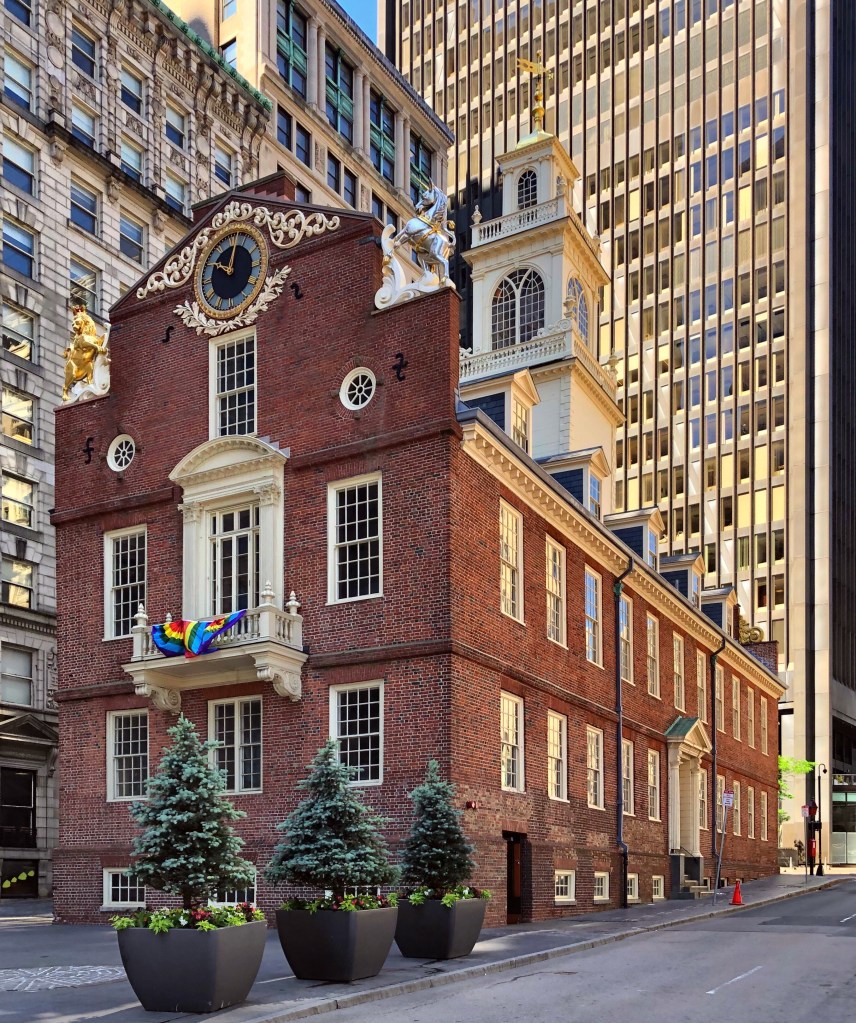
Nestled among the towering skyscrapers of Downtown Boston, the Old State House stands proudly, giving us a glimpse into pre-Revolutionary life and events. Happy Fourth of July!
Built in 1713, the “Town House” as it was originally known, served as a merchants’ exchange on the first floor and the seat of colonial and later state government on the second floor throughout the 1700s. The royal governor, appointed by the King of Great Britain, held his office in the building until 1775, and from the balcony gave voice via decrees and speeches to the King 3000 miles removed from London. Above the balcony, a lion and unicorn—royal symbols of the King of Great Britain—graced the main façade facing the public square.
“A cobblestone circle beneath the Old State House balcony marks the site of the 1770 Boston Massacre. Tensions ran high in Boston in early 1770. More than 2,000 British soldiers occupied the city of 16,000 colonists and tried to enforce Britain’s tax laws, like the Stamp Act and Townshend Acts. American colonists rebelled against the taxes they found repressive, rallying around the cry, “no taxation without representation.” On the frigid, snowy evening of March 5, 1770, Private Hugh White was the only soldier guarding the King’s money stored inside the Custom House on King Street. It wasn’t long before angry colonists joined him and insulted him and threatened violence. Calling reinforcements, a group of British soldiers stood near the Town House and were pelted with snowballs and rocks, with one soldier firing out of panic. Once the first shot rang out, other soldiers opened fire, killing five colonists–including Crispus Attucks, a local dockworker of mixed racial heritage–and wounding six. The event was one of the flashpoints which began the American Revolution.
Six years later, on July 18, 1776, Colonel Thomas Crafts read the Declaration of Independence from the balcony of the Old State House as a statement of strength from where the King’s declarations were given just years prior.

 Buildings of New England