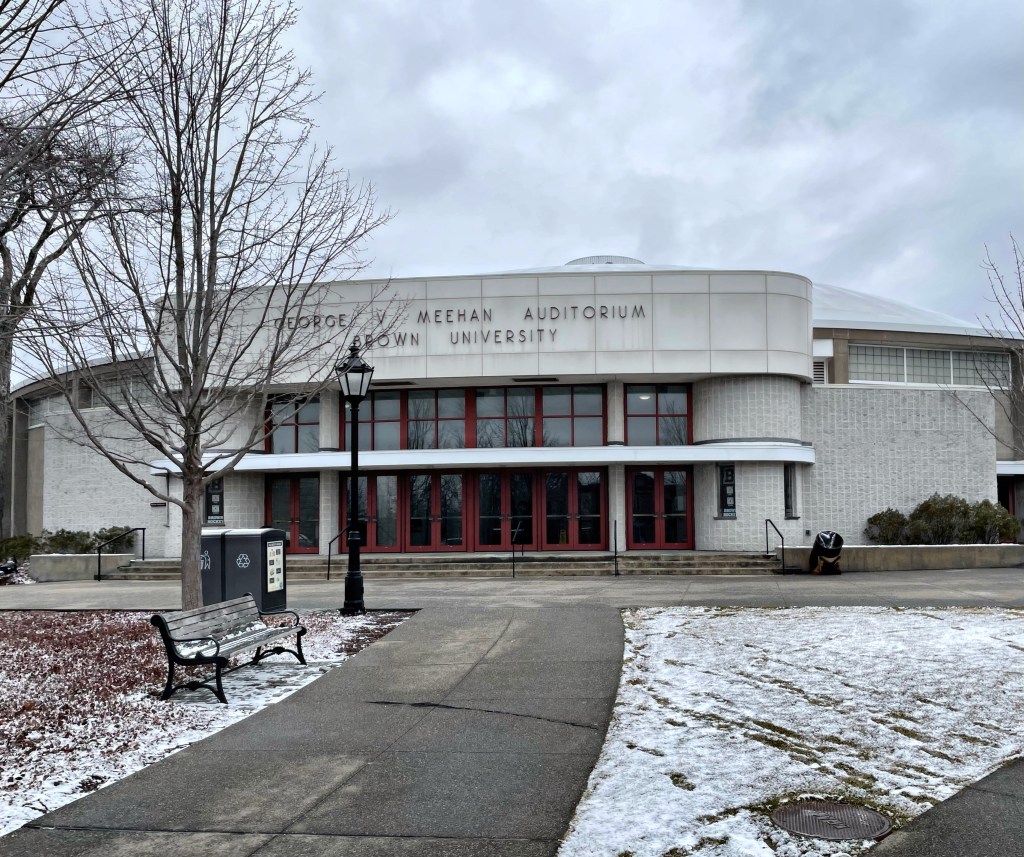
Meehan Auditorium – Brown University // 1962

Across from the new Nelson Fitness Center at Brown University in Providence, Rhode Island,Meehan Auditorium is an excellent example of a 1960s institutional athletic facility. The auditorium was dedicated at the Brown-Princeton hockey game on January 6, 1962 and was named after George V. Meehan, donor of half a million dollars for its construction. The new facility filled the need for a skating rink and large auditorium for indoor functions, specifically for ice skating and hockey and was the first building of the new athletic plant at Aldrich-Dexter Field east of the campus. The building was designed by Perry, Shaw, Hepburn & Dean, a prominent firm who designed many collegiate buildings in the 20th century, all over New England.

Andrews Hall – Brown University // 1947

Andrews Hall was built after WWII to serve as a dormitory for Pembroke College, the women’s college affiliated with Brown University (later merging in 1971). The new building was named for Elisha Benjamin Andrews, president of Brown University (1889-1898) who was instrumental in the establishment of the college for women in 1891. The new building created a central link, joining Miller and Metcalf halls and nearly doubling the dormitory capacity of Pembroke College, creating an enclosed yard in the process. The architectural firm of Perry, Shaw, Hepburn & Dean (in existence today as Perry Dean Rogers Architects) was hired to provide the plans, which serves a northern edge of the small former Pembroke College quad. Principal architect Thomas Mott Shaw used specially colored brick to give the building a weathered look to achieve harmony with the two buildings which it connected. The style of Andrews Hall is Colonial Revival with a hip on cross-gable roof and is constructed of brick with central three-bays clad limestone facing the courtyard. The building is set over the dining hall which is set into the sunken landscape with the terrace above. The three buildings were recently renovated by CBT Architects and shine today!

Alumnae Hall – Pembroke College – Brown University // 1926

It’s not often that a building has not one, but three distinct and beautifully designed facades. Lucky for us, the 1926 Alumnae Hall at Pembroke College (now Brown University), fits the bill! Alumnae Hall on the Pembroke Campus was dedicated in October 1927 with funds for the building raised through the efforts of the Alumnae Association with Stephen O. Metcalf would duplicate all gifts of students and alumnae. The campaign continued until 1926, when the $50,000 contributed by the students and the $150,000 contributed by the alumnae, together with Mr. Metcalf’s matching funds, were deemed sufficient to start the building. The cornerstone was laid in May 1926 with the Boston architectural firm of Andrews, Jones, Biscoe and Whitmore as architects, who designed the building in the Colonial Revival style. Alumnae Hall, built of brick with limestone trim, was designed to accommodate the social and religious activities of the Women’s College. Its main entrance is a balustraded stone terrace on the campus leading to an auditorium on the main floor, the various sections create a visually stunning complex of wings and facades built into the landscape.

Sayles Hall – Pembroke College – Brown University // 1907

Sayles Hall was the second purpose-built building erected for Pembroke College, a women’s college affiliated with Brown University in Providence. Sayles was originally built as a gymnasium facility for female students and was designed by the same architects as Pembroke Hall, Stone, Carpenter and Willson. Architecturally, the building compliments Pembroke Hall which was built the decade prior with the use of red brick, terracotta trim, and arched openings and gabled pediments at the roof. The funds for the construction of the building were a gift from Frank A. Sayles (whom the building was originally named after). Until 1990, Sayles Gym was used for sports and offices by the Physical Education Department. In 2001, Sayles Hall was completely renovated and converted into classroom space, receiving a new name (Smith-Buonanno Hall). A great example of adaptive reuse!