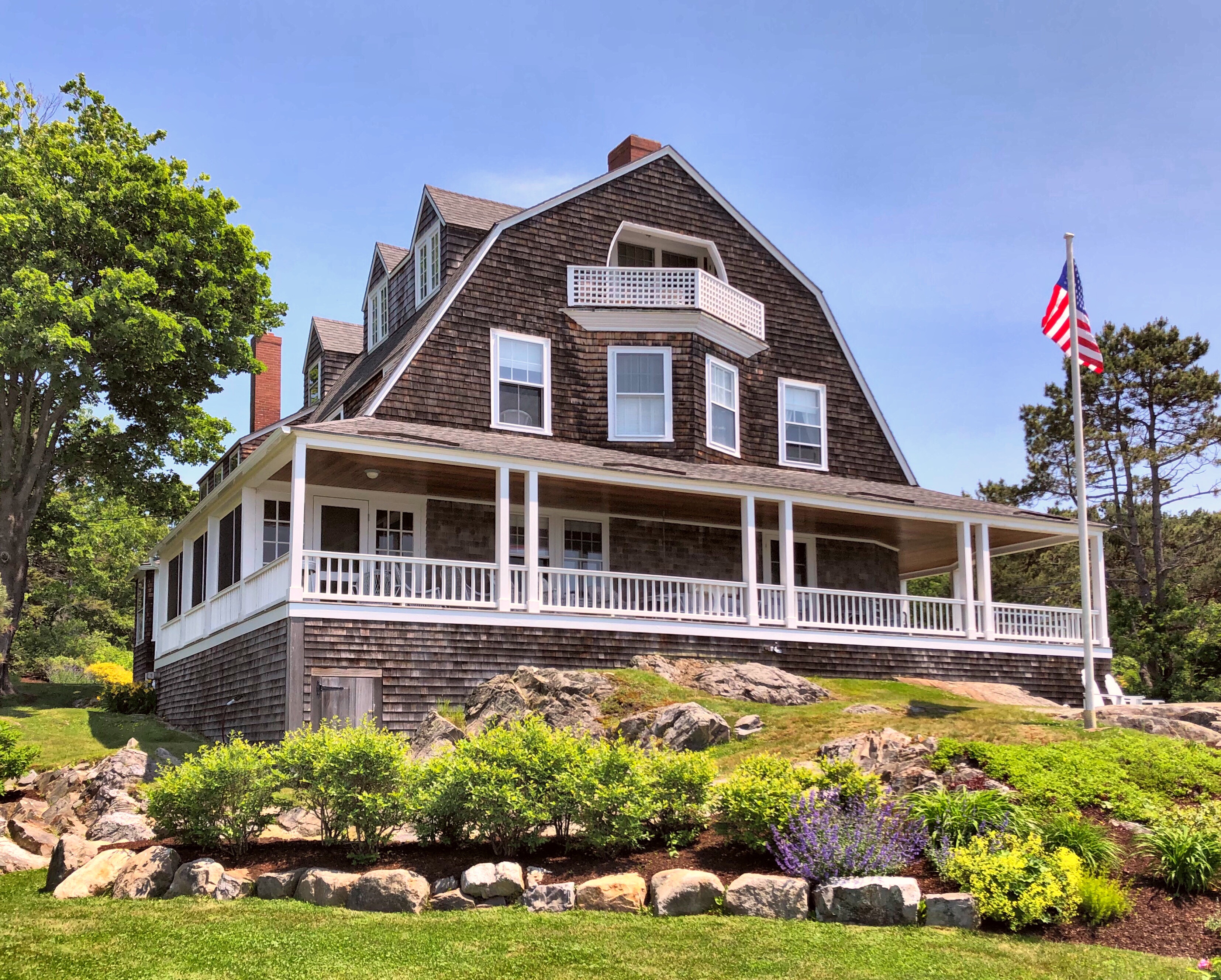
Rock Ledge Cottage // 1887

One of the jewels of the Cape Arundel summer cottages in Kennebunkport is the Rock Ledge Cottage, sited prominently on a hill overlooking the Atlantic. Rock Ledge was a cottage built in 1887 for Elon Dunbar Lockwood (1836-1891) of Philadelphia. Lockwood was a merchant who started a dry goods business with his brother, forming W. E. & E. W. Lockwood. Elon became a highly respected businessman in Philadelphia and later became a member of the Committee of Fifty, a group formed to devise measures for the 1876 Centennial Exposition in Philadelphia which would showcase the city for the first ever World’s Exposition in the United States. Elon’s wife Elizabeth died in 1884, and a couple years later, he had this summer cottage built, where he would apparently entertain, giving him the designation as a womanizer until his death in 1891 at the age of 54. The cottage was designed by William Ralph Emerson, one of the busiest architects in New England at the time, with commissions all over the region, including many summer cottages in Maine.

The Kedge // 1887

Located in the Cape Arundel Summer colony in Kennebunkport, this Shingle style cottage, built in 1887 sits perched on a hill with views of the Atlantic Ocean. Built for John Bach McMaster, a historian who was also a professor at the University of Pennsylvania, the house was the first of two he owned in Kennebunkport, where he summered. The son of a former Mississippi plantation owner, McMaster grew up in New York City and worked his way through the City College of New York. Although he obtained a degree in civil engineering in 1873, he was deeply interested in American history. He worked briefly as a civil engineer in Virginia and Chicago in 1873, but he returned to New York the following year and earned a meagre living by tutoring.

McMaster was appointed assistant professor of civil engineering at Princeton University in 1877. Meanwhile, he planned to write a broad-scale history of the United States. In the summer of 1878 he led an expedition to the American West, an experience that impressed on him the pioneers’ efforts and the need for a social history of the West. His inspiration materialized in 1881 with the completion of the first chapter of A History of the People of the United States from the Revolution to the Civil War. The earnings from the series gave him substantial wealth and he then bought a summer residence up in Maine seen here.

If anyone knows the architect of this house, please share!