Former Chicopee Public Library // 1911

Tucked to the side of the towering City Hall building on Market Square in Chicopee, Massachusetts, this long-vacant former public library is undergoing a major renovation to convert the building to a business incubator and community hub. The library was built in 1911 and was designed by the Springfield architectural firm of Kirkham & Parlett and is a great example of a Classical Revival style civic building with its strict symmetry, Ionic columned and pedimented entrance, and corner quoins. The original town library was organized as early as 1846 under the name “Cabot Institute” a subscription-based library. In 1853, the Cabot Institute donated its collection of nine hundred books to form a public library. The town voted that year to support a public library from tax dollars, making the Chicopee Public Library the first library funded by public funds in Western Massachusetts. The library was located in the City Hall building when it was completed in 1871, and was later moved out of the building to make space for the Board of Aldermen offices. In 1907, Mrs. Sarah Cooley Spaulding bequeathed $20,000 in her will towards a new library building as a memorial to her late husband, Justin Spaulding, and in May 1913, the Chicopee Library opened its first building built solely for the purpose of being a library. The library was expanded in the latter half of the 20th century and ultimately outgrew its space, with the City building a new library in 2004 on Front Street. This library closed at that time and had sat vacant until plans were unveiled to re-imagine this significant building as a community hub. I love to see old buildings repurposed rather than demolished!
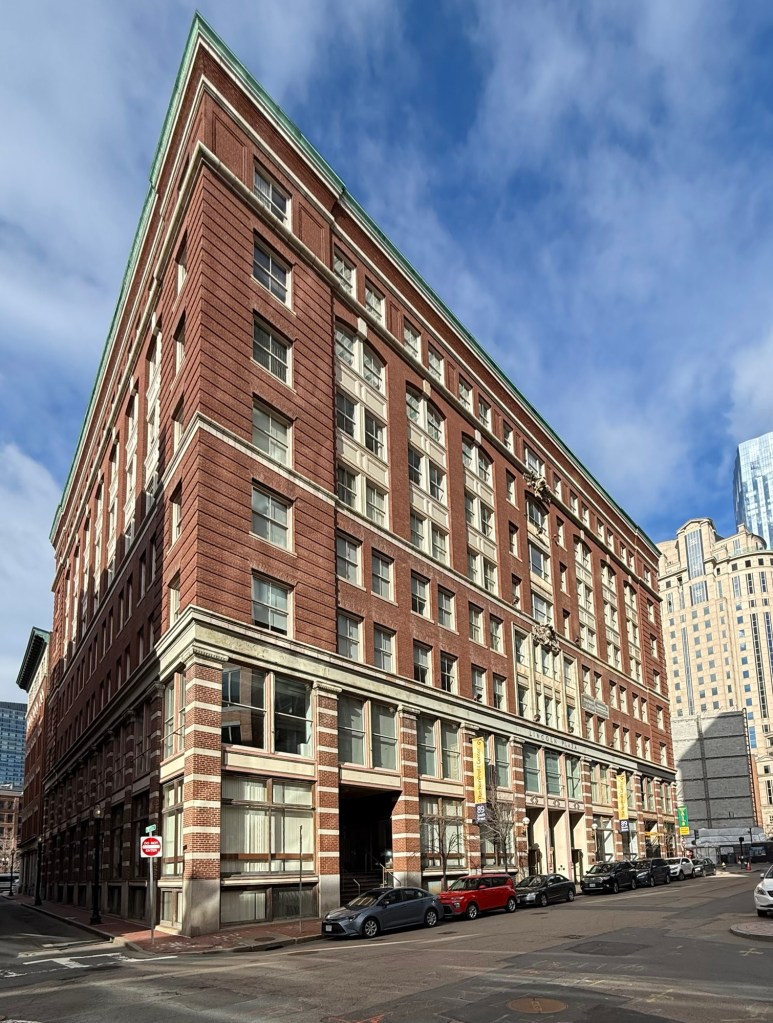
South Street Building // 1899

One of the larger mercantile buildings in the Leather District of Boston is this turn-of-the-century block, historically known as the South Street Building. Bounded by three streets, this eight-story building was constructed in 1899 from plans by Winslow, Wetherill & Bigelow and is a great example of a Classical Revival style commercial block with Beaux Arts motifs to further decorate the facades. In 1901, as expected, the city directories list many leather and soft goods-related occupants in the building, including: The American Calfskin Leather Company, John F. Moore Co., leather dealer, and Charles D. French, leather remnants dealer. The building was renovated in 1990 and rebranded as Lincoln Plaza, becoming a major space for non-profit offices.

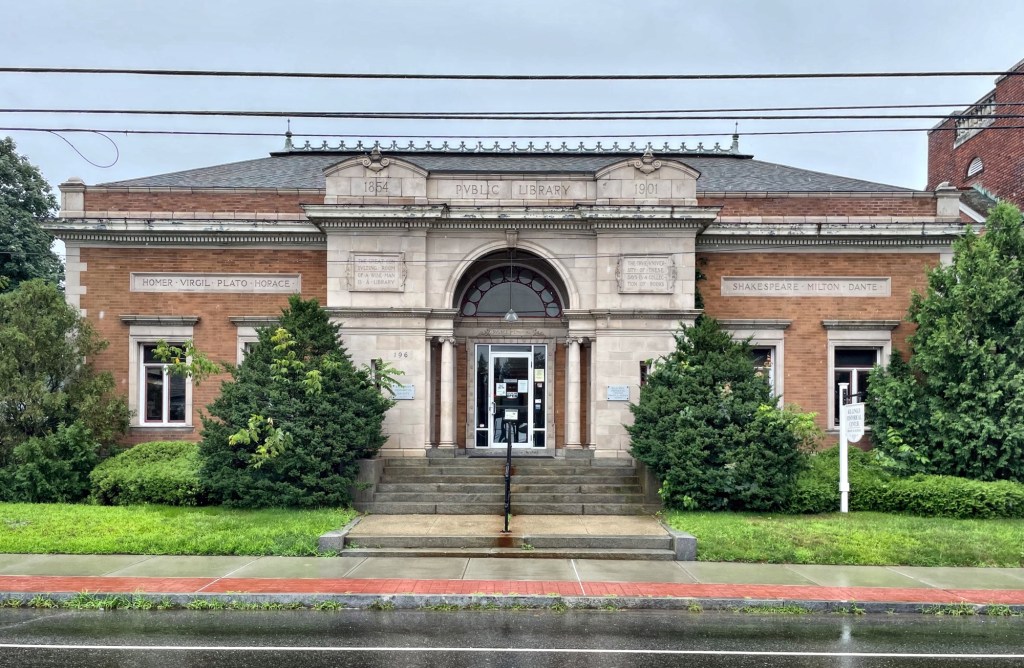
Bugbee Memorial Library // 1901

The Bugbee Memorial Library sits on Main Street in Danielson, the main village in the town of Killingly, Connecticut. The library was built in 1901 and financed by a bequest from Edwin Holmes Bugbee, who made his fortune at local mills. When Bugbee died in 1900, his estate left his entire collection of books along with funds for a new library for Danielson. Boston architect Walter Jefferson Paine designed the library building in the Classical Revival style with buff brick and stone construction. The names of Homer, Virgil, Plato and Horace, along with Shakespeare, Milton and Dante, are boldly emblazoned across the facade denoting the building as a house of learning. The library was outgrown, and a new library was built nearby in 1994. The old Bugbee Memorial Library has since been occupied by the Killingly Historical Society.

Berzelius Tomb // 1910

Yale, like other Ivy League colleges, has a long and complex history of secret societies. The secret societies all are headquartered at their own buildings, called “tombs”. These are massive, very impressive structures without windows or signage and all share an unmistakable message with their architecture: “Private; keep out.” One of the lesser-known tombs at Yale is the Berzelius Tomb, completed by 1910 from plans by architect Donn Barber. The Berzelius was established in 1848 as a secret society and formerly was located in Berzelius Hall, a Romanesque style building. The tomb is sited on an difficult lot at the convergence of three main roads but holds its own architecturally as a highly ornamented box. This austere tomb is built of limestone, with a balustrade and detailed cornice at the roof, but the main attraction is the entrance, which is a double brass door with floral panels, all surrounded by a Classical surround. Above the entrance, a limestone panel showcases the Society’s insignia with fruit and flower swags.

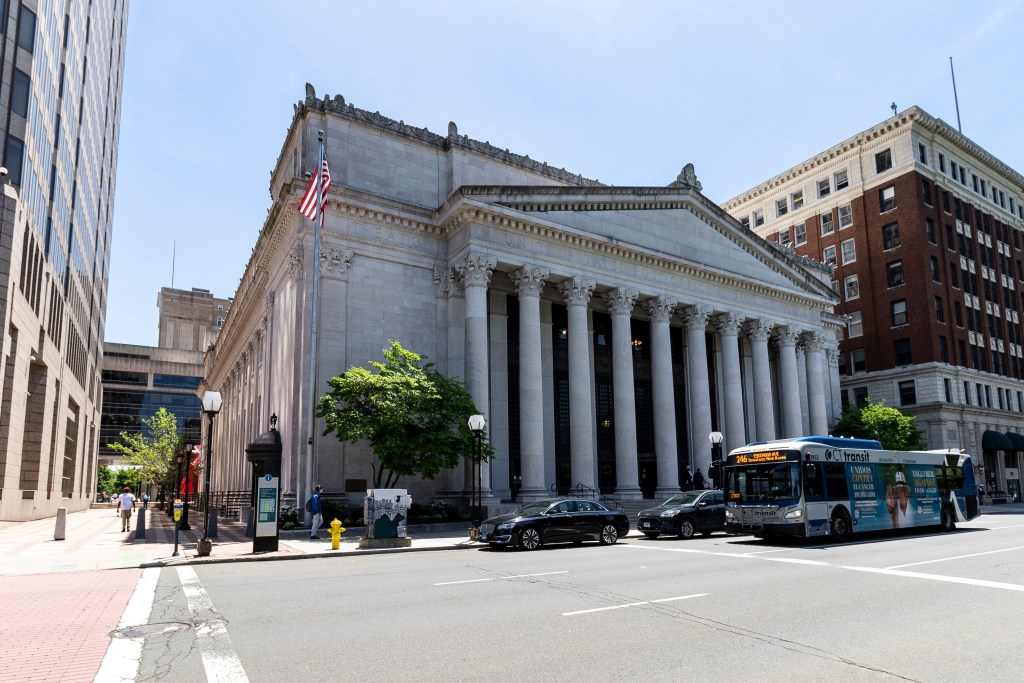
Richard C. Lee U. S. Courthouse // 1913

Image by Brandon Bartoszek

The monumental Richard C. Lee U.S. Courthouse is located on the west side of the Town Green in New Haven, Connecticut, a stone’s throw from the New Haven City Hall. The building is an excellent example of Classical Revival architecture. The building originally served both as a courthouse and post office, although the post office moved to another location in 1979. James Gamble Rogers designed the building, which was constructed between 1913 and 1919. Rogers was also the architect for structures at Yale University, his alma mater (more on some of those later). The building was the last to be designed under the auspices of the Tarsney Act (1890-1912), which allowed the Treasury Department to hire private architects rather than use only designers employed by the federal government. Classical architecture was commonly seen in federal building design during the early twentieth century because officials believed it conveyed the dignity of the federal government. The New Haven courthouse displays several hallmarks of the style, including the colossal portico and pediment with columns capped by Corinthian capitals. The courthouse was slated for demolition in the 1960s as part of an urban renewal plan. However, a coalition of federal judges and local historic preservationists rallied to save it. In 1998, the building was renamed to honor Richard C. Lee, a former New Haven mayor who was a pivotal figure in the building’s preservation as well as the city’s revitalization.