Originally, the parishioners living in present-day Southbury would travel to Woodbury Center to attend church services. This changed after the Southbury parish was incorporated in 1731, voting to erect a church a year later. Founded in 1732, the Southbury Congregational Church was dwelled in several sites until the third church was built on the present site in 1844. This Greek Revival style church features Doric pilasters and Ionic columns at the recessed portico with a large pediment above with ornate scroll carvings around the clock. The church remains well-preserved and a visual landmark on the Main street.
Located on Main Street in Southbury, this stately Federal style mansion stands out as one of the most unique and interesting in town! The house here was originally built in the 1760s as a more modest Georgian house by members of the Curtiss Family, one of the earliest families to settle in the area after land here was purchased from the Potatuck Native Americans. In the early 19th century, the house was modernized in the fashionable Federal style, giving the house the present appearance. The facade is dominated by an excellent doorway with a projecting Palladian portico above. The property was later owned by Benjamin Fabrique.
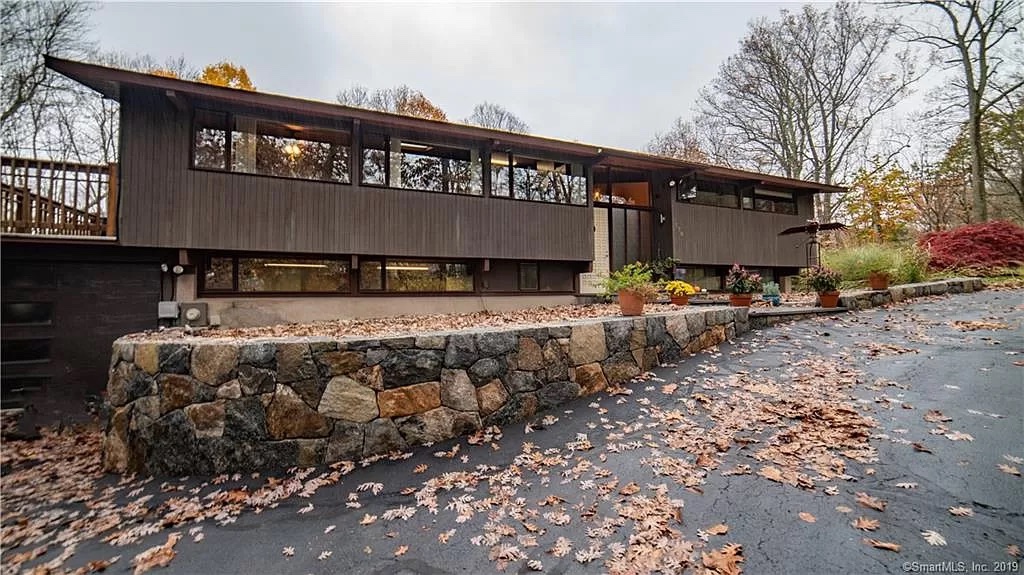
I don’t share Mid-Century buildings on here enough, mostly due to the fact that so many of the houses of the period are secluded down winding driveways and surrounded by trees! This stunning house is located in Southbury, Connecticut, and is a great example of a Deck House. The Deck House was a housing type developed by architect Carl Koch. According to At Home With Tomorrow, he began his lifelong mission to create “the good, the beautiful, and the inexpensive” in housing while at Harvard under the guidance of Walter Gropius, who is famous for the development of the Modernist Movement in architecture. After the war, he turned his focus on the housing shortage, a symptom of the Great Depression, WWII, and returning Veterans with growing families and VA mortgage loan offers. His solution was for an affordable house of pre-fabricated parts to cut costs and provide streamlined construction. In 1953, his Techbuilt house was launched, after a decade of research. William Berkes and Robert Brownell had worked with Koch at Techbuilt after graduate school, but wanted to create a design of their own. They left Techbuilt in 1959 and founded Deck House, using the same principles. The exposed Douglas fir beams, wood panel ceilings and mahogany trim and window casements are what give the deck house a lot of its signature aesthetic. A wall of glazing, open floor plan with sloping roof rafters extending beyond the walls and a low placement in seemingly untouched nature are further elements that have endeared these houses to the modern homeowner.
This charming cottage shows that you do not need a stately or elaborate house to have some serious curb appeal and house envy. This is the Benjamin Osborn House, located in Southbury Connecticut. The house was built in the early 20th century for newlyweds Benjamin B. Osborn and Sarah Stiles, who married in 1808. As a gift to the couple, Sarah’s father Ephraim Stiles, who lived in a house across the street, seemingly deeded a portion of his property for his daughter and son-in-law to build their family. Tragically, Sarah died one year later, possibly during childbirth. Benjamin would marry another of Ephraim’s daughters soon after… messy. The home is a four-bay Cape, with its off-center entrance sheltered by a Colonial Revival hip-roofed portico supported by Tuscan columns.
The Reuben Curtiss House is a classic example of a Greek Revival farmhouse from the mid-19th century, located in Southbury, Connecticut. Local history states that a house built here by Israel Curtiss (1716-1795) who farmed the land with his large family. In 1798, Israel’s large estate was distributed among three of his sons, Joseph, Benjamin, and Reuben. This was complicated by the fact that in the same year, both Joseph and Benjamin died, leaving the entire estate to Reuben. From about 1840 and possibly until he sold the property in 1866, Reuben B. Curtiss ran an academy here, known as “Buck Hill Seminary for Boys.” It was a large operation, as suggested by the size of the addition and confirmed by the 1850 federal census. At that time there were 23 students in residence, ranging in age from 8 to 12, along with four adult supervisors. It was likely that the former farmhouse was expanded and the present 1840s Greek Revival block was added which now is the main facade.
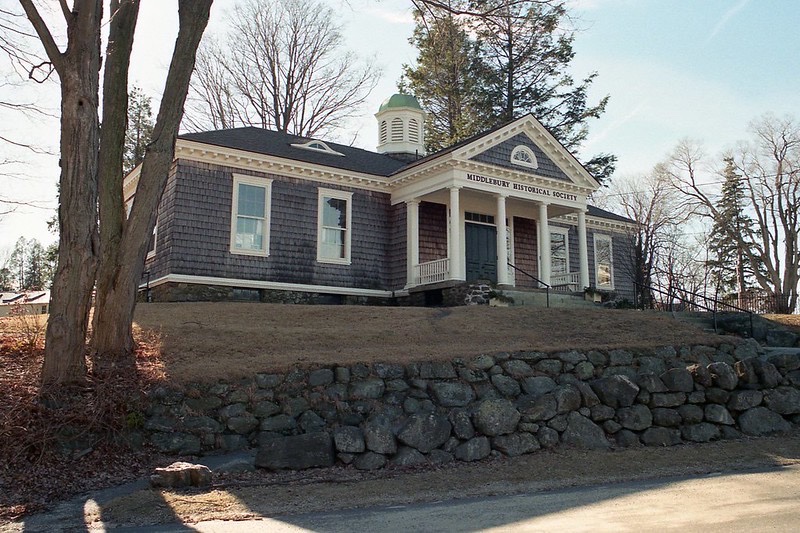
Having the tall order of being a neighbor to the later Westover School, the town of Middlebury’s Central School still packs an architectural punch. The school was built in 1898, replacing the former Union Academy building also near the town green. The school building is Neo-Classical in style with a projecting pedimented portico supported by four columns. A cupola extends through the roofline and shingle siding add some charm to the small two-room school building. The former school later housed the Middlebury Public Library and is now occupied by the Middlebury Historical Society.
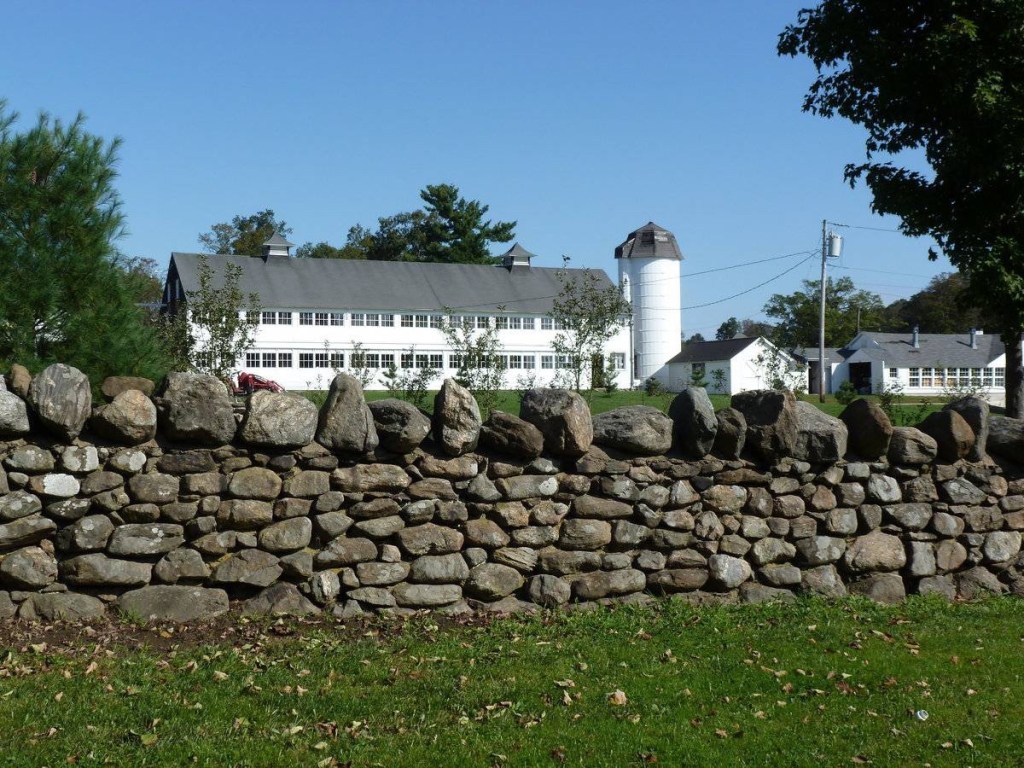
Tranquillity Farm, spanning the rolling hills around Lake Quassapaug in Middlebury Connecticut, was originally a 303-acre model/gentleman’s farm developed by John Howard Whittemore, a successful industrial-era businessman in Naugatuck, and his wife Julia Spencer Whittemore. Whittemore was a major figure in Naugatuck, sponsoring a series of commissions of McKim, Mead & White for buildings in the city center. For his country farm estate, he again commissioned McKim, Mead & White to design a new country house, a farm superintendent’s house, boat house on the lake, and other outbuildings for a working farm. An older farm was purchased, which included a modest Greek Revival style farmhouse dating to the early-mid 19th century (seen here) and a large wooden barn. Both of these were kept and incorporated into the estate near the southern entrance to the property, possibly to harken visitors back to the charm of rural living. The sweeping landscape, featuring miles of distinctive stone walls lining the roads and crisscrossing the fields, was designed by Charles Eliot and completed by Warren H. Manning – both protégée of Olmsted.
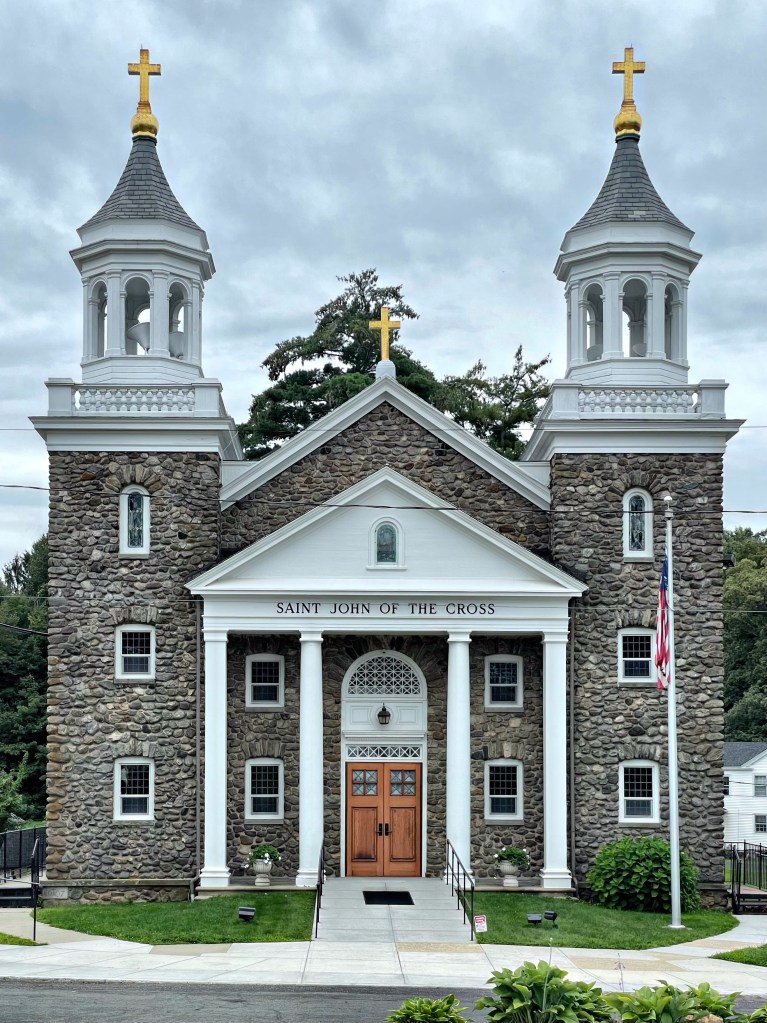
One of the more substantial buildings in the small town of Middlebury, Connecticut is this large church which faces the town green. In 1904 St. John of the Cross Parish was granted ecclesiastical status however, a decade would pass before the newly constructed stone church on the Middlebury Green was dedicated on November 22, 1914. The building was constructed in rubblestone with a Classical Revival temple-front pavillion and two Renaissance Revival square towers with open belfries. Reports stated that the building took over five years to construct, which was almost entirely built with volunteer labor and built with stones taken from parishioners fields. The architect of the church is unknown.
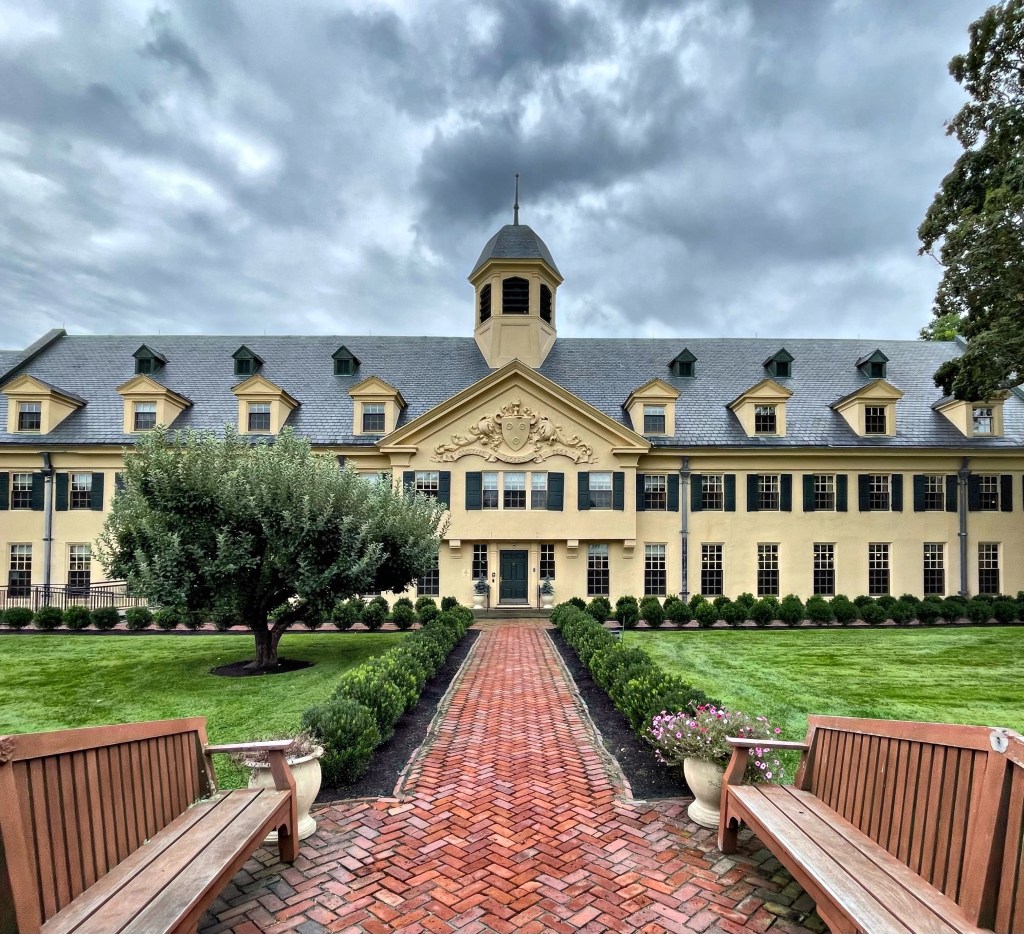
At the heart of the rural community of Middlebury, comprised largely of Connecticut farmers, far from the hustle and bustle of the world, Mary Robbins Hillard (1862-1932) sought to create a girls school to “provide young women with a liberal education in a community which would contribute to the development of their character, independence and sense of responsibility.” To accomplish this, they needed a school, and Mary hired her good friend (and architect) Theodate Pope Riddle to design the private girl’s school campus and main buildings on a site fronting the town green. The school opened in 1909 with125 pupils, slightly over capacity. For the design Theodate Pope Riddle – who was one of the first American women architects and a survivor of the sinking of the RMS Lusitania – took inspiration from English Arts and Crafts and historical precedence in English schools with large open courtyard plans. Originally finished in a gray stucco, the building enclosed a quadrangle at the rear. Inside, administration offices, reception rooms, living rooms, a library, gymnasium, chapel, dining rooms, infirmary, and (of course) classrooms lined the interiors on a closed loop to allow students and teachers access to all parts of the building without ever stepping outside in the cold New England winters. The Westover School remains active and one of the highest ranked private schools in the area today, and with a more cheery yellow coat!
The first white settlers arrived in what is now the Town of Middlebury, Connecticut in the early 1700s, displacing Algonquin people who lived there long before. By the late 1700s, there was sufficient population to justify a petition to the General Assembly for establishment of a separate Middlebury ecclesiastical society, and such action was taken by the legislature December 29, 1790. They named the new town Middlebury due to its location between the existing towns of Waterbury, Woodbury and Southbury. The first church edifice was completed four years later, on the town green in the center of the new town. Other buildings normally found in a village center followed, including store, tavern, school, blacksmith shop and other churches. The town grew organically as a more agricultural center and saw some suburban development due to the proximity to larger population centers. In 1935, a fire destroyed the existing 1840s church and 1890s town hall, forcing the town to rebuilt. They hired J. Frederick Kelly, who was not only an architect but a historian who restored many significant buildings all over the state, to furnish plans for a new town hall. The present Classical/Colonial Revival building features two columns in antis and recessed pediment that echoes the adjoining Greek Revival church, but the Town Hall is executed in brick instead of wood (to give it more fireproofing than the last building). On the sides, the building has elliptical and round-headed windows and other elaborate details that suggest the Federal style.







 Buildings of New England