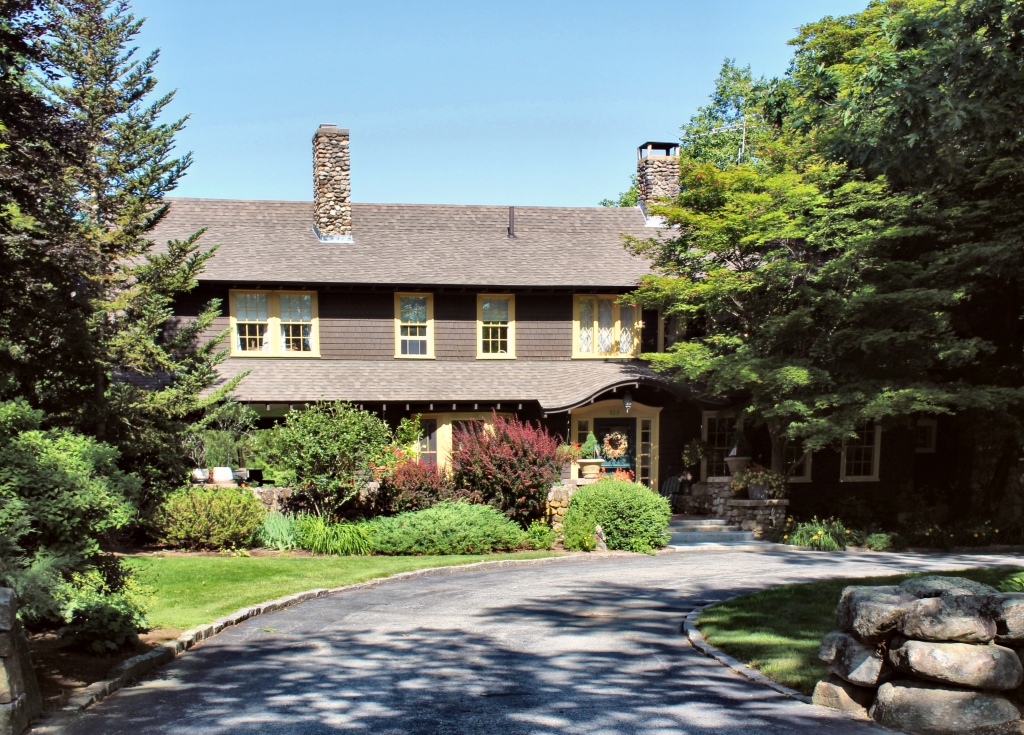
Harry Gregg House // c.1910

Harry A. Gregg, was the son of David Gregg, a lumber dealer and wooden goods manufacturer who built a mansion in Wilton’s East Village. Harry followed in his father’s footsteps, running the day-to-day business out of their Nashua, NH offices. With a lot of spare money, Gregg purchased pastoral land in Wilton Center and built a summer residence which may have also served as a gentleman’s farm. The Arts and Crafts style home showcases the best in the style with rubblestone, shingles, organic forms and exposed rafters. The house is pretty perfect!

Charles Dexter House // c.1910

Craftsman bungalows are a rarity in New England. The Craftsman style surged in the early 1900s, which coincided with the ever-popular Colonial Revival styles reign as most commonly built house style. Many of the Craftsmans that were built are less “ornate” than the West Coast counterparts, lacking deep exposed rafters, sweeping porches, and low-pitched roofs, but they are out there. This bungalow in Rochester was built around 1910 and has some Colonial qualities, including the Tuscan columns, boxed eaves, and shingle siding. I do love that full-length porch and hipped roof with a cute centered dormer! Do you wish we had more Craftsmans in New England?

Tewksbury State Hospital, Superintendent’s Residence // 1894

Located adjacent to the Administration Building at the Tewksbury State Hospital, the Superintendent’s Residence, built in 1894, combines elements of the Craftsman and Colonial Revival styles wonderfully. The home is two-stories, and built of red brick laid in Flemish bond, capped with a slate hipped roof with exposed rafters. A massive uncovered porch wraps around the home and sits atop a rubblestone foundation. Like the adjacent Administration Building, the Superintendent’s Residence was also designed by Boston architect John A. Fox. From this residence, the massive almshouse and asylum would be run by the superintendent, who oversaw day to day activities and made sure everything was running smoothly. The house appears vacant now.

Wheeler House // 1914

The Wheeler House is a 1-1/2-story, Craftsman bungalow home in Hollis, New Hampshire, with near full-length shed dormers at the front and rear sloping roofs. This home was preceded on the site by several earlier buildings including an ice house and a garage. The garage burned in 1912 during a fire which also destroyed the adjacent store. After the fire, a temporary store was erected by Will Gates in 1914, the temporary store was bought by Almond A. Wheeler who remodeled it into the present house for his family. Wheeler occupied the house until his death in 1936 and it was later occupied by his widow, Ruth Hills Wheeler. Mrs. Wheeler died in 1979 and according to the terms of her will, the house became the property of the Hollis Historical Society, which it remains to this day.