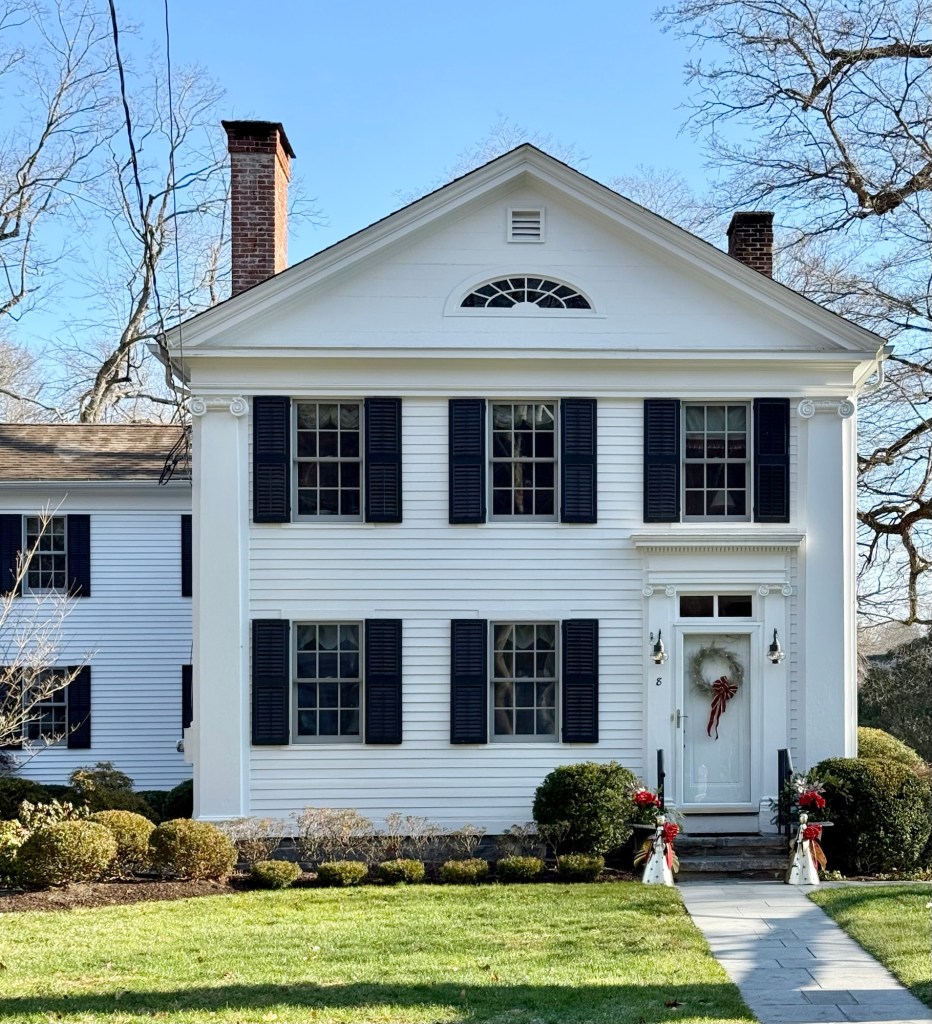
Ezra L’Hommedieu House // c.1835

Ezra L’Hommedieu (1772-1860) settled in Chester, Connecticut, in 1812 with his brother Joshua, and built a factory on the south branch of the Pattaconk Brook, which cut through the small village. The brothers manufactured gimlets (not the cocktail), a small wood-boring hand tool used to drill precise pilot holes for screws or nails, preventing wood from splitting and making driving fasteners easier. Ezra invented and patented the single-twist ship auger in 1812, which helped propel Chester into a prominent ship-building community. From his success, Ezra had this residence built on North Main Street in about 1835, which, like his brother’s house on Maple Street, blends Federal and Greek Revival styles elegantly.

Moody-Hall House // 1830

Transitional Federal/Greek Revival style houses are among my favorite. You can see the emergence of Classical architecture blending with American architecture with features of both styles, which work well together. This example can be found on Elm Street in Georgetown, Massachusetts. The dwelling appears to have been built for Dr. George Moody, one of four physicians in Georgetown in 1840, who began his practice in town in 1830. In his first years there, he oversaw patients during Typhus and Dysentery outbreaks and was credited with having determined that a high sulphur content in the local water supply accounted for the increased cases. Dr. Moody died in 1866, and his widow continued to live in the house until her death in 1880, after which it was sold to Mrs. Charlotte Sawyer Hall, the widow of local shoemaker Seth Hall.

Darius Knight House // c.1830

Another of the stunning early 19th century homes in the charming town of Chaplin, Connecticut is this transitional Federal/Greek Revival home built around 1830. The house appears to have been built for Darius Knight (1792-1882), a Deacon at the nearby Congregational Church. Of an interesting note, the Knight House is located across the street from the E. W. Day House, thus the intersection was colloquially known as the Knight and Day Corner. The house’s gable-end form with gable reading like a pediment supported by corner pilasters are all clearly Greek Revival style, but the fan lights in said gable and as a transom window are holdouts of the tried-and-true Federal style which dominated up until that point. What a great house!