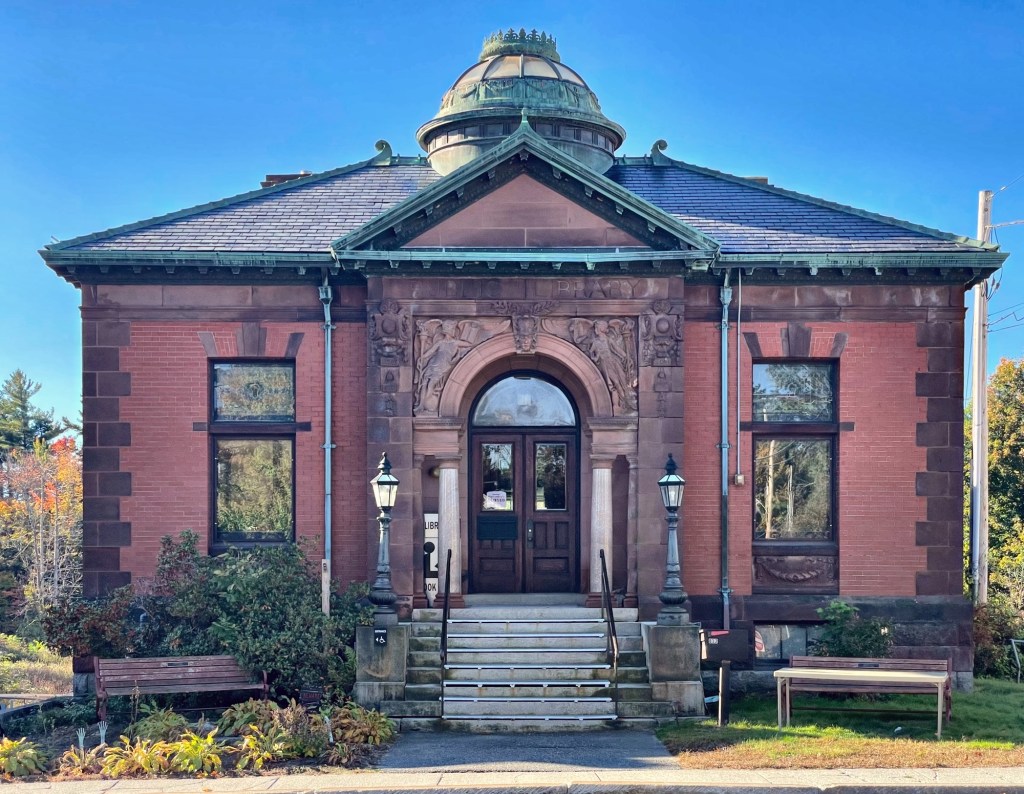
Ashby Public Library // 1902

The Ashby Public Library in Ashby, Massachusetts, was built in 1902, completely funded by a donation from Edwin Chapman (1841-1915) who lived across the street from the new library. Mr. Chapman was raised in Ashby and became a wealthy Boston-area merchant in the meat trade by the late 19th century. Before this library was built, the town’s library collection was housed in the Wyman Tavern. The building was designed by architect Henry M. Francis in the Neoclassical style with Romanesque detail in brick and brownstone to make the building fireproof. The library was added onto in the rear in 2006 by The Galante Architecture Studio, which is recessed and mostly visible from the rear parking area. The addition is Modern in style to distinguish itself from the main library building.

Gould-Goodnough-Lyman House // 1816

The largest house in the smallest town (in Middlesex County) of Ashby, Massachusetts, is this towering, three-story Federal period home on South Road. Local history states that the home was originally a two-story Federal style home with shallow hipped roof. The Goodnough’s “modernized” the home by the 1870s, adding a mansard roof and built a stable on the property. Lastly, the third major owner, Jesse P. Lyman, and his wife, Mary Chapman Lyman, had the home “modernized” again, in 1898, but in the Colonial Revival style, harkening back to the house’s original Colonial-inspired roots. Fitchburg-based architect Henry M. Francis converted the old mansard roof to a full third-floor, updated the carriage house, and added side wings to flank the main block of the house (similar to his design at the old Lyman School in town). The house recently sold for over $600,000 in 2020, which may be the best steal ever! This house is a stunner!

Abbott Memorial Library // 1905

Gifted to the town of Pomfret by Ira Abbott, the Abbott Memorial Library is one of the most stunning little libraries in the State of Vermont. Given to his hometown as a memorial to his parents by Ira Abbott, who was at that time a State Supreme Court justice in the territory of New Mexico. Its architect, Henry M. Francis, used diverse materials — brick, granite, fieldstone, red birch, and pre-stressed concrete, to design the eclectic building. Capped with a red slate roof with terra cotta ridge tiles, the building stands out as one of the most unique buildings in the state and has been extremely well-maintained through its public-privately funded Commission.