Hoosac Tunnel // 1877

It is impossible to overstate the significance of the railroad in the 19th century to the industrial growth and economy of New England and American cities. In order to connect Boston and its ports to the Hudson Valley in New York, a western rail line was constructed in the southern part of Massachusetts but was not an ideal route. In response, businessmen and politicians began to envision a more direct rail line across Massachusetts, but with one problem: trains hate climbing mountains! Instead of going around Hoosac Mountain, a massive detour, engineers thought they could tunnel through it, and that’s what they did, creating the Hoosac Tunnel. The tunnel through Hoosac Mountain is just under 5 miles long. Its active construction period consumed roughly a quarter-century and cost at least $17 million in 1870s dollars – an enormous sum. The cost was paid in dollars and the lives of nearly 200 miners (many of whom suffered terrible deaths as you can imagine). The first train passed through the tunnel in 1875, with the eastern portal wall constructed in 1877 (seen here). By 1895, roughly 60% of Boston’s exports traveled through the tunnel. Since then, some small collapses and deferred maintenance have left their mark on the tunnel, though it is still in operation today!

New Kimbell Building // 1902

Located on Main Street in North Adams, you’ll find this monstrous commercial block looking like it belongs in New York, not in Western MA. North Adams in the early 20th century was booming as an industrial center with a rapidly growing population. Due to this, business owners had the capital and clientele needed to erect large commercial buildings. A man named Jencks Kimbell owned a couple large parcels of land on Main Street and ran a livery stable there until his death in 1858. The business was ran by his sons until their death and the property was willed to their widows Clara and Lydia who saw the potential for the site to make them money. In 1902, the two widows erected this magnificent block on Main Street, with a stone facade. Built on top of a quicksand pit, it was the first building in North Adams to be built on steel pilings. I could find no information on the architect, but it is Eclectic to say the least! It has Romaneque arches, monumental pilasters with Corinthian capitals, and a Swan’s neck broken pediment at the parapet.

Charles Cutting House // 1881

This stunning Stick style house in North Adams was built for Charles Cutting (1850-1940), founder of the C. H. Cutting Company, a prosperous clothing company in town. The company started as a partnership between 20-year old Cutting and a Mr. Silsby, who retired just a year after co-founding the company. Cutting used his business connections to help establish other local clothing companies including the Bay State Clothing Company in Adams, the Orange Clothing Company in Orange, MA, and the Athol Clothing Company in (you guessed it) Athol. With his wealth, he had this amazing Victorian home built on East Main Street where he lived until his death in 1940.

Old State House // 1713

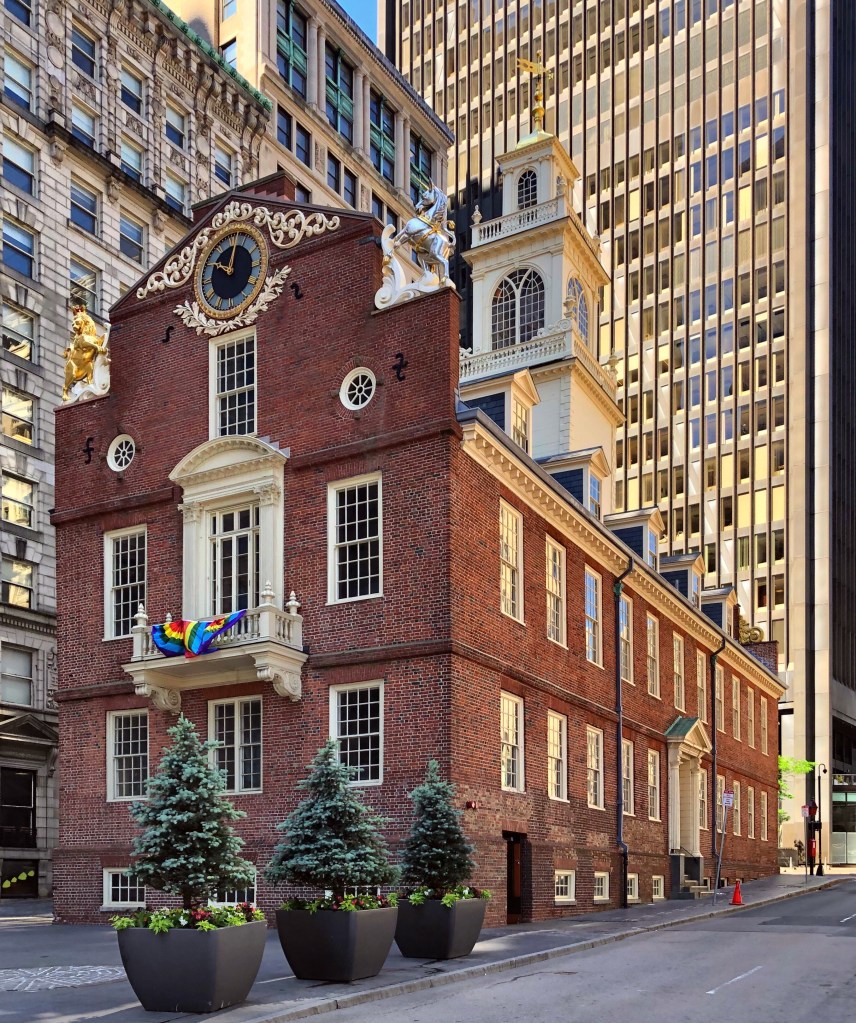
Nestled among the towering skyscrapers of Downtown Boston, the Old State House stands proudly, giving us a glimpse into pre-Revolutionary life and events. Happy Fourth of July!

Built in 1713, the “Town House” as it was originally known, served as a merchants’ exchange on the first floor and the seat of colonial and later state government on the second floor throughout the 1700s. The royal governor, appointed by the King of Great Britain, held his office in the building until 1775, and from the balcony gave voice via decrees and speeches to the King 3000 miles removed from London. Above the balcony, a lion and unicorn—royal symbols of the King of Great Britain—graced the main façade facing the public square.

“A cobblestone circle beneath the Old State House balcony marks the site of the 1770 Boston Massacre. Tensions ran high in Boston in early 1770. More than 2,000 British soldiers occupied the city of 16,000 colonists and tried to enforce Britain’s tax laws, like the Stamp Act and Townshend Acts. American colonists rebelled against the taxes they found repressive, rallying around the cry, “no taxation without representation.” On the frigid, snowy evening of March 5, 1770, Private Hugh White was the only soldier guarding the King’s money stored inside the Custom House on King Street. It wasn’t long before angry colonists joined him and insulted him and threatened violence. Calling reinforcements, a group of British soldiers stood near the Town House and were pelted with snowballs and rocks, with one soldier firing out of panic. Once the first shot rang out, other soldiers opened fire, killing five colonists–including Crispus Attucks, a local dockworker of mixed racial heritage–and wounding six. The event was one of the flashpoints which began the American Revolution.

Six years later, on July 18, 1776, Colonel Thomas Crafts read the Declaration of Independence from the balcony of the Old State House as a statement of strength from where the King’s declarations were given just years prior.