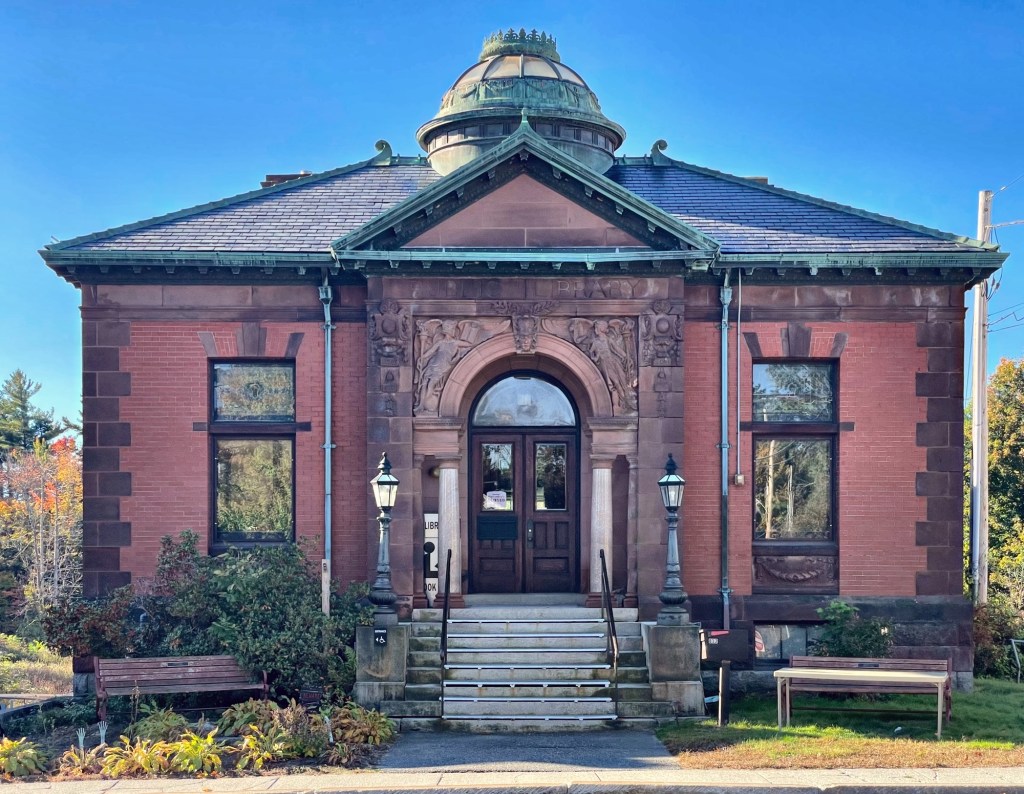
The Ashby Public Library in Ashby, Massachusetts, was built in 1902, completely funded by a donation from Edwin Chapman (1841-1915) who lived across the street from the new library. Mr. Chapman was raised in Ashby and became a wealthy Boston-area merchant in the meat trade by the late 19th century. Before this library was built, the town’s library collection was housed in the Wyman Tavern. The building was designed by architect Henry M. Francis in the Neoclassical style with Romanesque detail in brick and brownstone to make the building fireproof. The library was added onto in the rear in 2006 by The Galante Architecture Studio, which is recessed and mostly visible from the rear parking area. The addition is Modern in style to distinguish itself from the main library building.
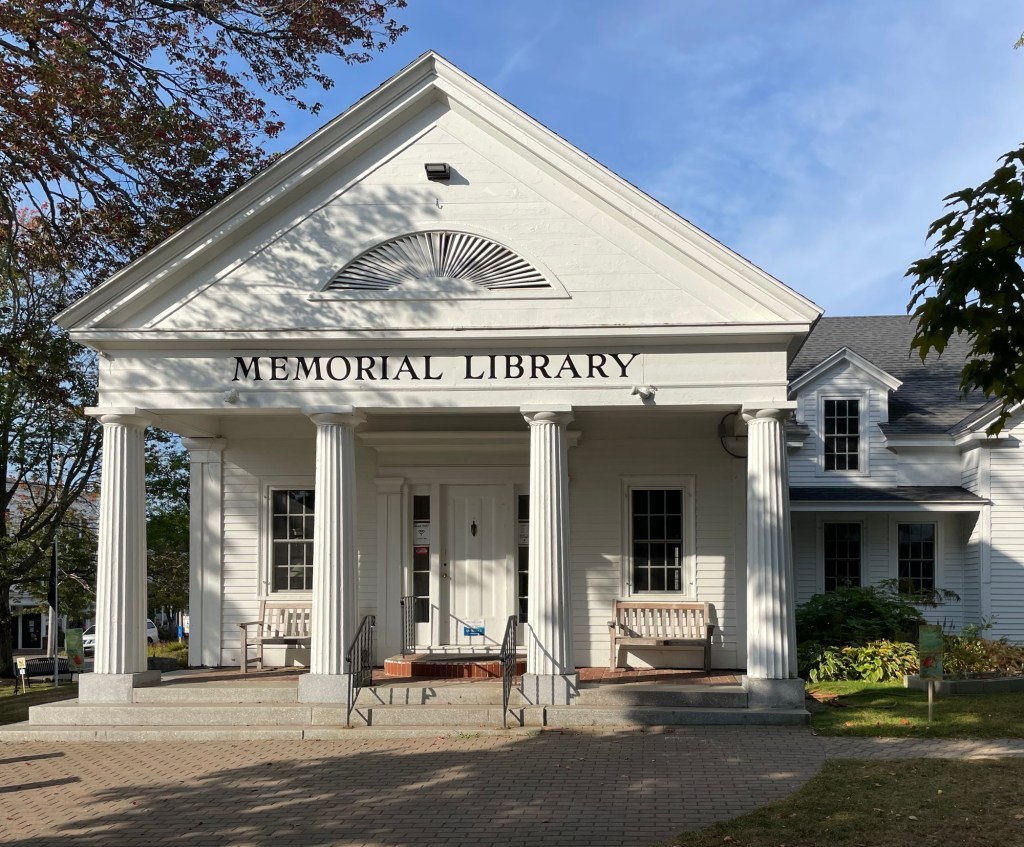
In 1906, the citizens of Boothbay Harbor voted to establish a free public library for all to enjoy. In 1923, the need for more library space, along with a desire for a World War I Memorial, led to the approval of a bond for the purchase of a 1842 Greek Revival style house on Oak Street. The building was remodelled for use as a library by the Boston architect William Stanley Parker, and was enlarged in 1966 to a design by Parker’s son, Stanley Jr. The temple-front, Neo-Classical entry was added at this time and harkens back to the original classical style Greek Revival home, while clearly showing a grander scale seen in the 20th century.
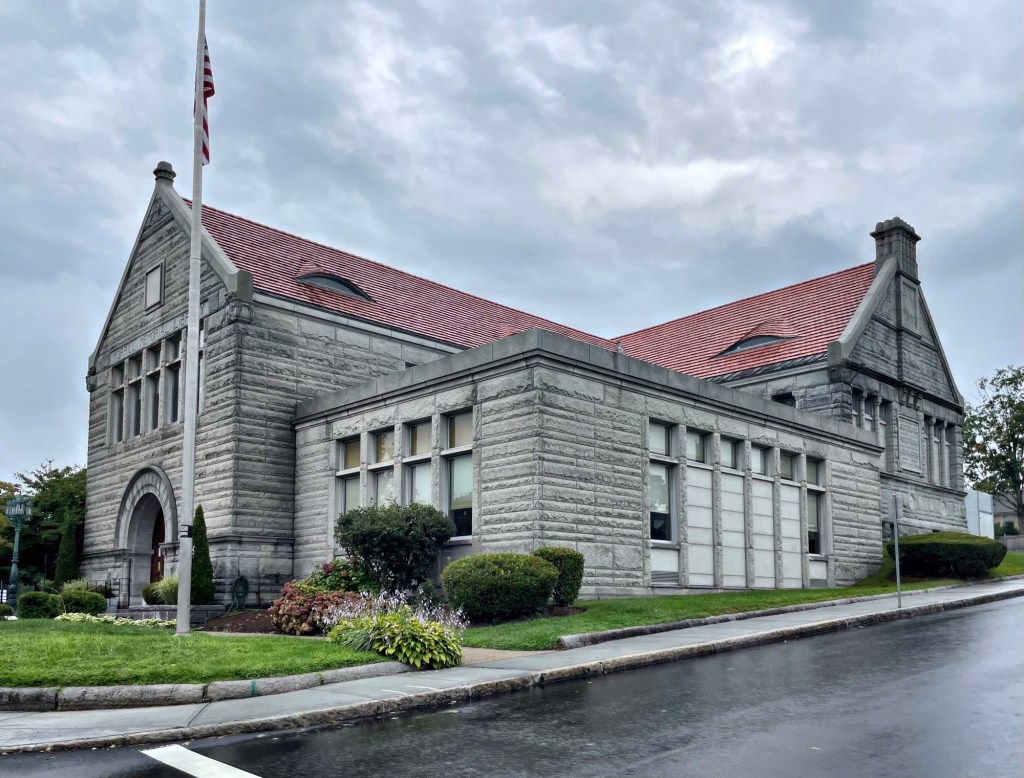
One of the best parts about New England is the diversity of the architecture and history of local public libraries. The Morrill Memorial Library in Norwood, Massachusetts, was erected by George H. Morrill in memory of his daughter Sarah Bond Morrill, who apparently died in 1895 of Typhoid Fever at the age of 22. George Morrill made his fortune as one of the largest producers of printing inks in America. The business was founded by Samuel Morrill, father of George H. Morrill in 1845 in Andover, but in 1856, he moved the works to South Dedham (present-day Norwood). The company grew rapidly and factories were built in Norwood and expanded to meet increasing operations. Mr. Morrill built a massive estate in Norwood (no longer extant) and also houses for his family members nearby to create a small enclave for the family. One of the lots on Walpole Street was utilized for a memorial library in honor of his late daughter. Architect Joseph Neal, who originally worked for Shepley, Rutan & Coolidge in Boston, designed the Richardsonian Romanesque library constructed of rough-faced granite blocks with a red terracotta tile roof above. The main entrance was deeply recessed within a great Assyrian arch typical of an arch-type that was a hallmark of the public and ecclesiastical buildings of Boston architect Henry Hobson Richardson during the 1870’s and 1880’s, but has since been enclosed by a vestibule, somewhat diminishing the original entry. The library was originally cruciform in plan but one-story additions constructed in the 1960s, on either side of the original facade have altered its original volume, but at least they are of a similar material. The library is one of the more unique in the Boston area and a testament to a father’s love to their children.
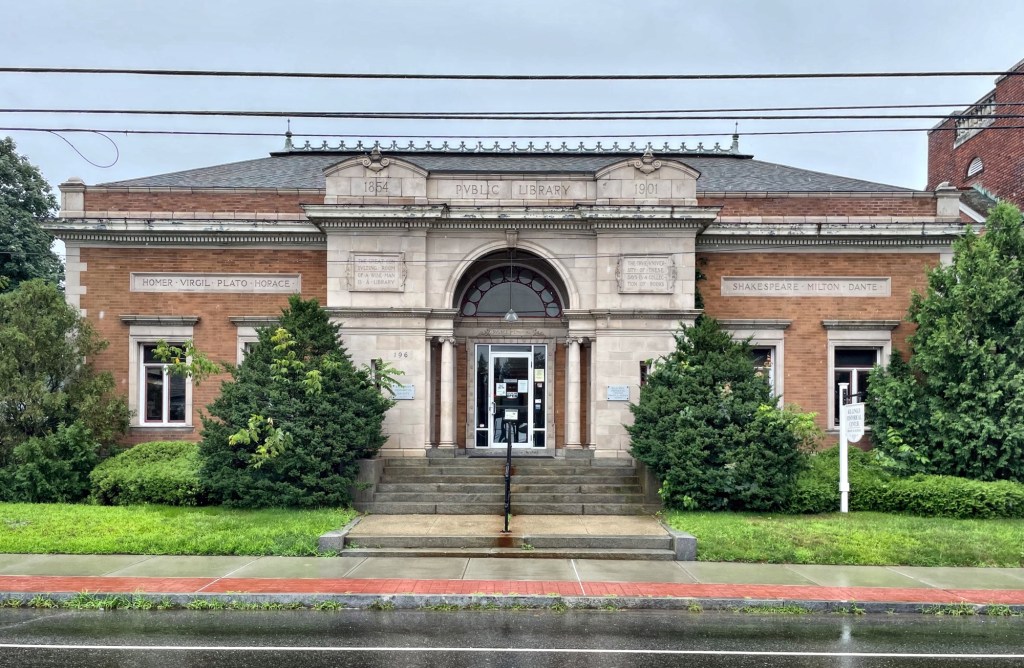
The Bugbee Memorial Library sits on Main Street in Danielson, the main village in the town of Killingly, Connecticut. The library was built in 1901 and financed by a bequest from Edwin Holmes Bugbee, who made his fortune at local mills. When Bugbee died in 1900, his estate left his entire collection of books along with funds for a new library for Danielson. Boston architect Walter Jefferson Paine designed the library building in the Classical Revival style with buff brick and stone construction. The names of Homer, Virgil, Plato and Horace, along with Shakespeare, Milton and Dante, are boldly emblazoned across the facade denoting the building as a house of learning. The library was outgrown, and a new library was built nearby in 1994. The old Bugbee Memorial Library has since been occupied by the Killingly Historical Society.
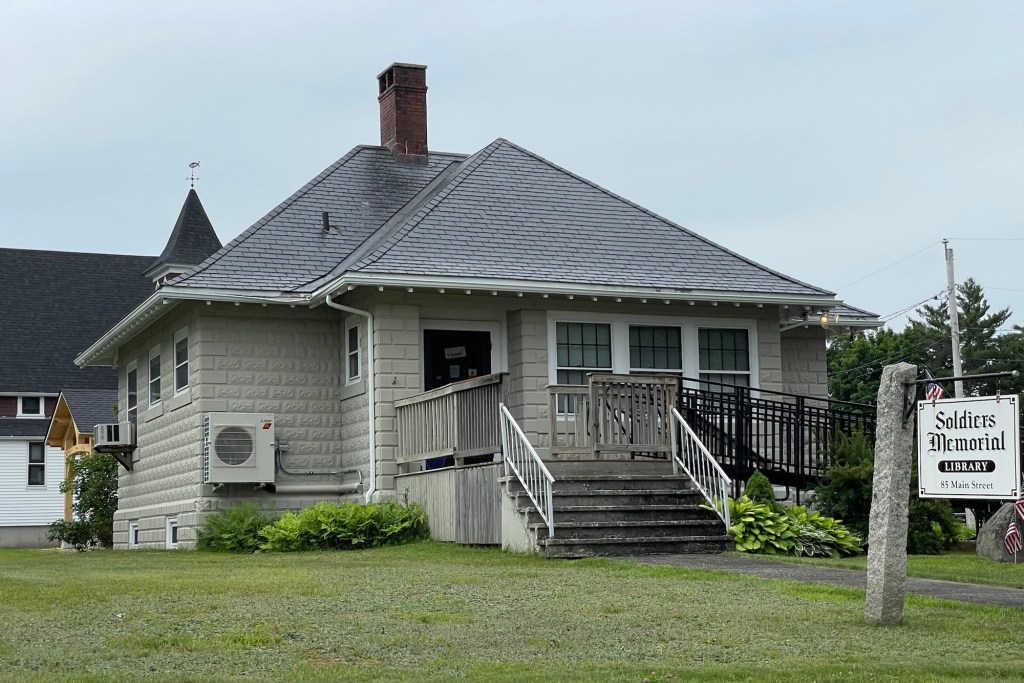
Located on a slight rise above Main Street and across from the sprawling Hiram Village Cemetery, this one-story library with walls of textured concrete blocks was dedicated in August of 1915 and has been a center for cultural activities in the town of Hiram, Maine, since that time. The Soldier’s Memorial Library was built with funds provided largely by Virginia Barker Jordan, a granddaughter of local businessman Benjamin Barker. Also instrumental in organizing Hiram’s first free public library was Llewellyn A. Wadsworth, local poet and cousin of Henry Wadsworth Longfellow. Beyond the unique use of concrete block construction for a library, other interesting exterior architectural features include the wide-flaring eaves with exposed rafters and the bands of windows on the first story walls, which hint of the Arts and Crafts/Bungalow styles. The library building was designed by Boston architects Robert Wambolt and Amos A. Lawrence.
In his will, lifelong Chaplin, Connecticut resident William Ross (1833-1908) bequeathed his hometown funds to erect its first purpose-built public library. As planning began, his widow, Emily Jones Ross donated even more to fund a building fitting of her late husband. The Queen Anne/Romanesque Revival style library is built of pressed brick with granite trim and features a prominent rounded corner bay of cedar shingles. The masonry work was done by George E. Snow but I could not locate the architect. The town outgrew the library and moved it into a new building nearby, selling the William Ross Public Library to a private owner, who appears to be renovating it now.
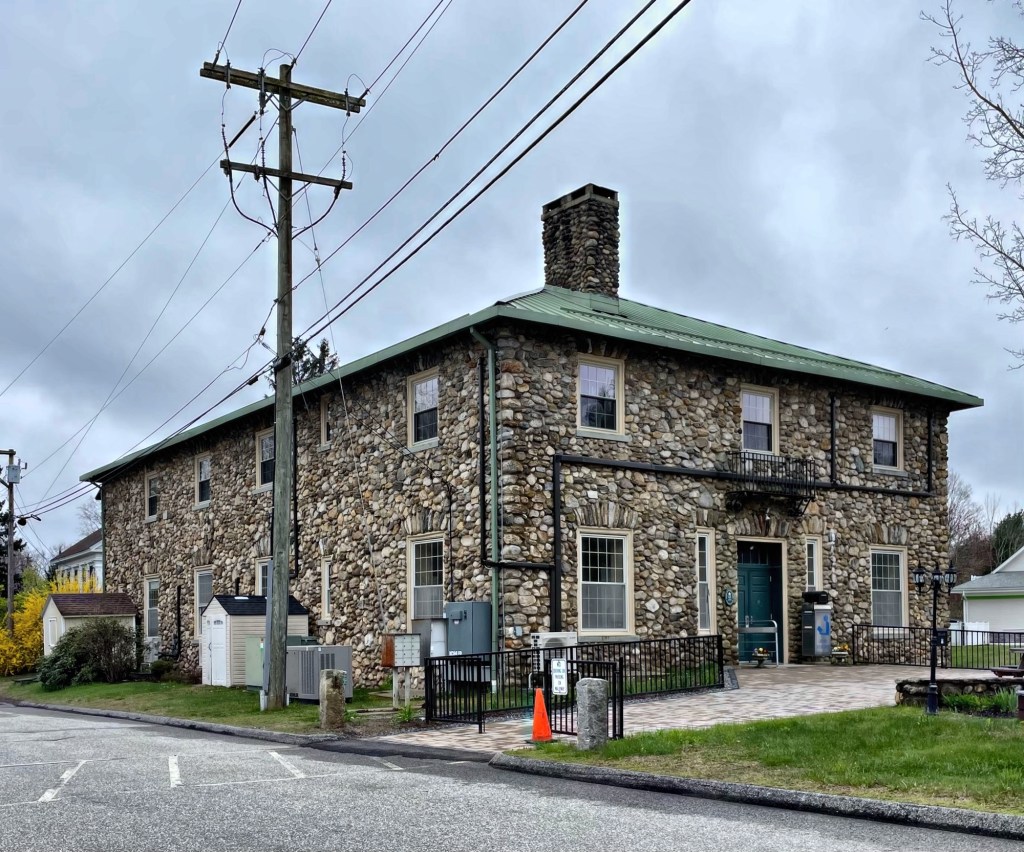
In the 1840s, Archibald Babcock (1780-1862) from Ashford, Connecticut, went west to engage in the California Gold Rush to seek his fortune. He did well and upon his return, moved to Charlestown, Massachusetts and began purchasing property for redevelopment. Upon his death in 1862, Mr. Babcock bequeathed $3,000 to the Town of Ashford start a “free” library there. For the next 60 years the library was located in a variety of private homes and country stores in town until the 1920s when this stone structure was built to house the town hall and library. Construction was made possible by a gift from Charles Knowlton, whose family had lived in the area since the 18th century. When built, it featured a number of modern innovations, including electrical service (generated on site), and steam heat. In addition to town offices and the library, the building also has an auditorium which is used for town meetings. Architect Herbert Loud furnished plans for the building which is rustic Arts and Crafts in style with randomly laid fieldstone walls with wide mortared joints. The roof eaves show exposed rafter tails below the shallow hipped roof.
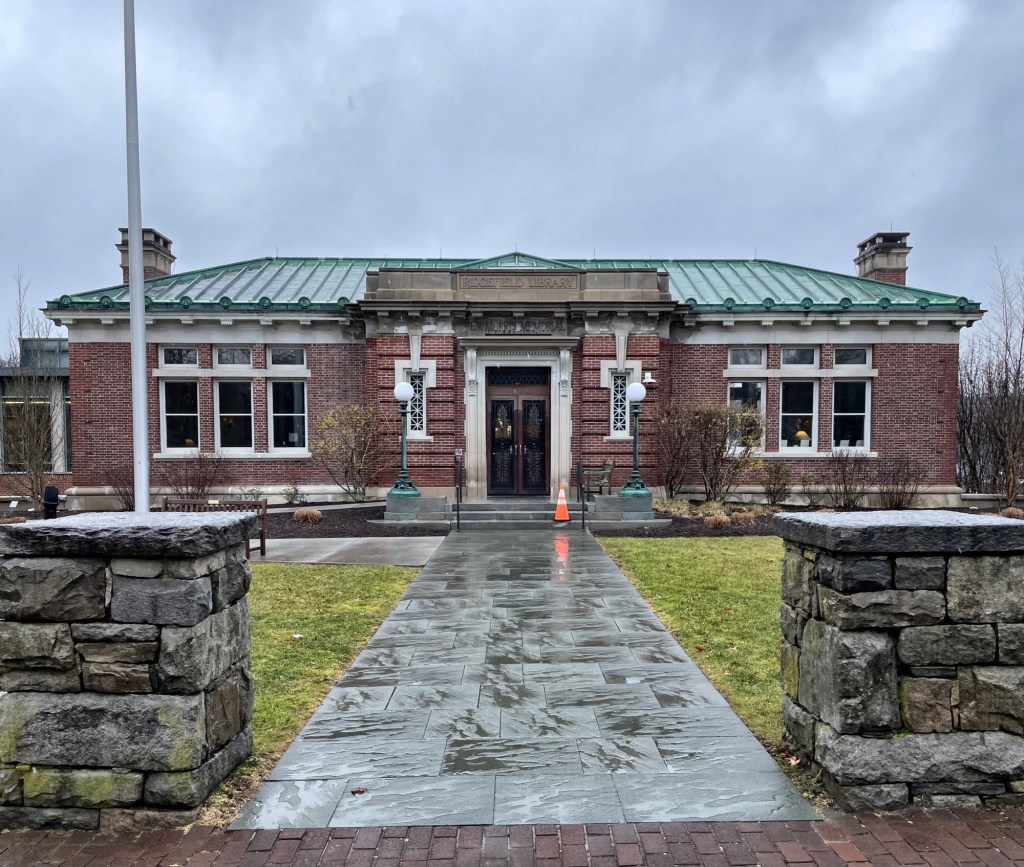
The Ridgefield Public Library is an intriguing Beaux Arts style building from the turn of the 20th century. Built in 1901, the brick structure replaced the Smith Tavern, a 1798 frame structure built by Amos Smith right on Main Street. In 1900 the Smith Family sold the property to James N. Morris who had this library built in memory of his wife, Elizabeth, donating it to the town. Architect Raleigh G. Gildersleeve is credited with the design which is comprised of a one-story building constructed of brick with cast stone trim details and ironwork at the door. The library was given later additions, which are recessive in location and detailing to let the original building shine, as it should!
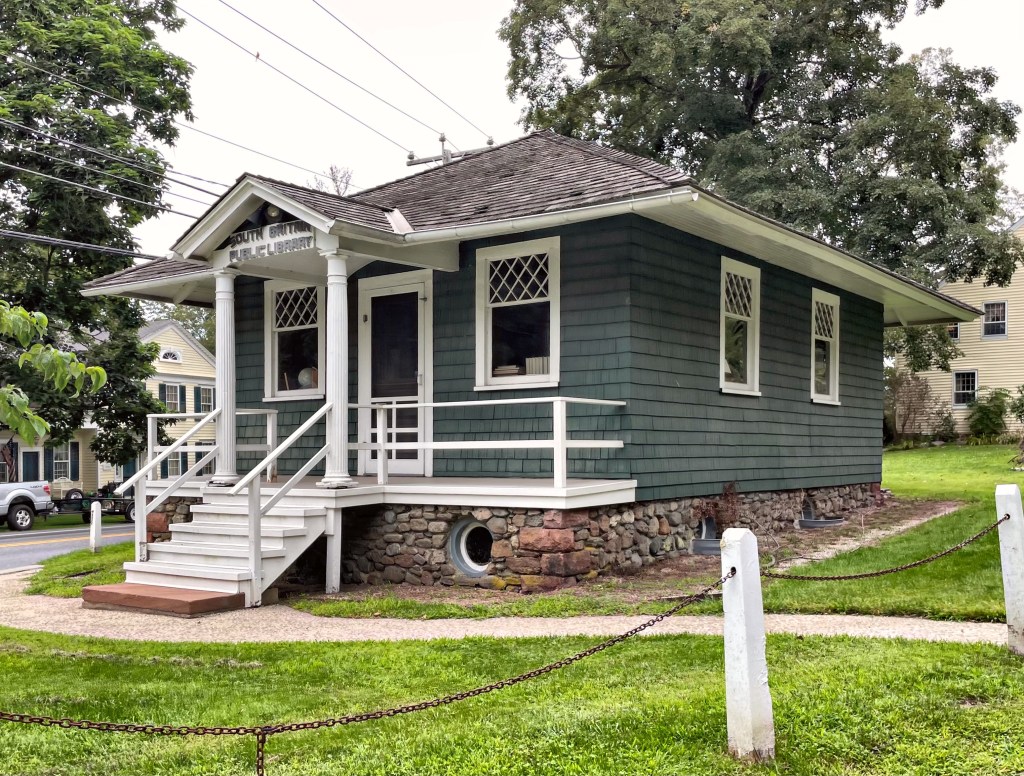
Historic library buildings might just be my favorite building type in New England. This charming example is the former South Britain Public Library in Southbury, Connecticut. The library was constructed in 1904 and blends Shingle and Arts & Crafts styles with the shingled walls atop a raised rubblestone foundation with a pyramidal roof with broad overhanging eaves with exposed rafter ends. The library was outgrown and rather than add onto the small building on its lot, a new library was built in 1969. The former library is now maintained by the Southbury Historic Buildings Commission and is operated by the Southbury Historical Society as a local history and genealogy research center.
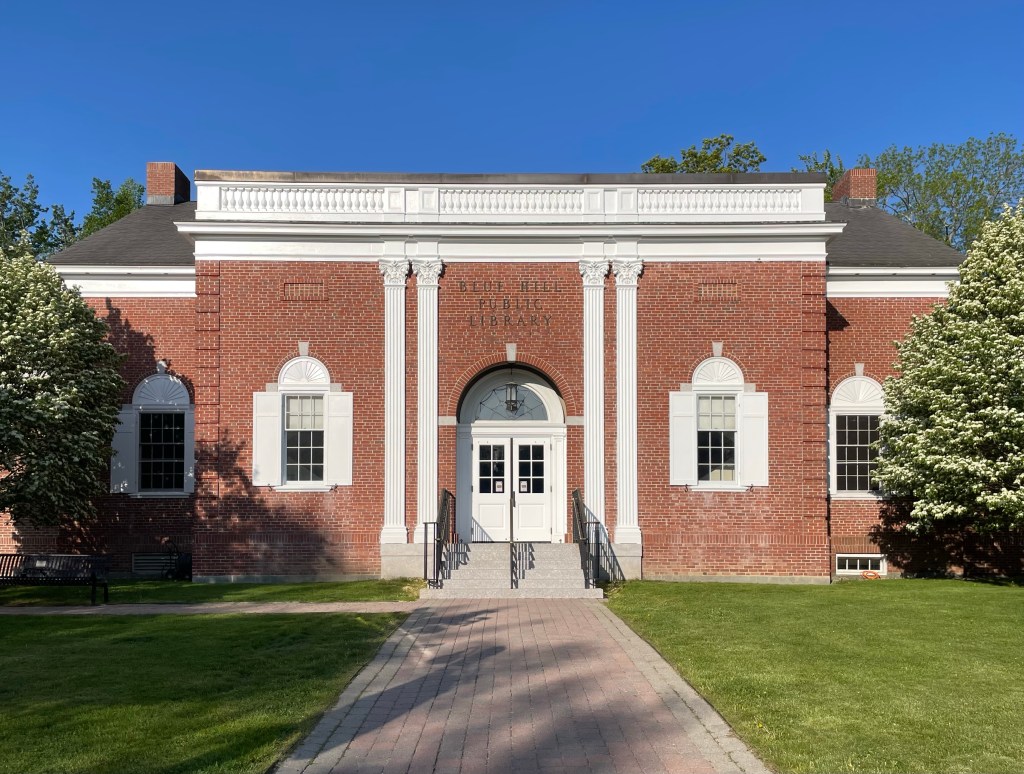
Some small town libraries really pack an architectural punch! Blue Hill had long had a public library building, which eventually outgrew its limited space in the 1895 Town Hall building. During the mid-late 1930s, in the depths of the Great Depression, plans began for a new library. Adelaide Pearson, who had moved to Blue Hill in 1928, took on the formidable task. She was described as “a small woman who got things done” and had a vision for a library that was an integral part of the community, serving more than as a place to store and retrieve books. To fulfill that dream, she organized a fundraising campaign to buy a vacant lot in town. Local pledges came in ranging from 25 cents to “one dollar or a day’s work.” With the help of librarian Anne Hinckley, Adelaide Pearson petitioned the federal government for funds from the Public Works Administration, part of the New Deal program. At last, in March of 1940, the Colonial Revival style library building designed by Bunker and Savage Architects of Augusta opened its doors. The library has been a centerpiece of life in the coastal town of Blue Hill ever since.

 Buildings of New England