Folger House // 1807

There is so much to love about this house! The lot here was purchased by Paul Macy and Gideon Folger in 1807, and they had this house built on the site that year. Paul Macy and, Gideon Folger were two major shareholders in the ill fated whaling schooner “Essex”. In 1820, while at sea in the southern Pacific Ocean under the command of Captain George Pollard Jr., the ship was attacked and sunk by a sperm whale. Thousands of miles from the coast of South America with little food and water, the 20-man crew was forced to make for land in the ship’s surviving whaleboats. The men suffered severe dehydration, starvation, and exposure on the open ocean, and the survivors eventually resorted to eating the bodies of the crewmen who had died. When that proved insufficient, members of the crew drew lots to determine whom they would sacrifice so that the others could live. Seven crew members were cannibalized before the last of the eight survivors were rescued, more than three months after the sinking of the Essex. This ordeal was inspired Herman Melville to write his famous 1851 novel Moby-Dick. The Folger House was owned for some time by Walter Folger, a lawyer who served in the state senate.

Robb-Kagan House // 1939

Colonial-inspired homes on Nantucket never will go away, and that is because the entire island is a local historic district! New construction, demolitions, and alterations to existing structures all need to be reviewed and approved on Nantucket, no easy task! This home was built in the inter-war period (before the historic district), when New Englanders still harkened back to the classics, Colonial homes. The house was built in 1939 for Annie Robb, and it was later purchased by artist couple Vladimir Kagan and Erica Wilson. Vladimir had a really interesting life. A cabinetmaker’s son, Mr. Kagan came to the United States at 11 after fleeing Nazi Germany with his family. He trained at his father’s New York workshop and by the 1940s was producing his own designs. One of his first orders was a set of tables and chairs for a delegate lounge at the fledgling United Nations! Meanwhile, across the English Channel, a young woman named Erica Wilson came into the world in 1928 in the town of Tidworth, England. Her father was in the military and the family moved to Bermuda soon after Erica’s birth. A drawing prodigy, Wilson “translated her drawing techniques into needlework,” Illya said. Needlework became her artistic focus and she graduated from the Royal School of Needlework in London. The duo lived in this home as a summer respite, where they could hone their artistry and skills. Their son, Ilya Kagan (also an artist, of course) also stayed in the home and still resides on the island. Love it!

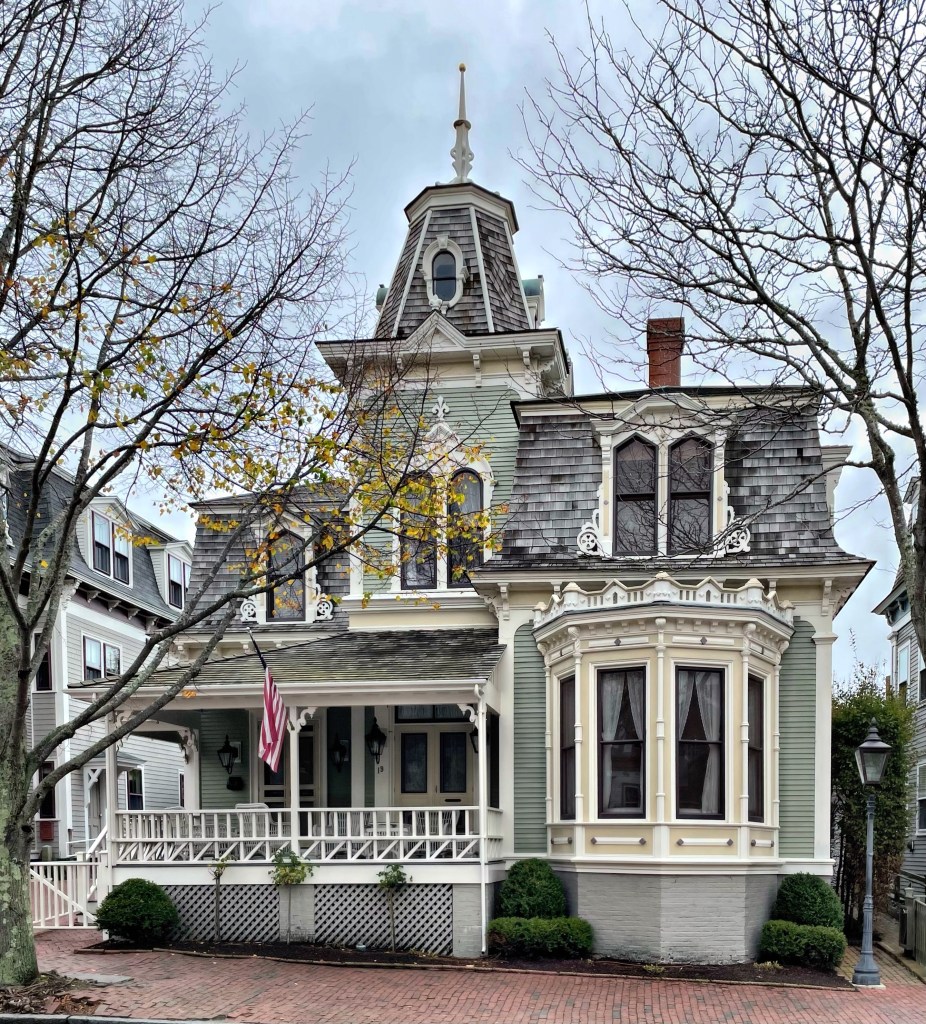
Andrew Hunt House // 1878

When one thinks of architecture on Nantucket, many would think of old Colonial-era capes and stately Federal and Greek Revival whaling captains mansions. There are Victorian-era houses on Nantucket, but building on the island tapered off by the mid 1800s after the mid-1700s to the late 1830s when Nantucket was the whaling capital of the world. In December of 1877, Nantucket coal dealer Andrew Hunt purchased a vacant lot on Broad Street to erect a new home for his family. Mr. Hunt hired local builder Charles H. Robinson to design and construct the Second Empire cottage, which today, remains one of the best-preserved and high-style Mansard residences on the island.

Turner House – Nantucket Cottage Hospital // 1800

In around 1800, Baker Turner built this beautiful Federal period home on Nantucket. It typifies the best parts of Nantucket architecture: gray weathered shingles, charm and simplicity. Over 100 years after the house was built, the property became significant as a facility for saving lives. The Nantucket Cottage Hospital was founded in 1911, conceived by the visions of Dr. John S. Grouard (who lived nearby) and Dr. Benjamin Sharp, to provide centralized high-quality medical services to the residents on the island. There had been no hospital on the island beforehand. The duo bought the former Turner homestead in 1912 and moved in. The hospital was eventually outgrown, and the hospital relocated to a modern building on available land in the 1950s. This building was sold and now appears to be a home, full circle.