Built c. 1710 this amazing Georgian Colonial house would have originally been a smaller, central chimney structure built by Nathaniel Langley. Major remodeling to effect the Georgian style seen today was done by a subsequent owner of the property. That owner was likely John Brown (1694-1764) a wealthy merchant that may have gifted or sold this home to his daughter, Ann Brown and her new husband, Charles Handy. Handy was a merchant and operated a spermaceti factory just to its west. Later owner, David King and his heirs owned the house for much of the 19th century. The house is on its original site and was purchased by the Newport Restoration Foundation (NRF) in 1969 and restored in 1970-71.
James Cahoone (1727-1814) and Stephen Yates built this stunning double-house on Green Street in Newport around 1763. Both James and Stephen worked as painters in town, and built this house together, each living in one half (Cahoone must have paid a little more because his “half” was a little larger). The Georgian style double-house eventually suffered from neglect and like several other Colonial-era buildings in Newport, its future was uncertain. Luckily, the Newport Restoration Foundation stepped in and purchased the property in 1968, restoring the houses in 1974, complete with a paint color even Cahoone and Yates would love!
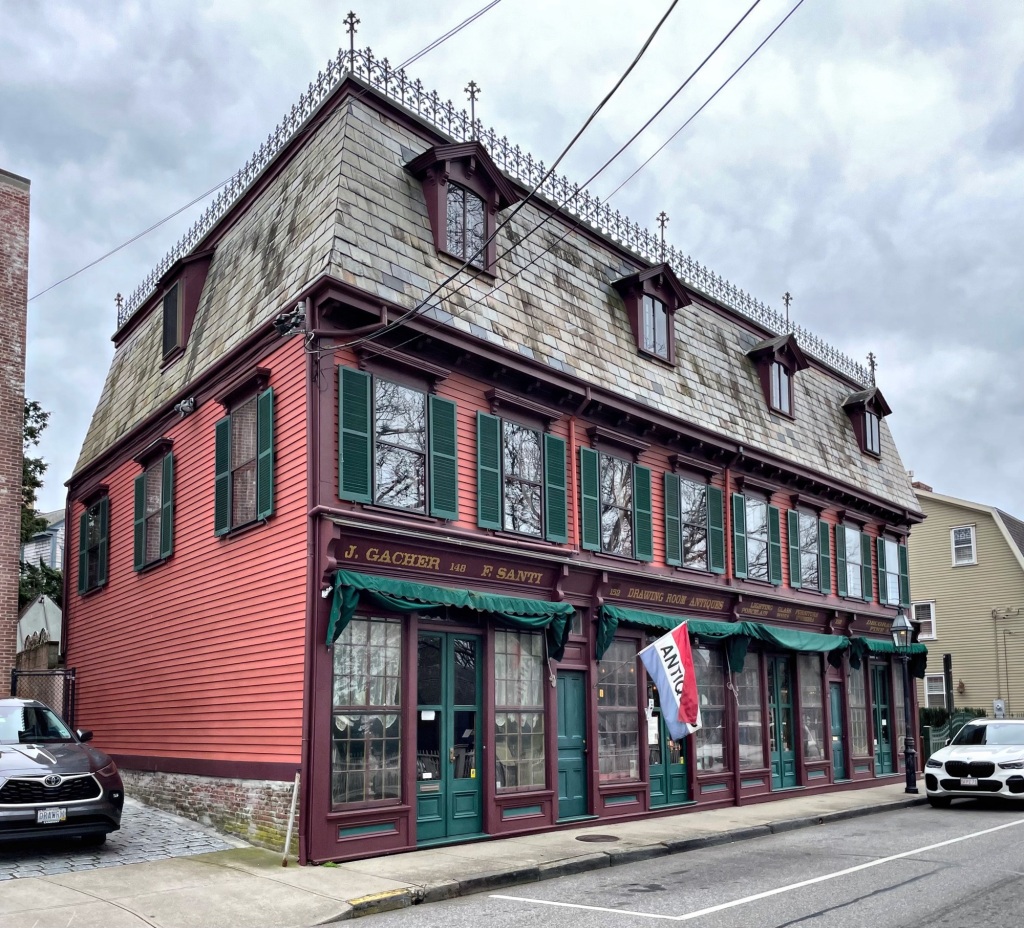
One of the finest commercial blocks in Newport is this building, the Theodore Helme Block, located on Spring Street, just behind Trinity Church. The block was built for Helme by 1875 and was possibly an early design by Dudley Newton, a local architect. The Second Empire style block has a slate roof with rare intact iron cresting and small dormers. The building was restored by Federico Santi & John Gacher, who operate The Drawing Room Antiques here.
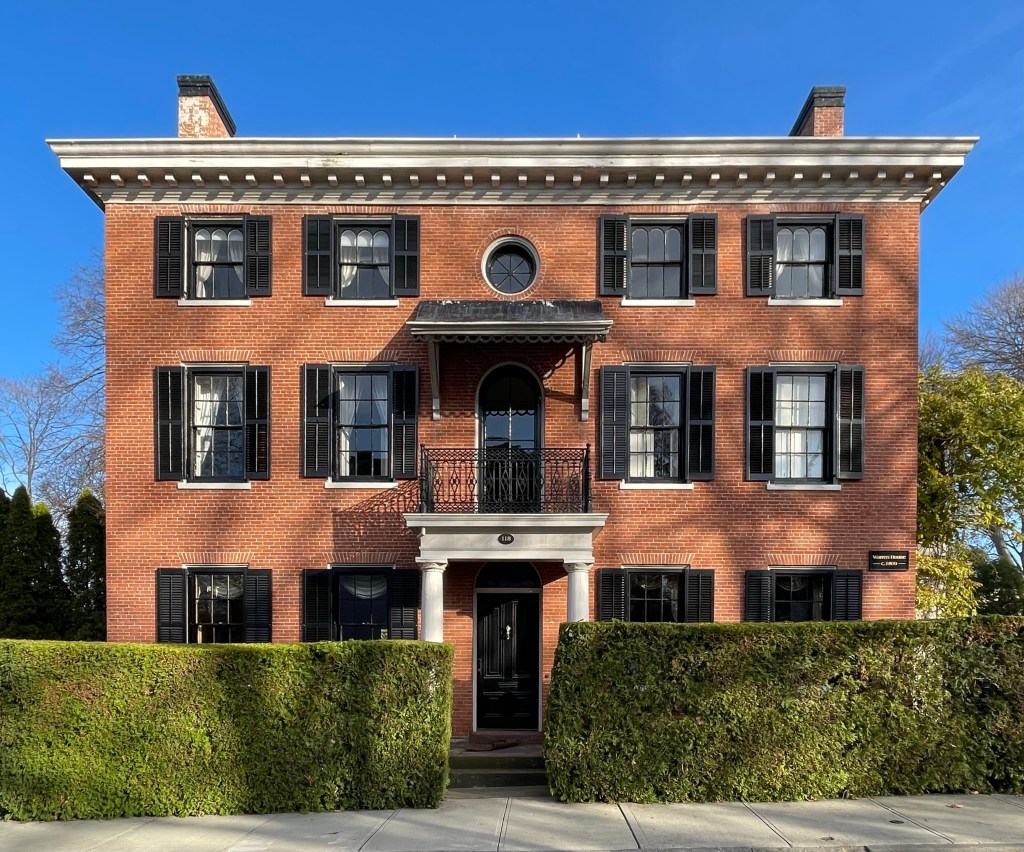
The Lawton-Warren House is one of the few large, brick Federal mansions in Newport, and is located a short walk from the Tillinghast House (last post) and the mysterious Newport Tower in Touro Park. The collapse of maritime trade in Newport following the British occupation was so complete that this house style, prevalent in Providence, is virtually nonexistent here. Robert Lawton was a sea captain and merchant who died at sea in 1818 off the coast of Africa and left the house to his wife, Penelope. After Penelope’s death in 1855, the traditional Federal style home was given Italianate detailing at the second floor. The home was likely painted around this time, which thankfully has been removed. The home was purchased in 1932 by George Henry Warren and his wife Mrs. Katherine Urquhart Warren. Katherine was a preservationist and art collector interested in preserving the Colonial town of Newport. To assist with this endeavor, she convinced the Countess Szycheni, a descendant of the Vanderbilt family and owner of The Breakers, to open The Breakers mansion to the public for tours. It was the start of the Preservation Society of Newport County. She would later be appointed by First Lady, Jacqueline Kennedy, to the committee to restore the White House in 1961. Katherine died in 1976, she willed the home here to the Preservation Society, and it held offices there until 1994. The home was sold to a private owner who restored the home to near original conditions, keeping the Italianate detailing.


 Buildings of New England