Saunders Cottage // c.1900

Charles Saunders, a carpenter, and his wife Annie Saunders, seemingly built and lived in this Shingle style cottage in the Ocean View summer colony of Rockport. The couple shows up in census records as living here in 1910 while in their 50s. The house likely dates to the 1890s and is a great example of the Shingle style for a middle-class residence. The house features a corner tower and a wrap-around porch with continuous shingle siding and columns. The property was deeded to a Lawrence Regester in 1924 when Annie sold the property after Charles’ death. The shingled cottage has remained in a great state of preservation for its existence!

Rockridge Cottage // c.1830

Few houses in Rockport, Massachusetts showcase the town’s history as a granite exporter as well as this large residence on the appropriately named Granite Street. The history of this dwelling goes back to 1828 when a young Samuel Parker (1801-1878) married Jane Boyd Rowe that year. From this marriage, Samuel and Jane inherited her family’s farmland here, which worked well for her new husband’s ambitions. Samuel Parker was engaged in granite quarries in Quincy, Massachusetts before moving to Rockport to establish a business here. In Pigeon Cove, Samuel worked as a foreman for the Pigeon Hill Granite Company and clearly used some of the granite quarried on the site to erect this stately home by around 1830. Samuel would later leave his wife for about 10 years to participate in the California Gold Rush from 1850-1860, but returned due to his older age. Their granite home became known as Rockridge Cottage through the subsequent generations of owners, all descendants of Samuel and Jane. The dormers and Victorian-era portico at the entrance were likely added in the latter decades of the 19th century.

“The Old Castle” // c.1712

Located in Pigeon Cove, the northern section of Rockport, Massachusetts, the “Old Castle” is an iconic landmark in the charming coastal town. The exact year it was built is not known, but it is believed to have been built in 1712 by Jethro Wheeler (1692-1755), a shoemaker who settled here from nearby Rowley. In 1724, Jethro deeded the property to his son Benjamin, and he moved out of town. Benjamin, is turn sold the property to his son Benjamin in 1769. Benjamin Jr.’s son, John D. Wheeler in 1792 inherited the property and added the lean-to/kitchen room to the rear to create the present saltbox roof form. Various Wheelers continued to own the Old Castle for another hundred years. The property was gifted in 1929 to the Pigeon Cove Village Improvement Society, and is presently under ownership of the Sandy Bay Historical Society, who manage the property as a house museum. The house with its overhanging second story reads like a garrison, a common element in First Period houses in Essex County.

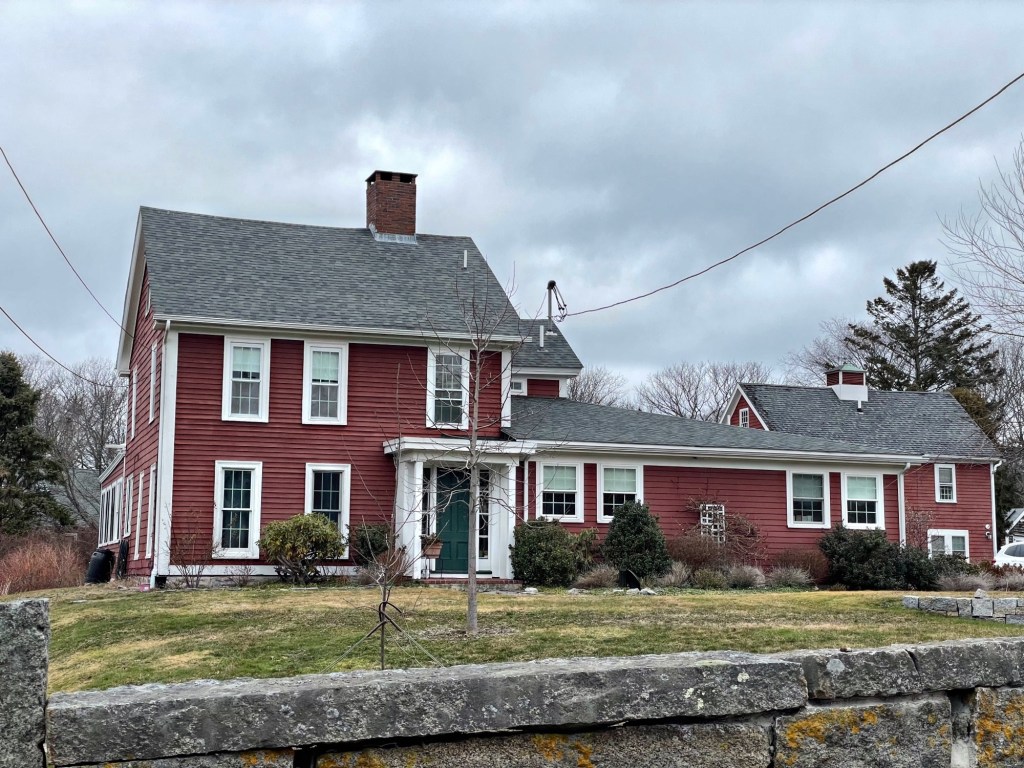
Norwood-Babson Farmhouse // 1799

Located in northern Rockport, Massachusetts, you will find this charming Colonial-era farmhouse set amongst the backdrop of ocean cliffs and granite quarries. At the tip of Pigeon Cove, adjacent to the present-day Halibut Point State Park, James Norwood purchased land and would erect this house by 1799 for his family (possibly built from an older dwelling formerly on the site). After James’ death, the property was willed to his daughter and son-in-law and sold a few times until 1820, when it was purchased by David Wallis Babson who raised his family here. As granite-quarrying became a lucrative trade in Rockport by the early-mid 19th century, David’s son Joseph bought twelve of the Babson Farm acres from other family members to organize a stone cutting business here. The property would leave the Babson Family decades later, but retained the family name until today. Edwin Canney would purchase the remaining 70-acre Babson Farm, selling it to the Rockport Granite Company. For the next thirty years, industrial-scale mining and shipping would redefine Halibut Point over the next thirty years. The quarries are now a State Park, and the former Norwood-Babson farmhouse remains intact as a significant piece of the town’s earlier history.