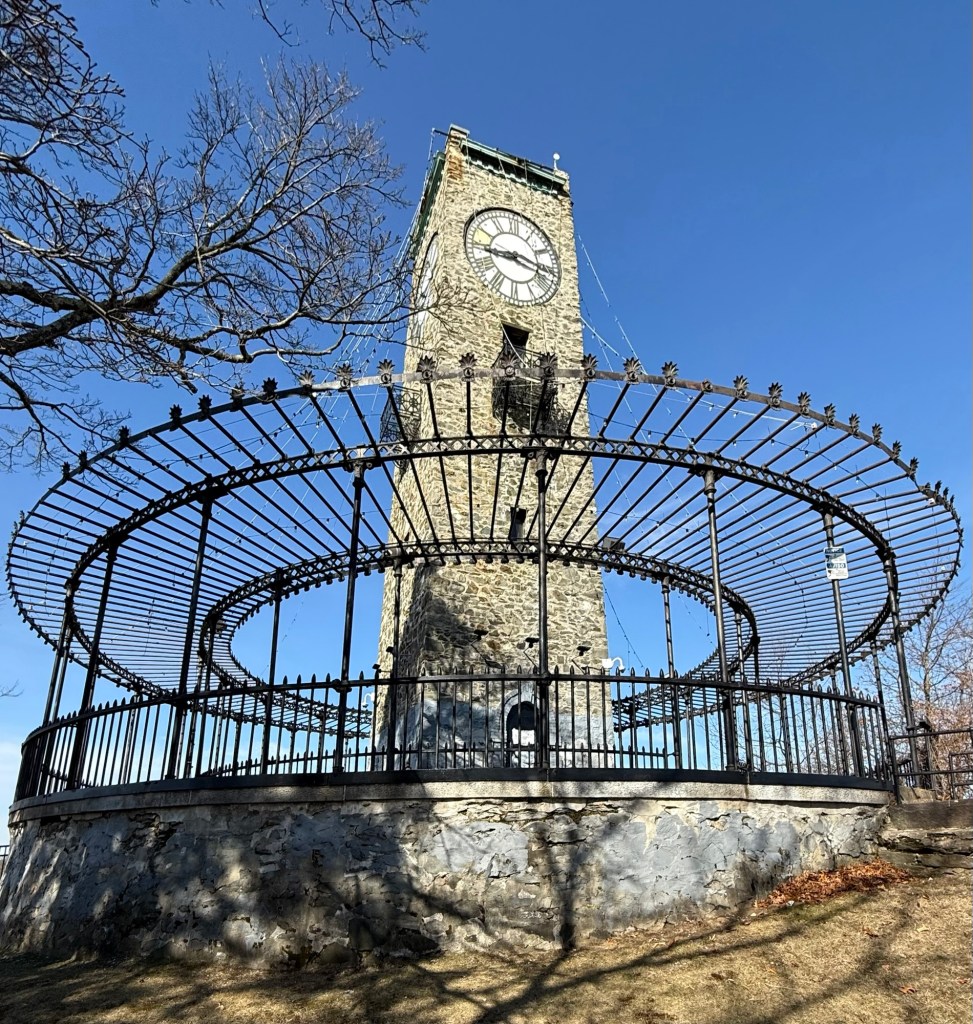
Cogswell Tower // 1904

The crown jewel of the nearly one square mile city of Central Falls, Rhode Island, is Jenks Park, the only large park in one of the densest cities in America. The land was a gift of Alvin Jenks, a descendant of the family which had been among the town’s earliest settlers and one of its leading industrial families, and provided a much-needed recreational/open space for the dense industrial city. In 1890, planning began on the park with consists of hilly terrain cut through by paved paths, rocky outcroppings, and large metal gazebos which were fabricated at the nearby Fales and Jenks machinery works. At the crest of the park’s hill is Cogswell Tower, a clock and observation tower given by a former resident, Caroline E. Richards Cogswell. The stone tower was designed by architect Albert Humes, who ironically, was serving as mayor of Central Falls at the time, which may represent somewhat of a conflict of interest to gain the commission… The Cogswell Tower stands 70-feet-tall and is constructed of rough stone with a pyramidal roof that was once surmounted by an eagle. Its most remarkable aspect, a circular, iron structure which surrounds the base appearing from below as a sort of Hula-Hoop to the tower. Jenks Park and the iconic Cogswell Tower remain as a source of pride for the City of Central Falls.
Fort Revere // 1898-1947

Fort Revere, named in honor of Paul Revere, was acquired as Nantasket Head Military Reservation in 1897 under the large-scale Endicott program, which initially included seven forts in the Harbor Defenses of Boston. The fort replaced the outdated Revolutionary-era fortifications and built upon the earthworks, creating batteries were built 1898–1906. Additionally, a 1903 concrete water tower was constructed to provide water and reconnaissance to the fort. After the American entry into World War I in early 1917, the fort was expanded to include temporary structures such as quarters and additional storehouses. With the outbreak of World War II in 1939, Fort Revere was again built up with temporary structures to accommodate the 1940–1941 mobilization. With new defenses completed elsewhere in the Boston area, the fort’s remaining original guns were scrapped in 1943. After the war, Fort Revere was disarmed and turned over to the Commonwealth of Massachusetts. Remains of Fort Revere include six gun emplacements built into the southeast, east and north sides of Telegraph Hill. They are connected by dugouts or bunkers and are of concrete and brick construction. Additionally, tunnels and storerooms can be explored, lined with graffiti and crumbling concrete. I highly recommend you all check it out and explore the grounds, its a great place to explore and learn history! Fingers crossed to see the remaining fortifications restored to their former glory.