Whitman House // c.1870

In 1870, the Annisquam Cotton Mill in Rockport, Massachusetts was sold at auction and acquired by a group of local investors and businessmen. One of those men was G. P. Whitman, who served as a local agent for the reorganized firm. Whitman built this home just a short walk to the mill, which stands prominently in the village. The home is a great example of the Stick style, using some Italianate forms and detailing. The Annisquam Mill saw less than ideal revenue as in 1877, it was announced that the workers would get a cut in pay to avoid closing the mill. G. P. Whitman realized the threat of fire to woolen mills, and operated a fire station nearby. Sadly, in 1883, a fire destroyed much of the mill, even with local fire companies doing their best. A portion of the mill and the old Whitman House stand as lasting remnants of the Annisquam Cotton Mill Company in Rockport.

Rev. David Jewett House // 1806

About the time that the First Congregational Church (featured previously) in Rockport, Mass. was built, the congregation began construction on a home for their pastor, David Jewett. The home was built in 1806 and sits right next to the old church. David Jewett (1773-1841) was born in Hollis, NH., and graduated from Dartmouth College in 1801. He was ordained pastor at the Congregational Church of Rockport on October 30, 1805, a position he held for more than 30 years The Federal style home features a central doorway with a fanlight above and it is flanked by pilasters topped with an entablature.

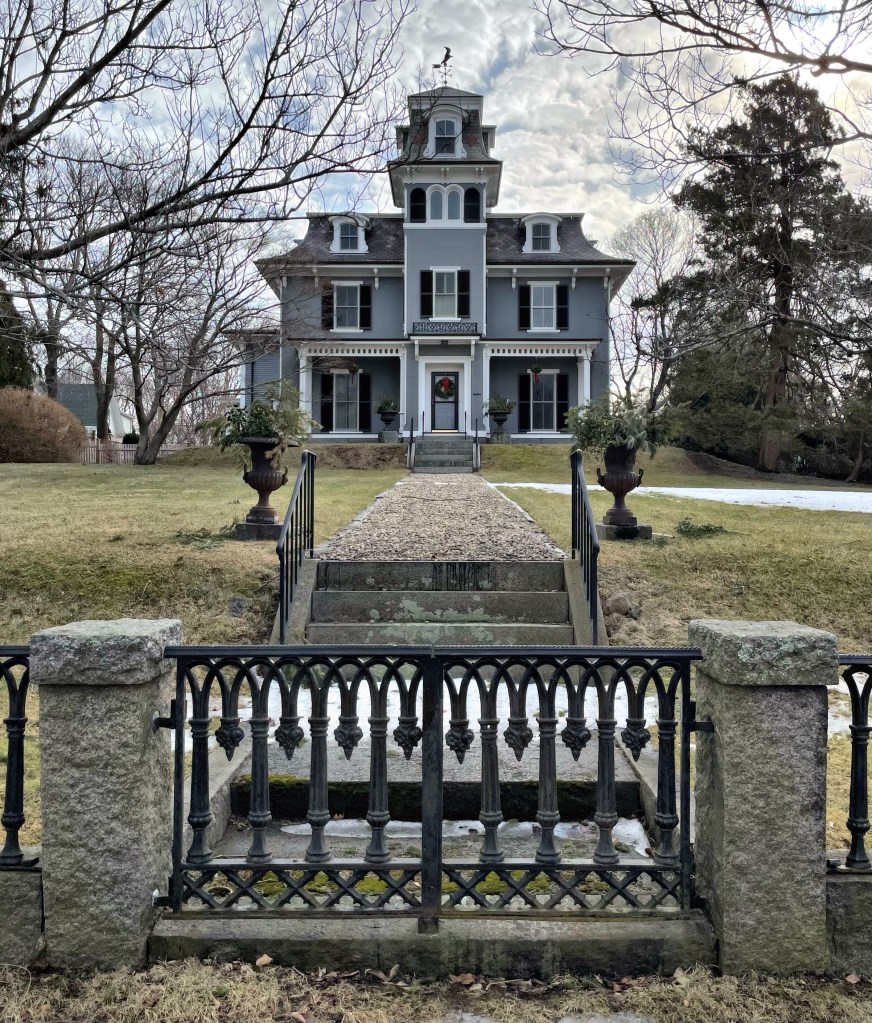
John D. Sanborn Mansion // c.1865

One of my absolute favorite homes in Rockport (there are many) is this mansion, which sits away from busy Bearskin Neck and the hustle-and-bustle of the village. The John Dearborn Sanborn Mansion was built around 1865 and is an elegant example of the Second Empire style of architecture in Rockport. John Sanborn was born in Hampton, NH, and eventually moved to present-day Rockport, marrying Laura Tarr of a prominent local family. Sanborn appears to have been a merchant and ship-owner. It appears that Sanborn was involved with the California Gold Rush, and is thought to have been one of the first men to send gold via the Pony Express, a mail service delivering messages, newspapers, and mail using relays of horse-mounted riders that operated from 1860 to 1861. It is possible that his investments with gold allowed Sanborn to build this stunning estate in Rockport, set behind an iron gate and perched upon a hill. I like to think that his wife Laura would sit in the tower and look towards the sea from the windows.