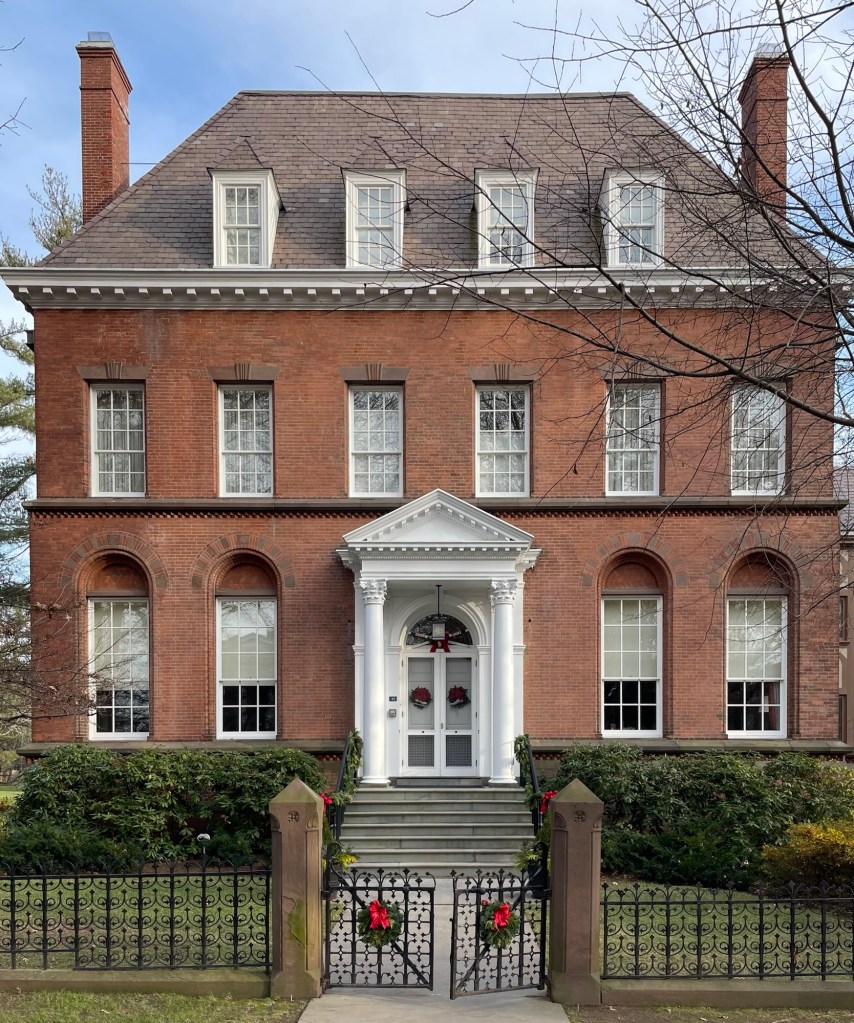
Farnam House – Yale President’s House // 1871

In 1871, wealthy engineer and philanthropist, Henry Farnam (1803-1883), purchased a house lot on the desirable Hillhouse Avenue in New Haven, Connecticut, where he would live out his final days in retirement. Mr. Farnam made his fortune beginning in 1839, when he was instrumental in building the railroad connecting New Haven to New York. In 1850, he moved to Illinois where he partnered with Joseph E. Sheffield to build the Chicago, Rock Island and Pacific Railroad, becoming that railroad’s president in 1854. In 1868, Farnam moved back to New Haven when he hired Russell Sturgis, Jr., to design and oversee construction on his home there. Henry Farnam also worked with Sturgis on Farnam Hall at Yale, where he is the benefactor and namesake of the building. Henry Farnam died in 1883, and in his will, he stipulated that he would gift his property to Yale College under the condition that his son, Henry W. Farnam, could live there until his death. Henry Walcott Farnam was an economist, and served as president of the American Economic Association. In 1933, the property ownership was officially transferred to Yale University, who in 1936, renovated the property, changing its appearance from Victorian Gothic to Colonial Revival. Architects, Richard A. Kimball and Ellery Husted furnished the designs for the stately residence. Since that time, the Farnam House has served as the residence of the Yale President.

Yale University – Lawrance Hall // 1886

Lawrance Hall was built in 1886 following a financial gift to the college by Frances (Garner) Lawrance, as a memorial to her late son, Thomas Garner Lawrance (1862-1883), who died unexpectedly during his senior year at Yale. The building was designed by New York architect Russell Sturgis, who previously designed Farnam and Durfee halls as well as the Battell Chapel, all enclosing the northeastern edge of the Old Yard. Lawrance Hall is the last Victorian Gothic style building constructed at Yale and also Sturgis’ last commission at the college. Here, Sturgis designed a Gothic building to provide continuity to his earlier dormitories nearby, but added French flair seen at the end towers and rounded turrets at the street facade. The French inspiration may have been a suggestion by Mr. and Mrs. Lawrance as they operated Cercle anglais, an English Club in Pau, France where they occupied Villa Lawrance, when living there. Today, Lawrance Hall is the freshman dormitory for Ezra Stiles College at Yale.

Yale University – Battell Chapel // 1874

As the Old Campus of Yale was being enclosed at its north and east by Farnam and Durfee halls, architect Russell Sturgis was again tasked to design a new building, but for a corner site; though this time, he would design a college chapel. Built between 1874–76, it was funded primarily with gifts from Joseph Battell. Succeeding two previous chapel buildings on Yale’s Old Campus, it provided space for daily chapel services, which were mandatory for Yale students until 1926, which were all-male and mostly Protestant. The large stone chapel is constructed of New Jersey brownstone with decorative elements in sandstone. The design of the Victorian Gothic chapel is great, but how it sits with the entrance unceremoniously dumping out to the end wall of Durfee Hall leaves much to be desired.

Yale University – Durfee Hall // 1871

Following his success of designing Farnam Hall at Yale, architect Russell Sturgis was again commissioned to design Durfee Hall, the residence hall built to enclose the northern edge of the Old Campus Yard. The elongated dormitory was the largest and most imposing building on the Old Campus when it was completed and was named for its benefactor, Bradford M. C. Durfee of Fall River, Massachusetts. The exterior of Durfee is covered in a combination of sandstone and bluestone, and is accentuated with gables, ornate turrets, and large brick chimneys. Upon its completion, it was considered a “high point in Victorian Gothic Style architecture,” and critics from American Architect and Building News commented that “It will be a long time before the quiet dignity of its roof and chimneys will be surpassed anywhere.” The exterior was renovated by Wiss, Janney, Elstner Associates Inc.

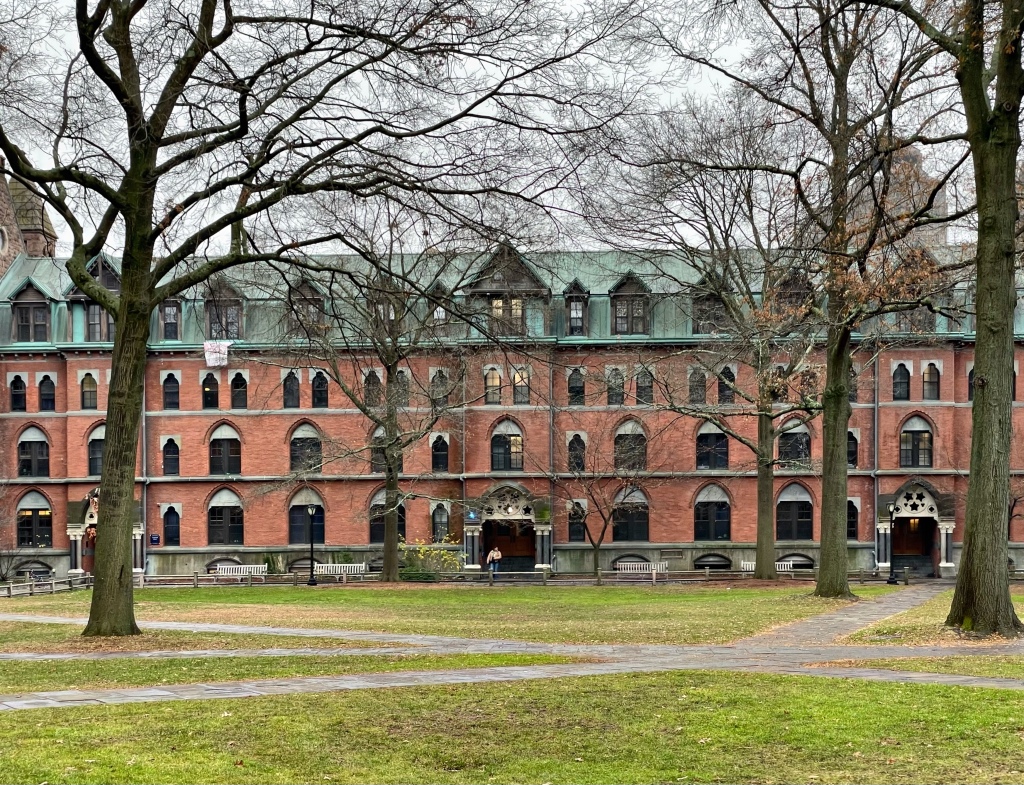
Yale University – Farnam Hall // 1870

Farnam Hall is Yale University’s oldest dormitory still in use. Designed by New York architect Russell Sturgis in a Ruskinian High Victorian Gothic style, Farnam Hall is considered Sturgis’s most important work and was completed in 1871, marking a new direction toward an enclosed campus, shielded off from the surrounding downtown district of New Haven. Named for Henry Farnam, its construction required the removal of the Second President’s House and a section of the Yale Fence, which was met with some trepidation. The red brick, four-story building originally consisted of twenty suites and ten common rooms on each floor. Sturgis, who was influenced by John Ruskin’s ideals put forward in his Seven Lamps of Architecture, used a variety of brick and stone on the facade all with hand carved detailing. Farnam Hall was renovated in 1977 by architect Edward Larrabee Barnes and today serves as a dormitory for first-year students belonging to Yale’s Jonathan Edwards College.