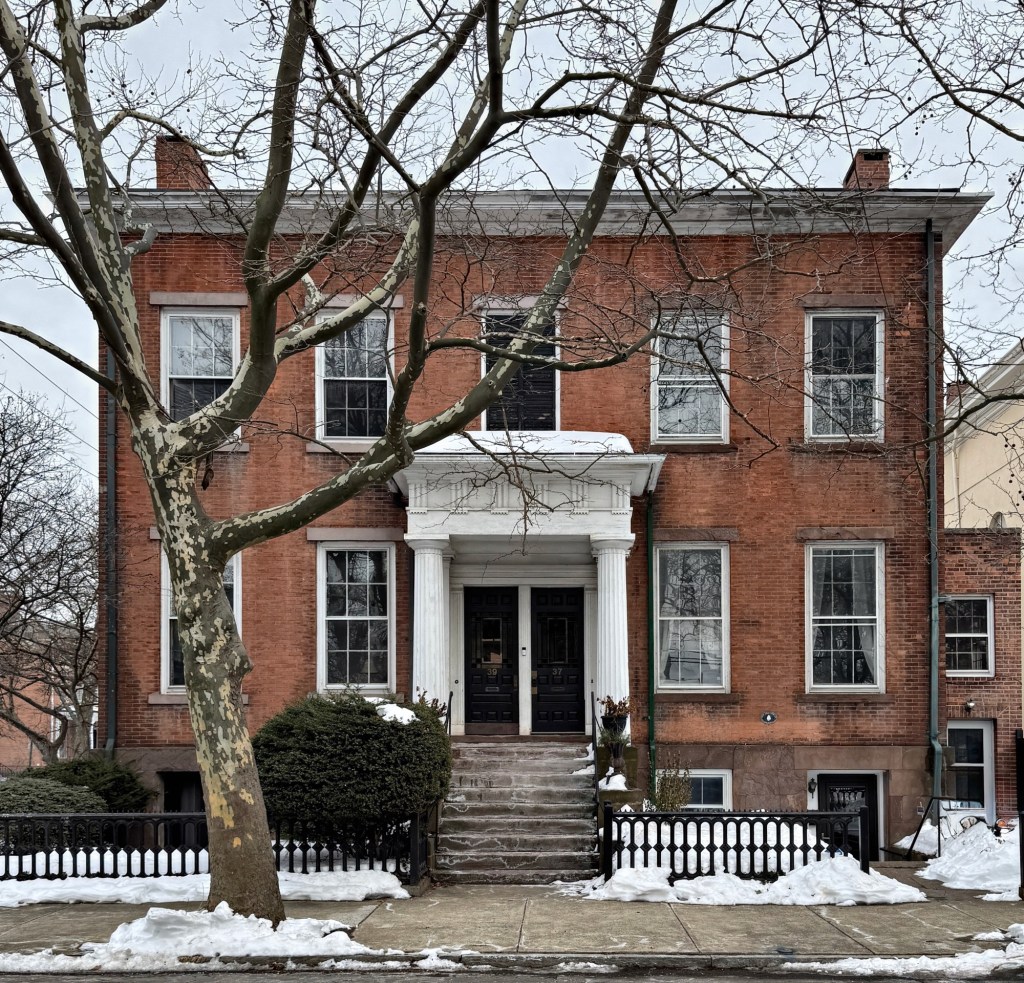
Mayor Robertson House // 1836

This large, brick, Greek Revival style residence sits on the corner of Wooster Place and Greene Street in New Haven’s iconic Wooster Square neighborhood, and stands as an important example of the style along with its significance of its early owner, who became a prominent local politician. In 1836, Dr. John Brownlee Robertson (1809-1892) married a second time to Mabel Heaton, following the death of his first wife, Mary, a year prior. Mabel’s father Abram Heaton, was an early investor who helped develop Wooster Square into the high-quality neighborhood in the early-mid 19th century, and upon this prominent corner lot, had this residence built for his newlywed daughter and son-in-law. The five-bay, two-story house features its original fluted column portico and a shallow hipped roof and was converted to a two-family around the turn of the 20th century.
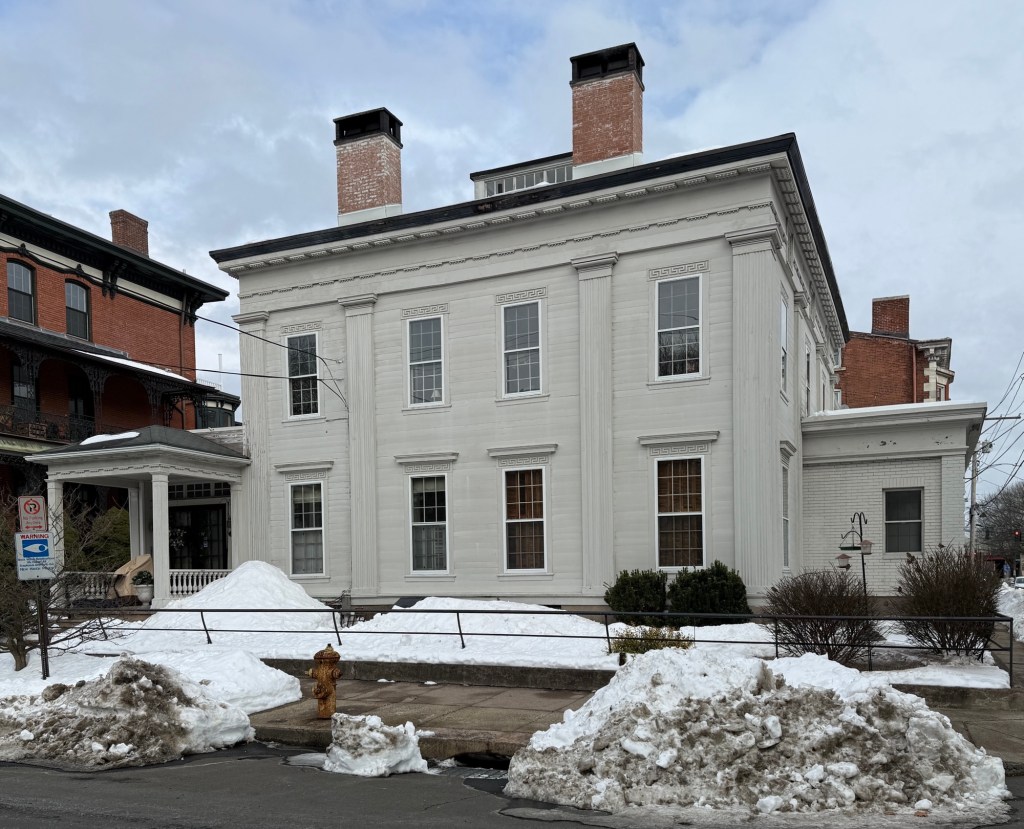
Elliott-Russo House // c.1835

Located at the corner of Wooster Place and Chapel Street in the iconic Wooster Square neighborhood of New Haven, this early Greek Revival style house is a physical landmark showcasing the evolution of the neighborhood in the 19th and 20th centuries. The residence was built around 1835 either for or purchased early on by Matthew Griswold Elliott (1805-1892), a businessman who later engaged in politics and became Vice President of the New Haven Savings Bank and a director of the New York and Hartford Railroad. In 1890, the property was purchased by Paulo “Paul” Russo, an Italian immigrant who was born in 1859, in Viggiano, Italy. His family moved to New York in 1869 and then New Haven in 1872. Paulo opened a small market in New Haven which became the first Italian-owned business in the state of Connecticut. In 1893, Russo became the first Italian to graduate from Yale Law School and he helped foster and grow the local Italian-American community around Wooster Square. After Paul Russo, Michael D’Onofrio, also of Italian descent, purchased the home and along with his wife, brothers, and friends, D’Onofrio transformed the building into a funeral home for over a decade before the house was converted to condominiums. The Elliott-Russo House is a landmark example of a hipped-roof, Greek Revival style residence with smooth flushboard siding, pilasters dividing the bays, and unique Greek meander motifs in the window lintels.

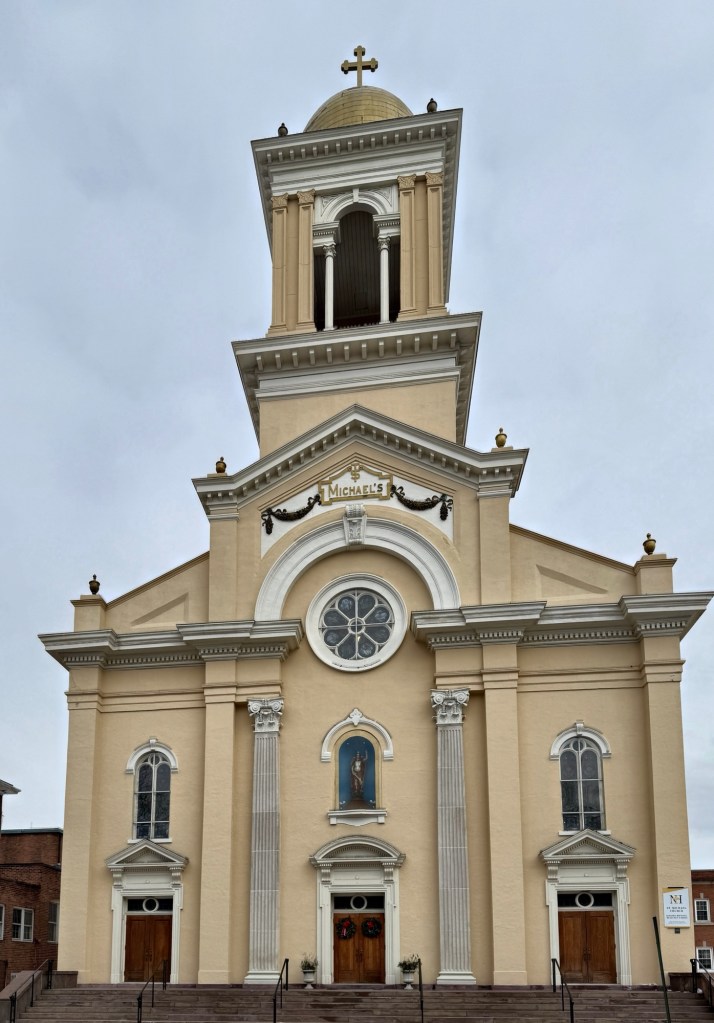
St. Michael’s Roman Catholic Church // 1904

St. Michael’s Roman Catholic Church in Wooster Square, New Haven, Connecticut, was established in 1889 to serve a burgeoning community of Italian immigrants and is said to be the oldest Italian Catholic church in the state. New Haven’s census of 1870 listed just ten Italian residents and by 1900, the census listed more than 5,000 Italian-born residents. Most of these Italian immigrants were drawn to New Haven for employment in the growing industrial and railroad industries and the proximity to New York, where many arriving immigrants passed through. New Haven’s Italian community centered around Wooster Square, where many today know all about the many Italian groceries and nationally known pizzerias. The Italian Community acquired a c.1855 church here by 1899 and following a fire, rebuilt the church in the current form. The New Haven-based architectural firm of Brown and Von Beren furnished plans for the Italian Renaissance Revival style renovations, which was completed in 1904 with bold central tower and stucco walls, retaining many original Italianate windows. The church has served as an important cultural and institutional landmark in New Haven for over 120 years and the congregation remains active.