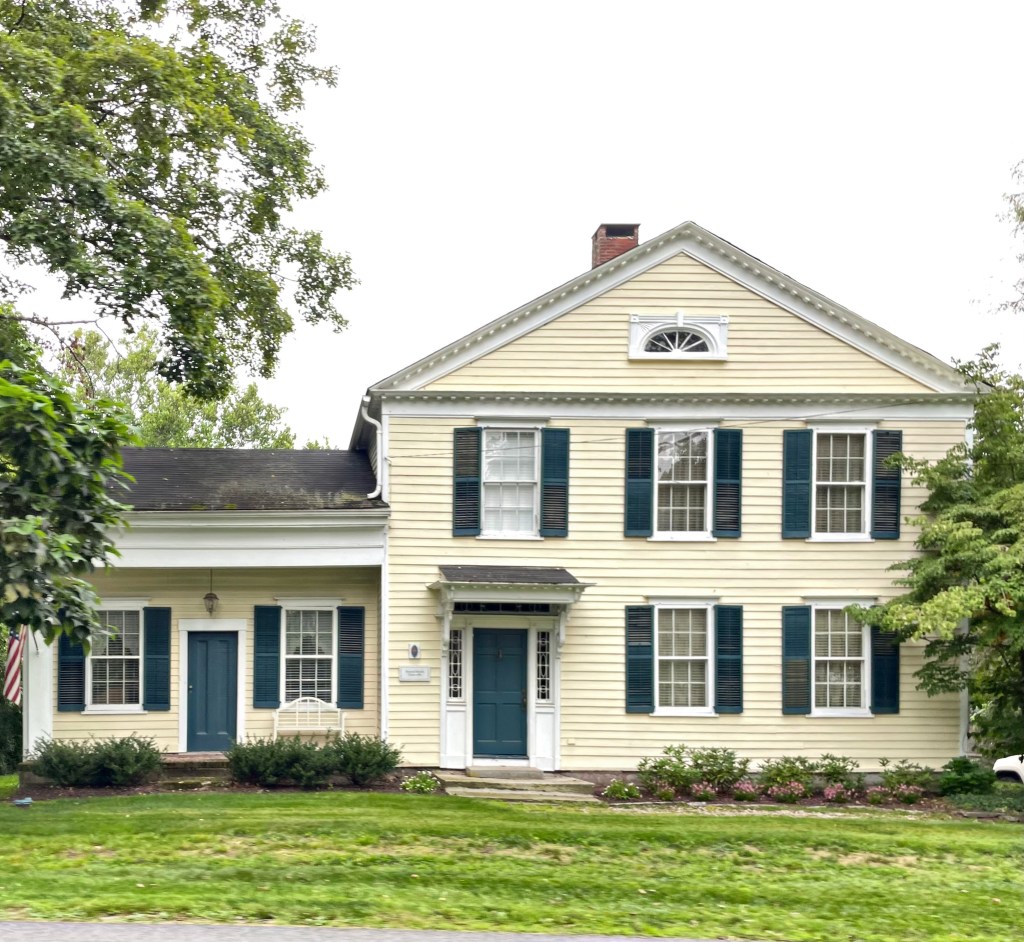
This transitional Federal-Greek Revival style house sits on the main street in South Britain, Southbury, Connecticut. The based on the style, the house was likely built around 1829 for Samuel Smith (1804-1856) who married Caroline Curtiss that year. Federal elements include the entry at the gable end, a pedimented facade embellished with modillions, and a doorway with sidelights and a leaded transom. Some moldings, the six-over-six windows and the simplicity of design are Greek Revival. It is one of the best preserved old houses in this part of Southbury.
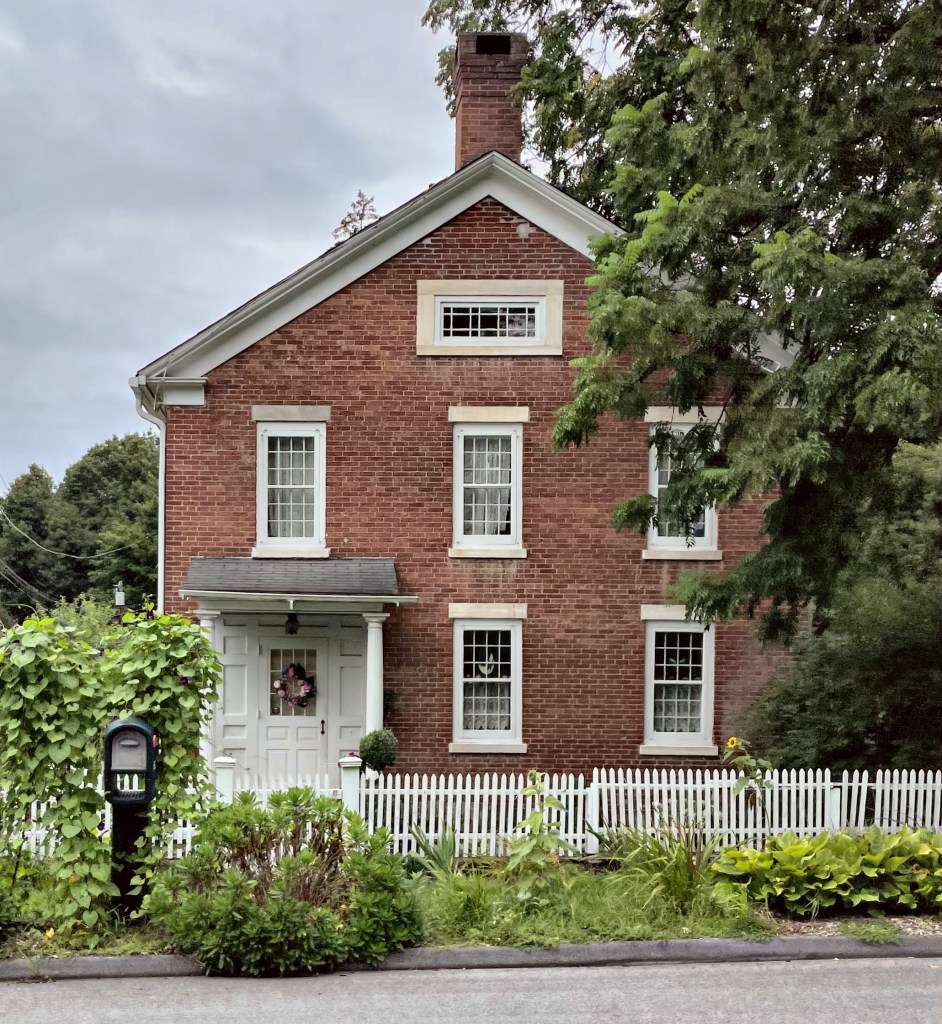
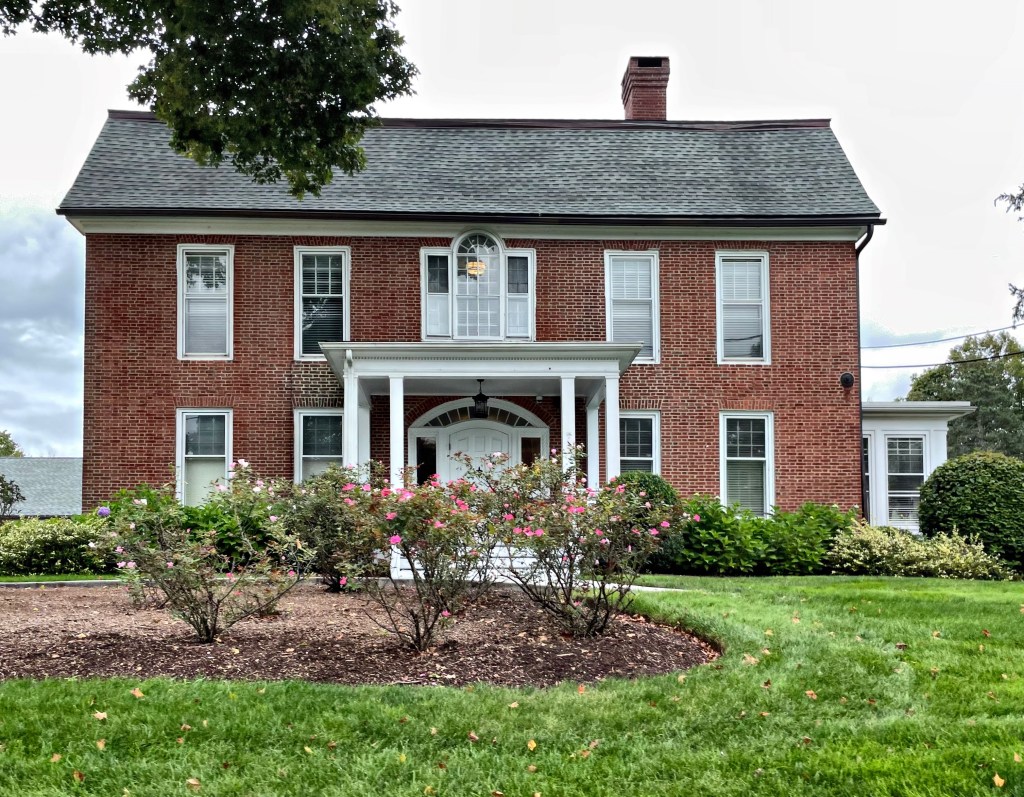
Located a stone’s throw from the Judson Manville House (last post) another uncommon brick Greek Revival style house in South Britain, Connecticut, this house stands out for its outstanding proportions and well-preserved exterior. This residence was built around 1830 for Benjamin Downs on the site of his family’s old property. The simple lines, portico at the entry supported by Ionic columns, and the window in the gable are all typical of the period.
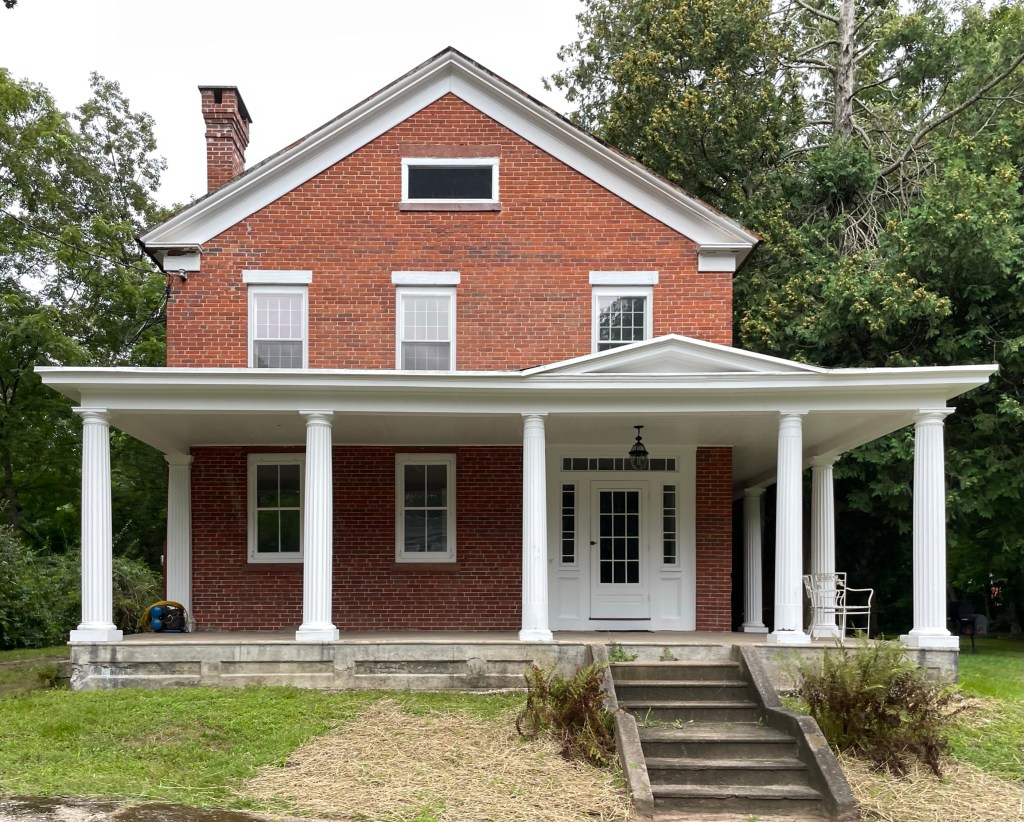
Greek Revival style houses in brick are amazing to find “in the wild”, when I stumble upon them! This example is located in the South Britain village of Southbury, Connecticut. The brick house was built for Judson Manville in 1835 and it was constructed of locally manufactured bricks. Judson operated a hat manufacture next door to this property and it clearly made him some money. The property was eventually acquired by the Hawkins Company at the turn of the 20th century and it was operated as the company offices. It was during this time that the 20th century wrap-around porch was added. It is now a private residence.
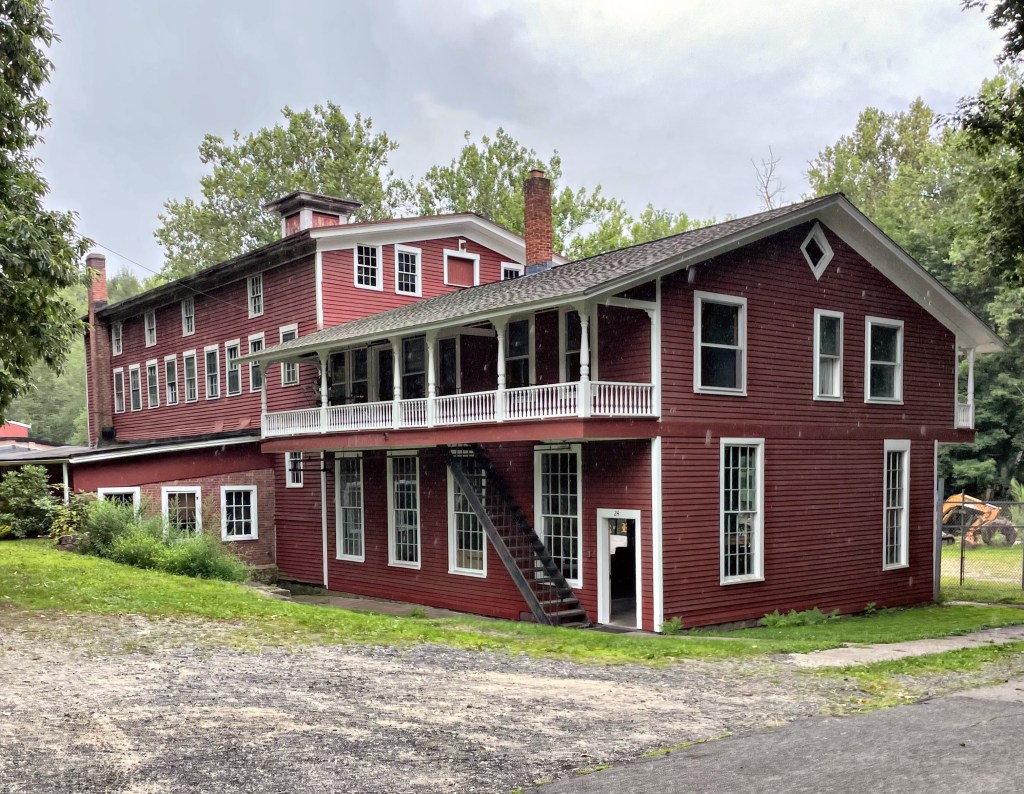
The Hawkins Company was originally organized by Ira L. Hawkins for the manufacture of tacks, buttons, and other metal specialties. The firm appears to have begun operations in Waterbury, Connecticut around 1890 acquired control of the former Blake, Lamb and Company, an animal trap manufacturer established in Waterbury during the mid-19th century. In 1899, Hawkins purchased this four-story woolen mill located in the South Britain section of Southbury that had formerly been operated by the Bradley and Hoyt Company. All of the Hawkins Company’s operations were moved to this plant c. 1900. Production of animal traps quickly became the primary focus of the Hawkins Company and the former Bradley and Hoyt Company mill was enlarged in several phases in order to accommodate demand. The Hawkins Company eventually closed its doors during the late 1960s. The building has been recently painted and maintained well, but it is unclear to me what it is used for, anyone know more?
This historic double-house in South Britain village of Southbury, Connecticut was reportedly built around 1752 by Zephania Clark with early residents being an M. M. Canfield and C. Muirhill (both possible renters). The house stands out as a rare example of a double-house from this period in a remote/rural section of town. A later owner, Deacon Mitchell deeded the property to two of his sons, who lived side-by-side in mirror residences. The property was likely “modernized” in the Federal period by Mitchell with the paired chimneys, Federal style entry with sidelights, portico, and tripartite window above the central entrance. It is presently covered in aluminum siding – which is likely preserving the clapboard siding and trim underneath – and a metal shingle roof.
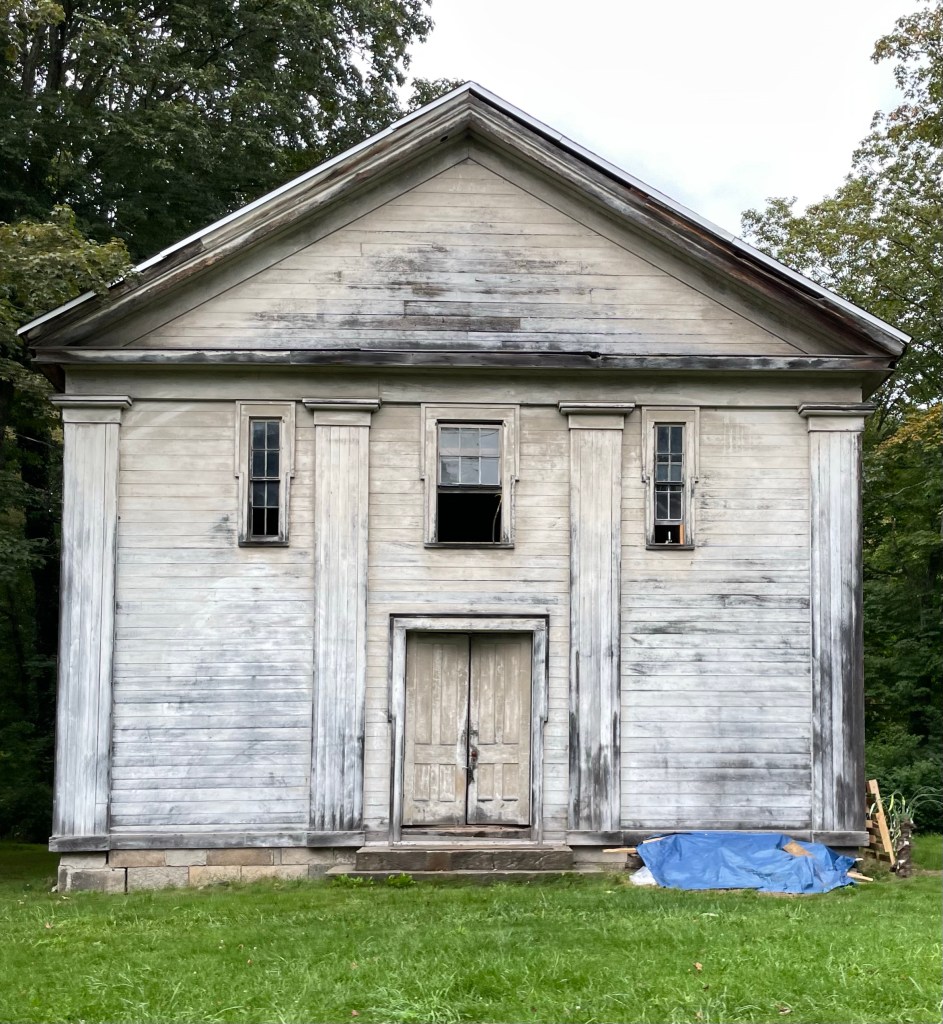
Constructed in 1839 by the Methodist Society of South Britain, Connecticut, this dilapidated old church has classic Greek Revival features including a flush sided facade divided into bays by Doric pilasters, a central double-leaf four-panel door, and high narrow windows. The church sits in the South Britain National Register District, which sadly does not provide any tangible protections for the building, which has been decaying for years. The square belfry was removed (or collapsed) a couple years ago and I would imagine there is some water damage from openings in the roof. What would you like to see this old church converted into?
The Southbury Training School occupies about 1,500 acres of land in Southbury, Connecticut comprised of two major sections: a self-sustaining 400-acre institutional campus and its contiguous 1,100-acre farm complex. Planning for the Southbury Training School began in 1935 at the height of the Great Depression. The State needed to provide housing and services for 1,200 residents on the waiting list for the Mansfield Training School, the state’s only facility for the mentally handicapped at that time. Site planning and development were the responsibility of architect Edwin A. Salmon, later Chairman of the NYC Planning Commission, along with A. F. Brinckerhoff, who was hired as the landscape architect. Two buildings of the nearly 100 that comprise the campus stood out to me the most, they are the Roselle School and the Administration Building. Both structures were built in 1940 and are hallmark examples of inter-war Colonial Revival style buildings for institutional use. Both structures have large cupolas at the roof and symmetrical facades with applied wood ornament over the brick. The Roselle School has a recessed entry and the Administration Building is notable for its hipped roof and pilastered façade. In recent decades, the State of Connecticut has been under-funding the complex, leading to lawsuits and concerns statewide. The state has been moving residents and patients to other facilities, likely in order to sell-off or redevelop the campus in the future. This is one to watch out for!
Formerly known as “Churaevka,” the community known today as Russian Village in Southbury, Connecticut, was established in 1925 as an artistic community for Russians who fled to America after the Russian Revolution of 1917. The village was created by two Russian writers, Count Ilya Tolstoy, the son of Leo Tolstoy (the author of War and Peace and Anna Karenina), and the famous Siberian novelist George Grebenstchikoff. Although Tolstoy was first to discover the area while visiting his translator in Southbury, it was Grebenstchikoff who dreamed of establishing a cultural center and planned to create a rural community of cottages where Russian writers, artists, musicians and scientists could live and flourish statestide. The village was named after a mythical Siberian village mentioned in the works of Grebenstchikoff and the centerpiece is this chapel, St. Sergius Chapel, which was built in 1932-33 from plans by Nicholas Roerich. The small square-plan chapel was likely built of stone gathered from the neighborhood.
Built for Revolutionary War veteran and local lawyer Benjamin Stiles, this stunning Georgian mansion is unique for its use of brick in construction, a material not too common for some of Southbury’s earliest homes. Local tradition holds that a French engineer in General Rochambeau’s army provided assistance in designing the building, using the metric system, likely on the march from Newport to Yorktown. Benjamin’s father was one of the original settlers who migrated from present-day Stratford to the un-developed Southbury. The hip-on-hip roof with pedimented dormers is really a stunner, and unique for the town!
Sherman Hinman (1752-1793) was born in present-day Southbury, Connecticut as the fourth and youngest child of Colonel Benjamin Hinman and Mary Stiles Hinman. He attended Yale and later married in 1777, his third cousin, Molly, youngest daughter of Captain Timothy and Emma (Preston) Hinman, of Southbury, and settled as a merchant-farmer in his native town of Southbury. He immediately began work on this large, brick mansion to not only impress his new wife, but all the people in town who had not yet seen such a stately mansion in town. He was said to have lived in “dashing splendor” for a few years but was soon reduced to comparative poverty by his extravagance. He died in 1793. The house is most famous for its association with Samuel G. Goodrich, owner from 1857 to 1860, who authored many popular children’s books and textbooks under the name of Peter Parley. By the turn of the 20th century, the expansive property was occupied by the German Lutheran Home for the Aged (now the Lutheran Home of Southbury) with many additions added to the building.



 Buildings of New England