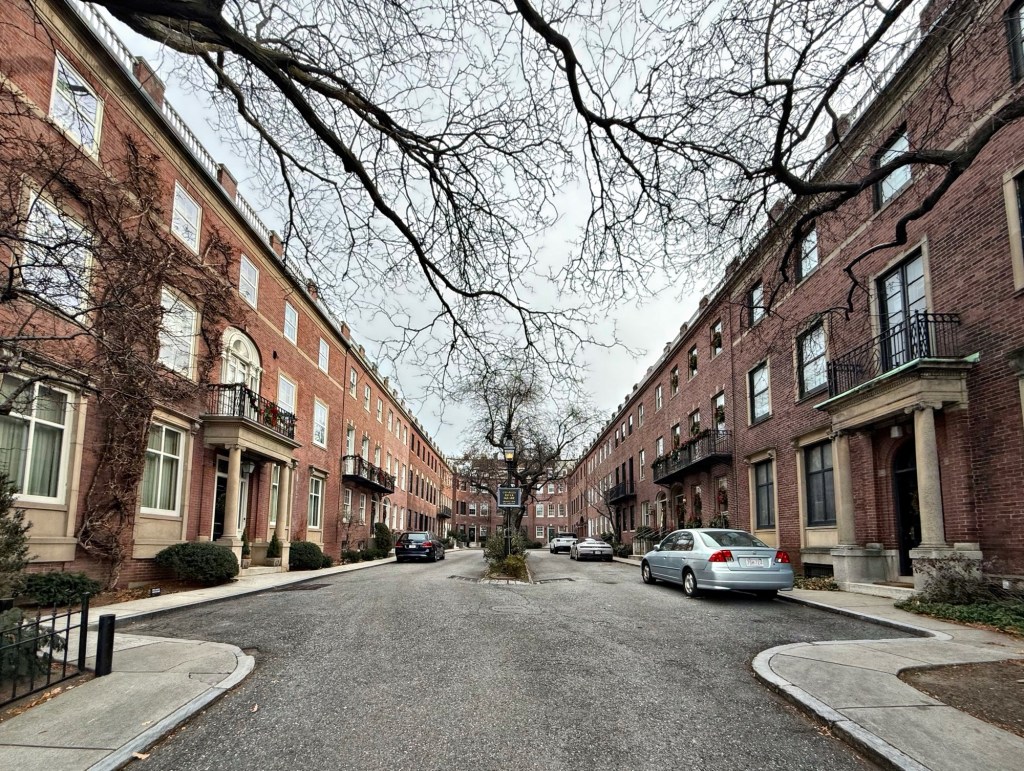
Charles River Square, a delightful development of red brick and cast-stone Colonial Revival townhomes in the Beacon Hill Flat, was developed in 1910 from plans by Boston architect, Frank A. Bourne. The development consists of a total of 21 residences, 19 of which front on the courtyard that is known as Charles River Square. The development is accessed off Charles River Road (which was made a busy thoroughfare in the 1950s and renamed Storrow Drive) and through a Palladianesque passageway off Revere Street. Along with its neighbor to the north, West Hill Place (1916), another group of attached townhouses organized around a courtyard built years later, its layout is a departure from the previous approach to urban planning, resembling the atmosphere of an old London street or mews. Charles River Square remains one of the most desirable developments in the exclusive Beacon Hill neighborhood.

 Buildings of New England
I can’t begin to tell you how much I appreciate your work!!!
LikeLiked by 1 person
Thank you! Feel free to share with friends/family who’d be interested! I also take donations to feature buildings or towns sooner than planned 🙂
LikeLike
The 1910 construction date puts this right in the era when Boston builders were transitioning from lime mortar to Portland cement — you’ll often find both in the same foundation depending on whether repairs were done over the decades.
These Beacon Hill foundations are almost always brick or stone below grade, and the biggest enemy isn’t age, it’s the water table. The Back Bay and Beacon Hill sit on fill, so hydrostatic pressure against those old masonry walls is constant.
When we work on pre-1920 foundations in Boston, repointing alone isn’t enough — you need to address drainage and waterproofing on the exterior, or the mortar joints just deteriorate again within a few years. Fascinating that 21 units share a courtyard — shared foundation walls between units make structural repair on these a real coordination challenge.
LikeLiked by 1 person