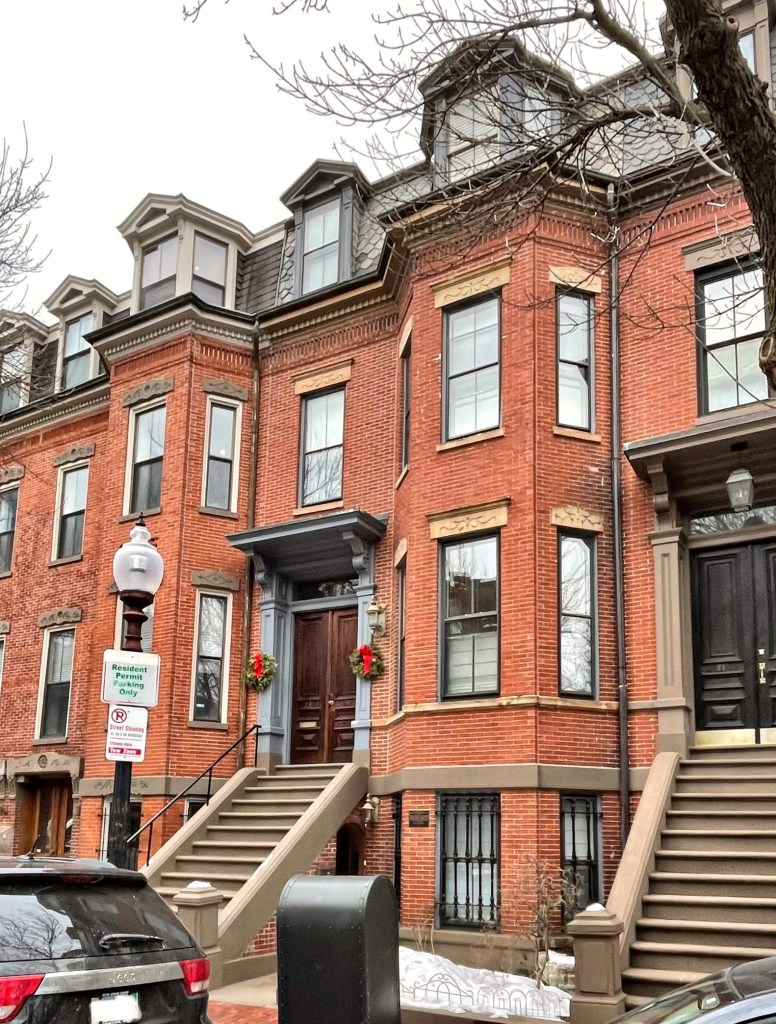
Susie King Taylor House // c.1874

The rowhouse at 23 Holyoke Street in the South End neighborhood of Boston is an excellent architectural specimen, but is best known for one of its residents, Susie King Taylor. Susie King Taylor (1848-1912) was born into slavery near Savannah, Georgia; and despite Georgia’s harsh laws against the formal education the enslaved, she attended two secret schools taught by black women. She became free at the age of 14 when she escaped onto a Union-owned boat off the coast of the then Confederate occupied Fort Pulaski on the islands off the coast of South Carolina. She soon attached herself to the First South Carolina Volunteers, the first black regiment in the US Army. She served under the Union Army in various capacities: officially as a “laundress” but in reality a nurse, caretaker, educator, and showcased such strength and courage as a young woman. Eventually, Taylor married Sergeant Edward King in 1862, and together they remained with the unit until it was mustered out of service in 1866. It is likely at that time that she met Harriet Tubman, who served as a nurse, scout, and spy for the 1st South Carolina Volunteers. Postwar, the Kings moved to Savannah, Georgia. She hoped to continue her teaching career and opened a private school for the children of freedmen. Unfortunately, her husband died the same year, and a public school opening caused her private school to fail. By 1868, Taylor was forced to find work as a domestic servant. She moved to Boston in 1872 where she married Russell Taylor in 1879. She devoted much of the rest of her life to work with the Woman’s Relief Corps, a national organization for female Civil War veterans. She lived at this home on Holyoke for much of her time in Boston, likely re-connecting with her old friend Harriet Tubman when she lived on the street.
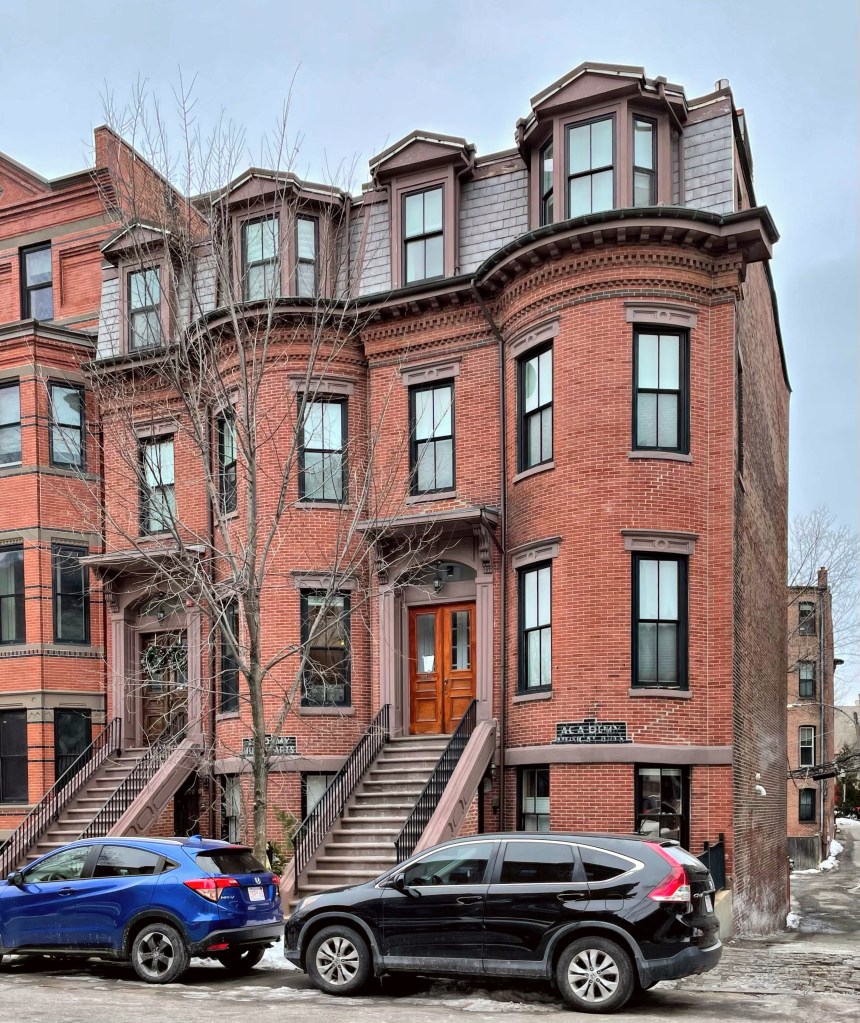
Boston Academy of Musical Arts // c.1874

These paired rowhouses at 1-3 Claremont Park in the South End were built by 1874 as speculative housing. Between 1922 and 1928, 3 Claremont Park was purchased by a twenty-something year old Anna Bobbitt Gardner, and she opened a studio in the home, teaching Bostonians how to play the piano. In 1932, Anna Bobbitt Gardner (1901-97) became the first African American women to be awarded a bachelor’s degree from the New England Conservatory of Music. Her studio, Pianoforte Studio bloomed in popularity among Black and White Bostonians, and she rebranded the school as the Boston Academy of Musical Arts, adding four more studios in the area. She would later acquire the adjacent house at 1 Claremont Park and expanded the school. She went on to manage ‘Colored American Nights’, featuring African American musicians at Boston Symphony Hall, and produced local radio and television programs to boost the African American audience in classical music. After her death in 1997, the New England Conservatory has annually granted a musician the Anna Bobbitt Gardner Lifetime Achievement Award, showing her impact on the arts in Boston.

Wally’s Cafe Jazz Club // 1947

Historically, the South End neighborhood of Boston was populated by middle- to upper-class white residents until the late 19th century, when financial crises paired with new, modern housing (constructed in the Back Bay West and Allston areas) shifted that population elsewhere. West Indian immigrants and Black Bostonians moved to the relatively new neighborhood and many formerly single-family homes were converted to tenements or multi-family uses. From this, a vibrant Black community flourished, bringing black-owned businesses like restaurants, banks and jazz clubs. The area’s famous jazz clubs boomed during the forties and fifties, yet, many have disappeared over the years with the gentrification and development in the neighborhood. Wally’s Cafe Jazz Club on Massachusetts Avenue, was founded by Joseph L. Walcott. Mr. Walcott “Wally” was a Barbadian who immigrated to America in 1910, eventually settling in Boston. He worked many jobs and eventually saved up enough by 1947, purchasing an old rowhome and converting the space into a club. Wally was believed to be the first African American to own a nightclub in New England. He brought famed jazz musicians to Boston, and they played at this iconic venue for decades until 1979, when the venue shifted across the street to this building. With the jazz movement waning in popularity, Wally maintained his commitment to the music by featuring young musicians who were attending prominent academic institutions such as Berklee College of Music and the New England Conservatory of Music. Mr. Walcott cleverly decided to hire these young music students and mixed them with seasoned professionals who were veterans of the Big Band era. This mix of talent was special, and the format enabled Mr. Walcott to continue to serve the jazz loving audiences of New England. After Wally’s death in 1998 at age 101, his three children took over the bar, and today Wally’s Cafe is still owned and managed by his family, though presently closed due to COVID-19 restrictions.