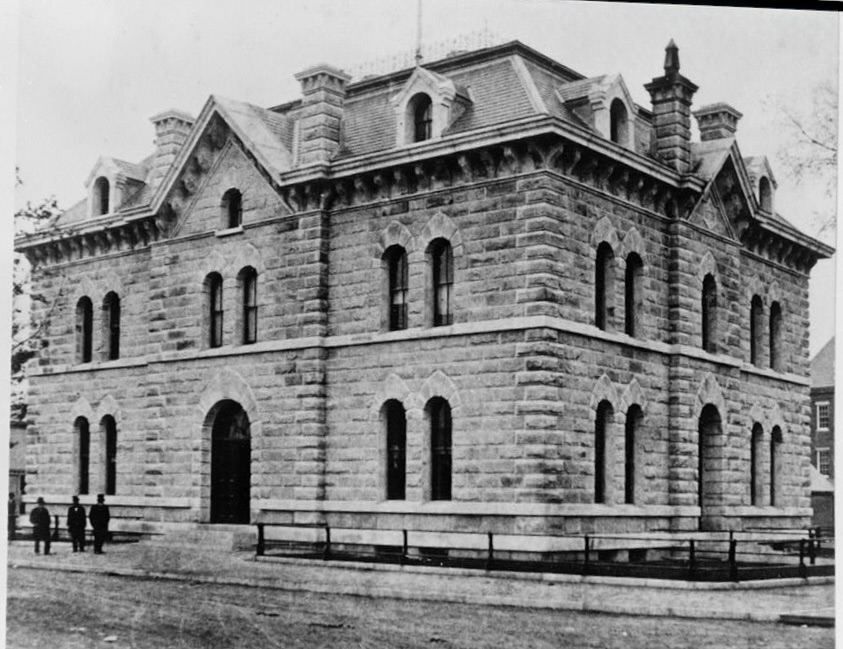
Rockland Custom House & Post Office // 1873-1969

Photo included in HABS documentation

It saddens me to see photos and learn about some of the amazing buildings demolished in the name of “progress”; it is even more disappointing when said building is replaced by a surface parking lot (over 50 years later)! This great stone building was built in Rockland, Maine, in 1876 as the town’s post office and custom house by the Federal government. Relatively unknown architect Alfred B. Mullett is credited with the design as he served from 1866 to 1874 as Supervising Architect of the United States Treasury Department. The building can be classified as Italianate-Second Empire in style and is constructed of massive, rough-faced granite block walls with a shallow mansard roof above. The building was offered for sale by the U.S. Government in 1967, likely due to the upkeep costs and a shrinking local population with the dependency on maritime trade diminished. The building was ultimately razed in late 1969, with a new, uninspiring, post office built next door to this site.
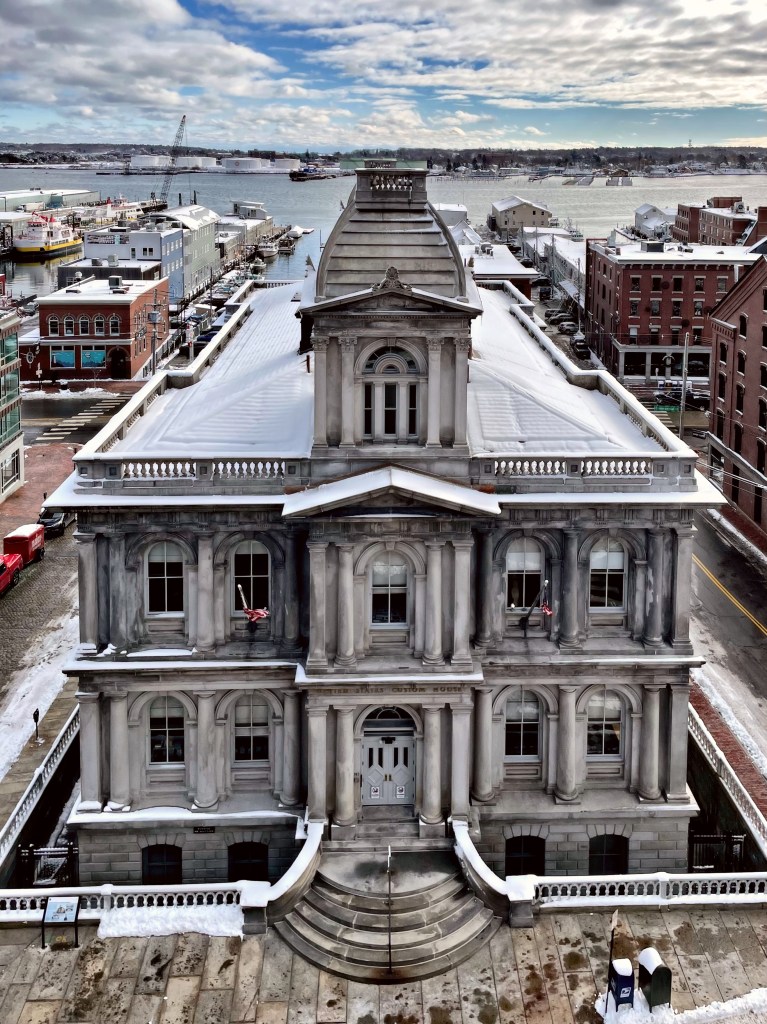
Portland Custom House // 1868

Probably my favorite building in Portland, Maine is the former Custom House building, an imposing granite building located a stone’s throw from the Portland Harbor. It was built to accommodate the city’s growing customs business, which, by 1866, was collecting $900,000 annually in customs duties—making Portland one of the most significant seaports in the country. The building is typical of the notable designs completed under the direction of Alfred B. Mullett, Supervising Architect of the Treasury from 1865 to 1874. Constructed between 1867 and 1872 (due to delays in obtaining granite for the upper stories) the U.S. Custom House combines elements of the Second Empire and Renaissance Revival styles and is one of the best preserved custom houses in New England. The interior custom hall is especially remarkable.

Barnstable Customs House – Coast Guard Heritage Museum // 1855

The former United States Customs House (now the Coast Guard Heritage Museum) in Barnstable is located at the eastern end of the village, and across the street from the Unitarian Church (featured previously). The building was constructed in 1855, likely under the supervision of Ammi B. Young, who was acting as the first Supervising Architect of the U.S. Treasury Department. The Seventh Customs District was established by Congress in 1789, and encompassed Barnstable County except Falmouth, and it ranked fourth in revenue among the state’s customs districts. By 1850, 91,102 tons of materials had been reported through the district, so the need for a new customs house was clear. The Customs House is said to have been the first ‘fireproof’ building constructed on Cape Cod, in contrast to the traditional wood-frame and shingled dwellings found there. This district merged with Boston in 1913, and the building became a local Post Office until 1958. It was converted to a museum and named after Donald G. Trayser. It was renamed the Coast Guard Heritage Museum in 2005.

Providence Custom House // 1855

The Providence Custom House was designed by the first Supervising Architect of the U.S. Treasury Department Ammi B. Young in an academic Italianate style. Built between 1855-1857, the structure was constructed of the iconic granite from quarries in Quincy, Massachusetts. It is a three-story building, topped by a hip roof and metal dome (hard to photograph), with strong quoined corners and cornices between the levels. After completion it housed the city’s main post office, Federal District Court, District Attorney, Internal Revenue Service, Collector of Customs, and Steamboat Inspector. The space was outgrown, and a modern Federal building was constructed a few streets away, though they retained offices in this building. According to Wikipedia, after the Federal Government vacated the structure in 1989, it was considered by a variety of businesses for occupation, including a restaurant, a facility for homeless persons, and offices. The building was bought by the State of Rhode Island and converted to office space for the State Courts System. After extensive renovation at a cost of $550,000, the building was opened by the state in 1992 as the John E. Fogarty Judicial Complex.

Louis T. Graves Memorial Library // 1813

What is known today as the public library of Kennebunkport, the Louis T. Graves Memorial Library was not always used for books and learning. Built in 1813 as a branch office of the Kennebunk National Bank, the brick structure was valuable as a local bank for the growing port neighborhood. By 1831, the Kennebunk Bank’s charter was revoked and they sold their branch location to the U.S. Government as a Customs House (the second floor was already partially occupied as a Customs House). By the end of the 19th century, the second floor was leased out to the Kennebunkport Public Library. The Customs District was eliminated in 1913, and by 1920, the building was acquired by Mr. and Mrs. Abbott Graves, who purchased the property at auction for $1,350., the couple lived just a couple blocks away in a rare Prairie style home. In 1921, the Graves family deeded the property to the Library Association on the condition that the Library be named in memory of their deceased son Louis T. Graves who valued books all his life.