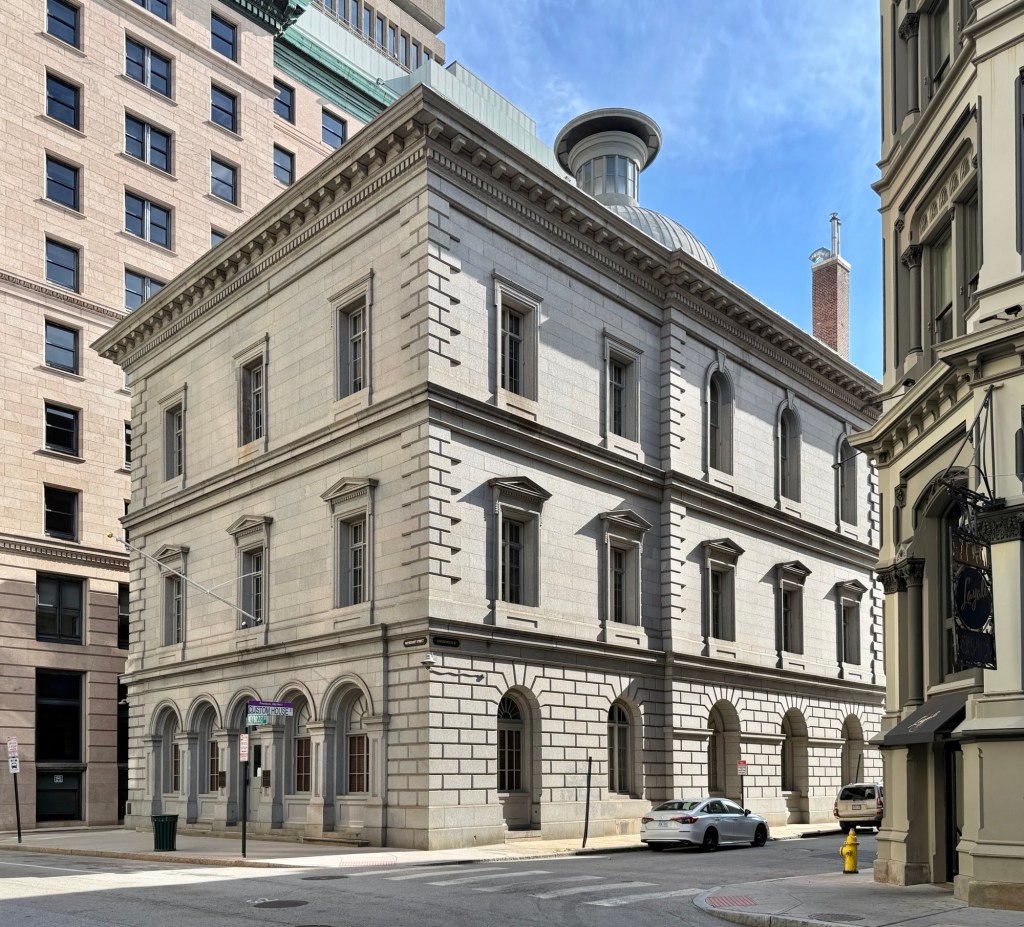
One of the finest buildings in Downtown Providence, the old Custom House and Post Office is a landmark, showcasing how Federal buildings were once well designed and meant to show stability through high-quality design and materials. The stately building was completed in 1857 from plans by architect, Ammi Young, who became the Supervising Architect of the U.S. Treasury Department in 1852. Ammi Young designed a number of notable buildings all over New England, with his finest being the many custom houses and other Federal buildings. For the Providence Custom House and Post Office, he utilized granite from quarries in Quincy, Massachusetts for its walls to show strength, with a hipped roof and metal dome and corner quoins as additional design elements. The building can be classified as a blending of Greek Revival and Italianate styles with the use of both pedimented and arched window treatments and blocky form. The building housed federal offices until November 1909, when a new and larger Federal Building was erected a few blocks away. The Federal Government vacated the structure in 1989 and was ultimately bought by the State of Rhode Island and converted to office space for the State Courts System. After extensive renovation at a cost of $550,000, the building was opened by the state in 1992 as the John E. Fogarty Judicial Complex.


