Van Etten-Dumond “Spy” House // c.1726

One of my favorite houses in Hurley is the Dumond House (also known as the “Spy House”), a pre-Revolutionary stone cottage built in Dutch traditions. The house is one and one-half stories high, and is built of limestone. The limestone walls are of various thickness, from a nearby quarry, with the square ends laid up in mortar made of clay, and pointed with lime mortar outside. The house was built by Jacobus Van Etten (1696-1779) and used as a Guard House during the American Revolution. In 1777, it was famous for housing the convicted British spy, Lt. Daniel Taylor after he was caught carrying a message between British Generals Henry Clinton and John Burgoyne. Lt. Taylor was arrested as a British spy, convicted in court of spying and held in the basement of the Du Mond House as a prisoner. He was hung on October 18, 1777 from a nearby tree. American soldiers encamped in the area were paraded by the body as a warning to any potential British sympathizers. The home was later owned by the Dumond Family. It has been owned by the Kent family since 1933.

Half Moon Tavern – Elmendorf House // c.1710

When Pieter Ostrander settled in Hurley, NY with his family in the late 1600s. Being of Dutch descent, he (and other settlers) built their homes and barns in Dutch traditions. This lot along the village’s main street was acquired by Pieter and inherited by his son, Arent in about 1710, about the time the home is estimated to have been built. It was acquired by the Elmendorf Family by the early 19th century. At that time, the property operated as the Half Moon Tavern, after Petrus Elmendorf purchased it in 1804. The addition to the east (right) was built as a weaving room. The property remained in the Elmendorf family until 2008 (that’s almost 300 years in two families!) It was acquired by the new owner who has been restoring and researching the home ever since. He runs a blog documenting the property’s rich history.

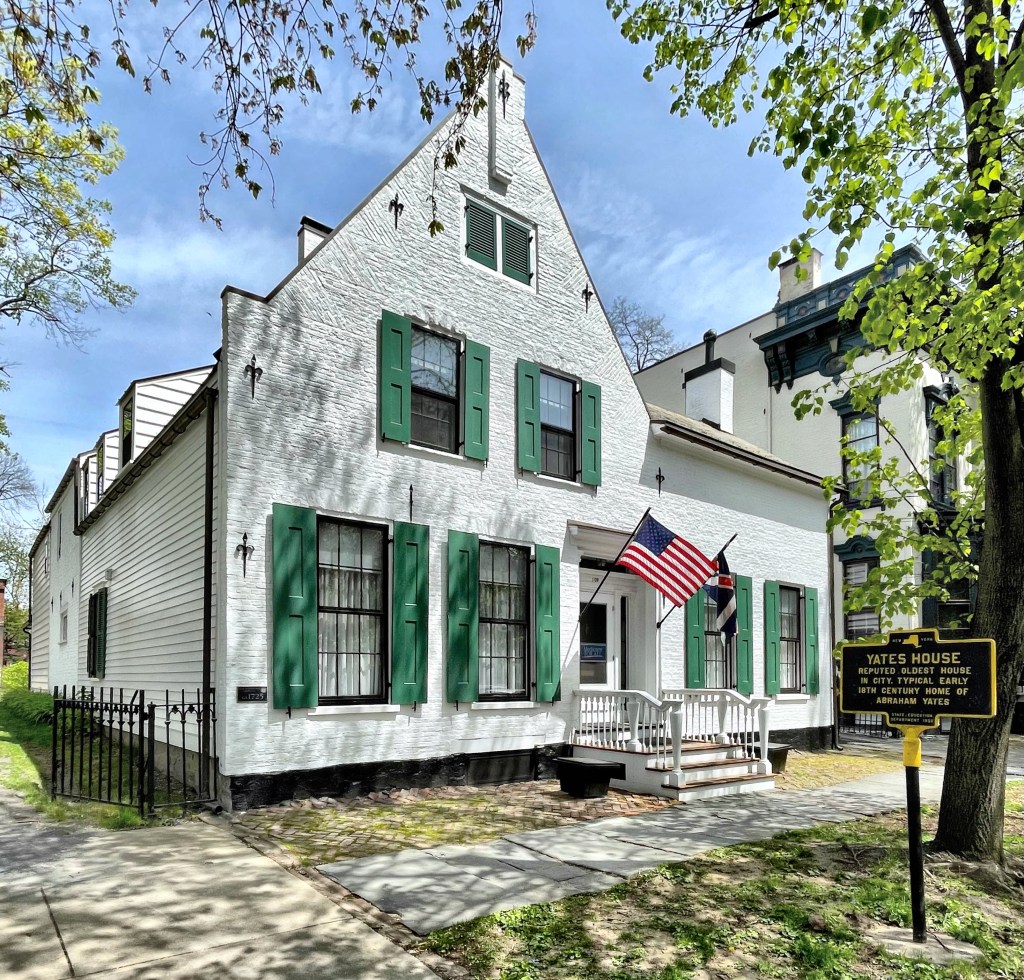
Yates House // 1730

Thought to be the oldest extant home in Schenectady, New York, the Yates House serves as an excellent example of Dutch-inspired architecture found in the days before the founding of the United States of America. The house, believed to have been constructed around 1730, is an example of Dutch Colonial architecture. Dutch Colonial architecture was clearly common in New Netherland, present-day New York. As a contrast with New England, which featured British-inspired Georgian architecture, the homes and buildings found in the New Netherland colony was unapologetically Dutch. The Yates House in Schenectady’s Stockade neighborhood features a Dutch gable end wall facing the street with interesting brickwork.

Dutch House // 1893

Located on the appropriately named Netherlands Road in Brookline, MA, this house was actually designed as a temporary structure as part of the 1893 World’s Fair, also known as the World’s Columbian Exposition or the White City, depicted in the great book, Devil in the White City. The Dutch House was constructed in 1893 by the Van Houten Cocoa Company of the Netherlands, as a display pavilion and cocoa house. It was located at one end of the Manufactures and Liberal Arts Building (the largest building ever constructed at the time). The Dutch House as we know of it today, was greatly inspired in design by the Franeker City Hall (c. 1591) in the Netherlands. While attending the World’s Fair, Captain Charles Brooks Appleton of Brookline be.came so captivated with the structure that after the Fair, he purchased the building and had it dismantled and transported to Brookline. By the early 2000s, much of the amazing carvings on the building had fallen off, until a new homeowner had them all restored from drawings and images of the building, to the iconic landmark we see today.