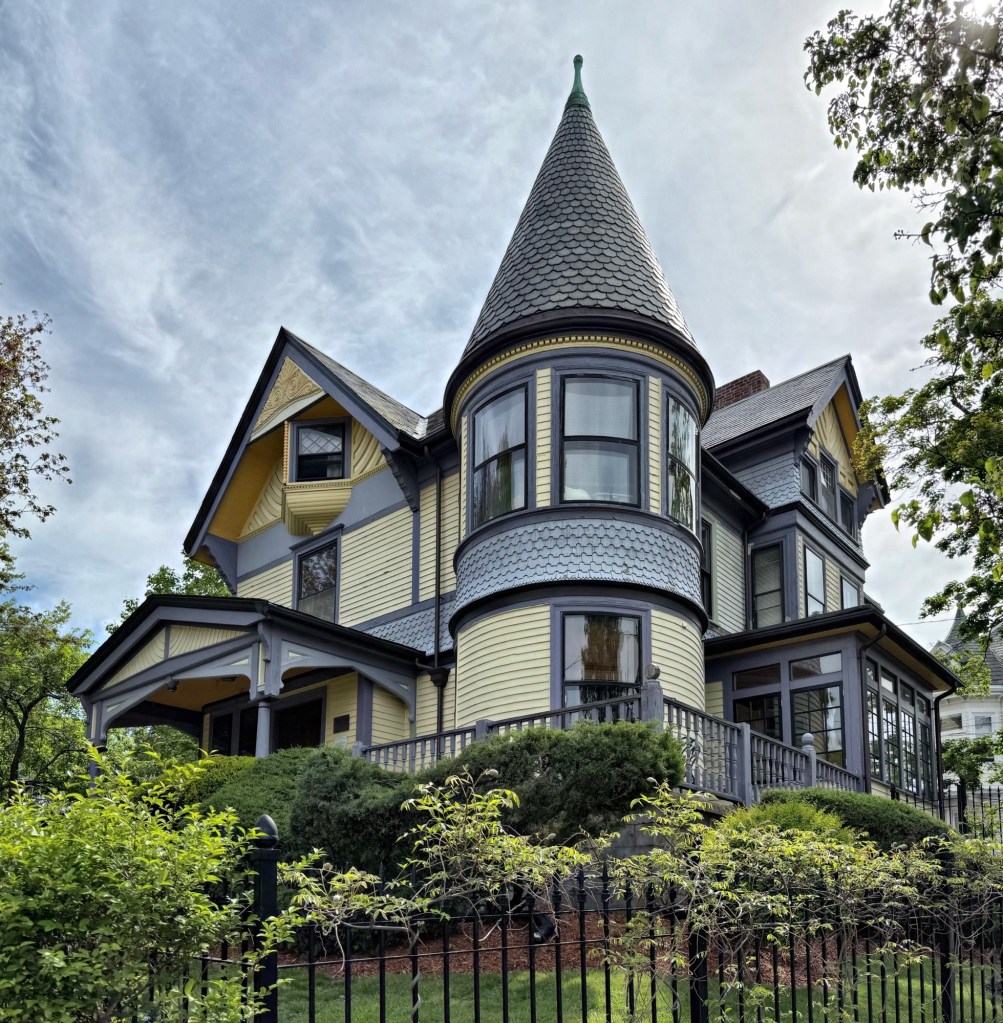
Louville Varanus Niles (1839-1928) was born in Maine and came to Boston in 1860 for the chance to make his fortune. In 1870, he formed a partnership with his two brothers in the provisions business under the name Niles Brothers. The company would later merge with the Boston Packing and Provision Company. Niles moved from Boston to Somerville in 1882, purchasing the Bradshaw estate on Walnut Street. He remained in the house until he decided to redevelop the property, building a number of dwellings on the former estate bounded by Walnut, Boston and Munroe streets. For his own residence, Louville hired the firm of T. B. Blaikie and Son, who designed this beautiful example of a Queen Anne style house in 1887. The building has irregular massing, with numerous gables and rooflines. There is a prominent two-story, rounded tower at the corner, capped with a conical roof, and applied ornament in the gable ends, all common features in this style in the Victorian period. The owners have painted the house to accent the many unique details found here.
 Buildings of New England