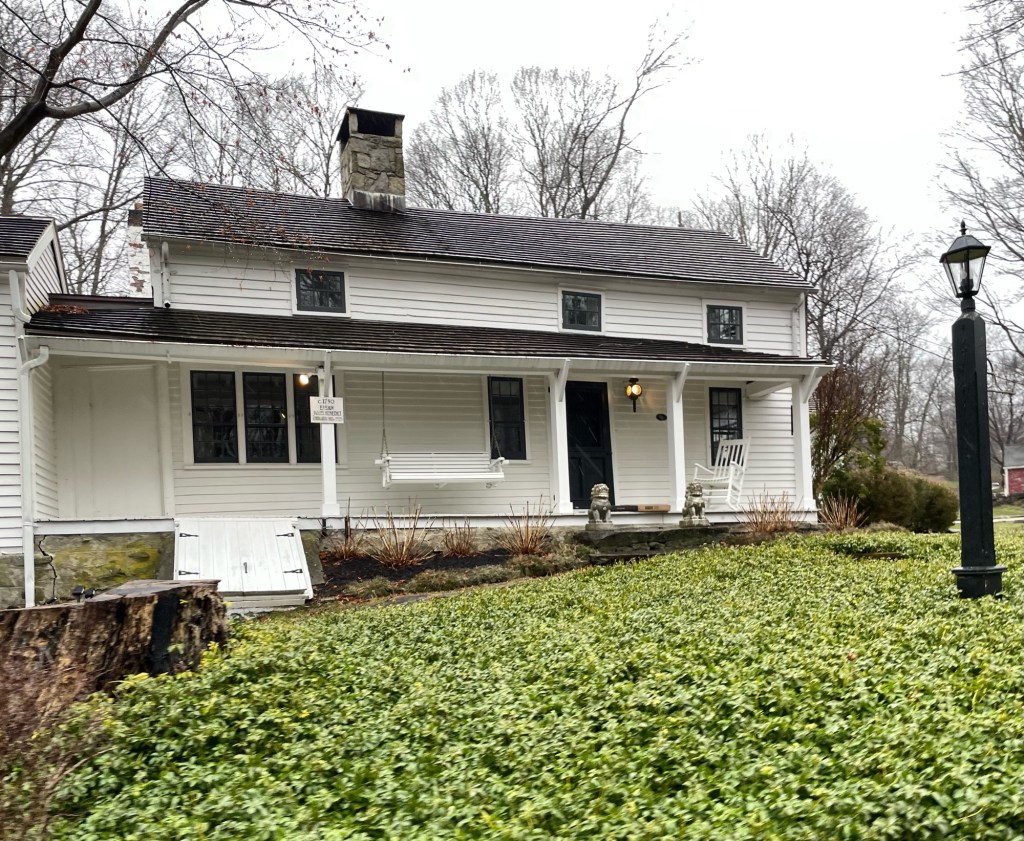
Benedict House // c.1740

The Benedict House in Ridgefield, Connecticut is a stunning Colonial-era cottage that was once the home of a cobbler, who had his shop on the property. The Benedict family, headed by James Benedict, Sr., were original proprietor settlers of Ridgefield. This house and shop have been attributed to James’ son James Benedict (1685-1762), who owned the land and was a shoemaker and deacon of the Congregational Church. Ensign Benedict was also a fence viewer, a term new to me. Fence viewers had power to make and enforce rulings regarding escaped or trespassing livestock, the location of fences, and, above all, maintenance of fences. With fences so crucial to keeping livestock where it belonged, loose boards and rotting posts were big concerns. The fence viewer could even compel a property owner to pay for needed maintenance or repair conducted by a neighbor if he or she failed to keep up their fence properly. The property left Benedict family ownership in 1848, and it was later extensively restored by renowned architect Cass Gilbert, who bought the property in 1920. Cass Gilbert also restored a few other Colonial-era houses in town. It was later the home of Robert and Mildred Wohlforth, both writers of note and six-decade residents of Ridgefield.

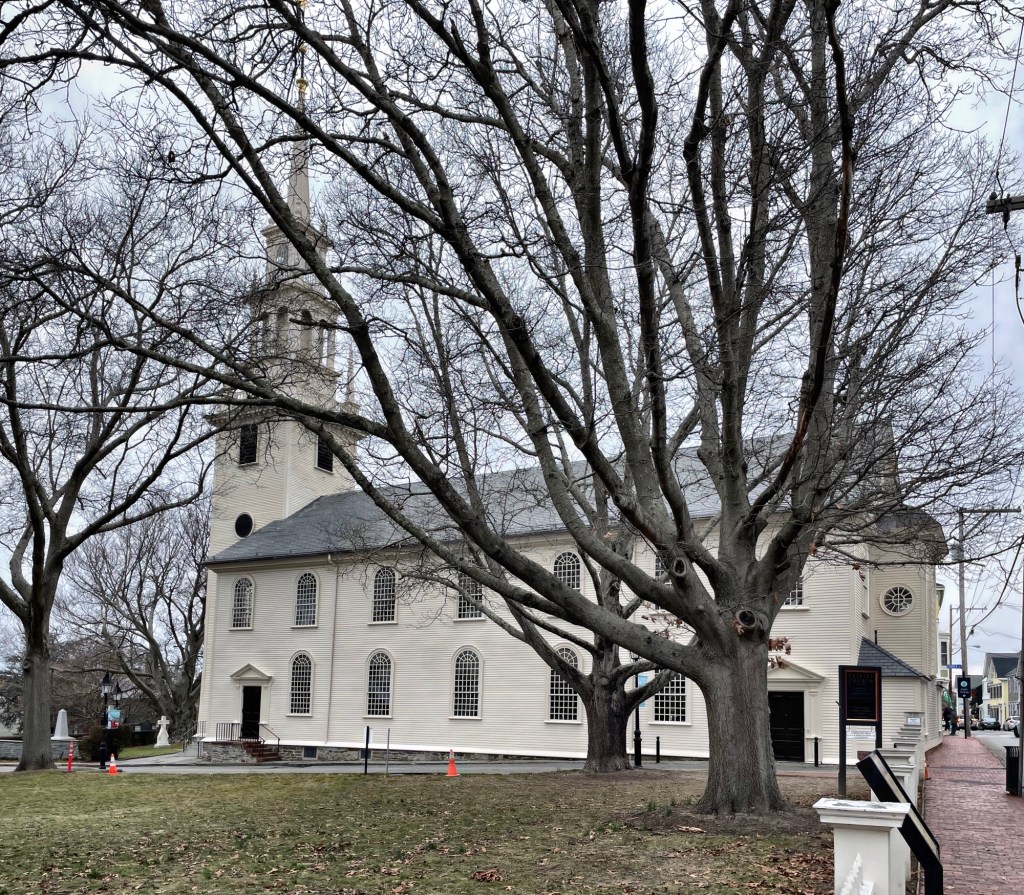
Trinity Church, Newport // 1725

Trinity Church in Newport, Rhode Island is one of the largest extant 18th century churches in New England, and founded in 1698, it is the oldest Episcopal parish in the state. Built in 1725, the Georgian style church was built just as the influence of Sir Christopher Wren’s churches reached the colonies, about a quarter century after his work had come to dominate ecclesiastical design in London. Trinity is the second major church built in the original colonies influenced by Wren, following Old North Church in Boston’s North End (1723). Stylistically, both churches are similar, with the notable difference in material (Old North in brick and Trinity Church in clapboard). Local builder Richard Munday, is credited with the design of Trinity Church. By the late 19th and early 20th centuries, many members of the Vanderbilt family and other wealthy residents attended sermons here when summering in Newport. When Newport was undergoing Urban Renewal in the mid-20th century, Queen Anne Square (the park which fronts the church) was created in the 1970s to establish a town common in a city which had never truly had one. “Early” buildings in the area to be bulldozed for the common were moved to other sites to enhance the “colonial” rehabilitation of the area around the harbor, making this one of the few examples of urban renewal having a positive impact on a city.

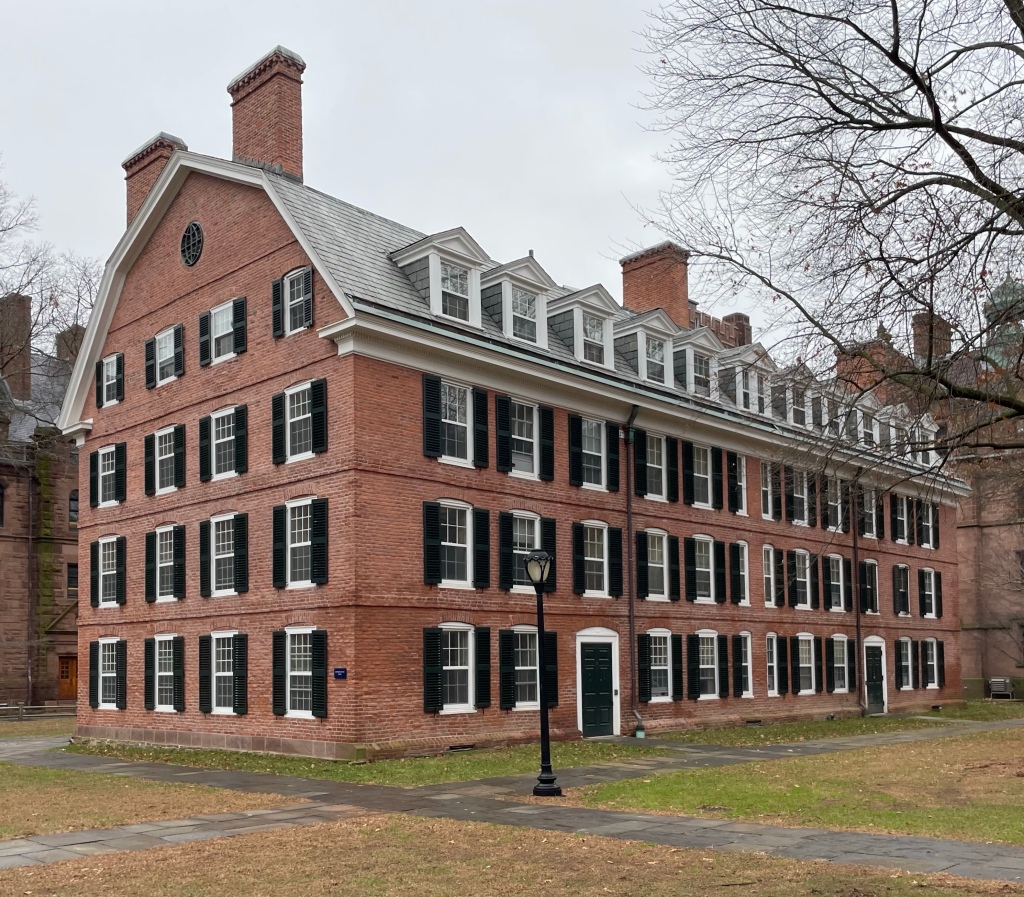
Yale University – Connecticut Hall // 1752

Welcome to Yale! When Yale College, one of the nine Colonial Colleges moved to New Haven in 1718, a wooden building was soon constructed and known as the College House. By 1747, the College House held less than half of the college’s enrolled students, and college president Thomas Clap announced that funds would be raised from the Colony of Connecticut for a “new College House” of three stories. The design followed the traditional Georgian appearance of Harvard College’s Massachusetts Hall, but by the 1790s, it was already outdated. The building was threatened with demolition, but Connecticut Hall was instead given an additional story and a new gambrel roof by 1820, being incorporated into the Brick Row, fronting the Green along College Street. But by the middle of the century the Brick Row was out of style and Connecticut Hall was being described as “dilapidated, scabby and malodorous.” After the Civil War Yale decided to raze all its old Georgian architecture and redevelop the West side of the Green with larger and more modern buildings. Luckily for us, by the 1890’s the Colonial Revival style was booming in popularity and before Connecticut Hall could be demolished, a group of alumni organized to save and restore it. Connecticut Hall stands today as the third-oldest of only seven surviving American colonial-era college buildings, and the second-oldest structure built for Yale College in New Haven (the oldest exant). It was built, in part, by at least five enslaved Africans, including one of whom was owned by Yale president Thomas Clap.