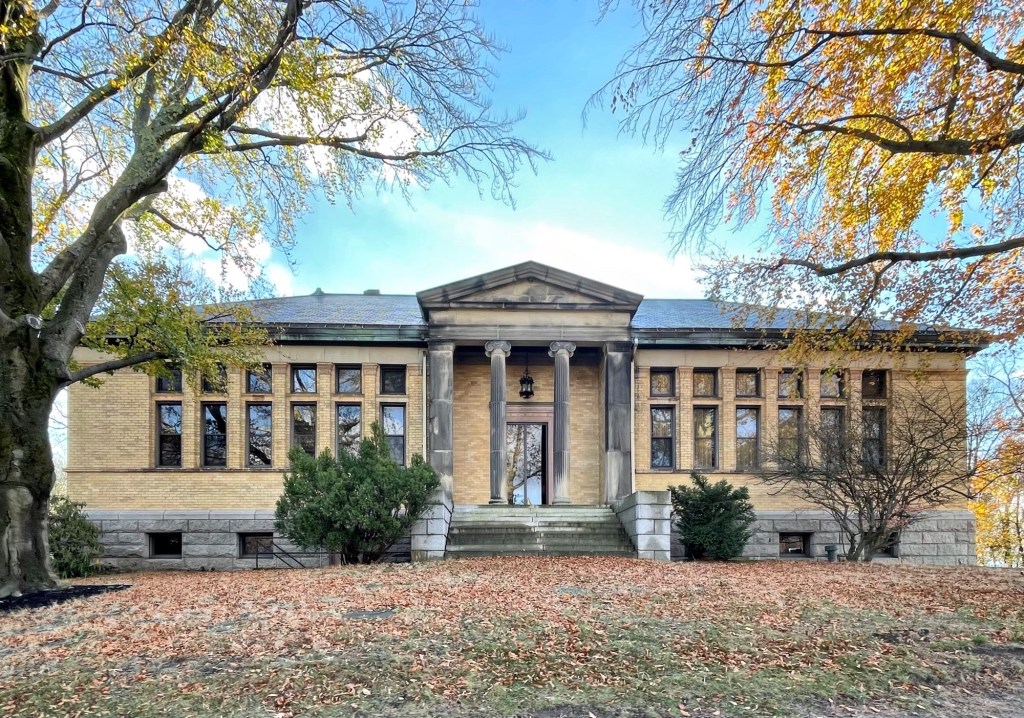
Hills Library – Andover Newton Theological School // 1895

The Hills Library is a formal building standing at the summit of Institution Hill, so-named as the home of the Newton Theological Institution (and most recently as the Andover Newton Theological School). The library was constructed in 1895 from plans by architects Henry H. Kendall and Edward F. Stevens of the firm, Kendall & Stevens. Designed in 1894 in the Neo-Classical style, the library has a stately portico in the Ionic order with a pediment above. The building is constructed of yellow brick with stone and terracotta trimmings with banks of vertical windows. The library would be added onto at the rear, with the main entrance later closed for an accessible entrance in a rear addition. The building is now known as the Hanns Sachs Memorial Library for the current owners and stewards, the Boston Psychoanalytic Society & Institute (BPSI).
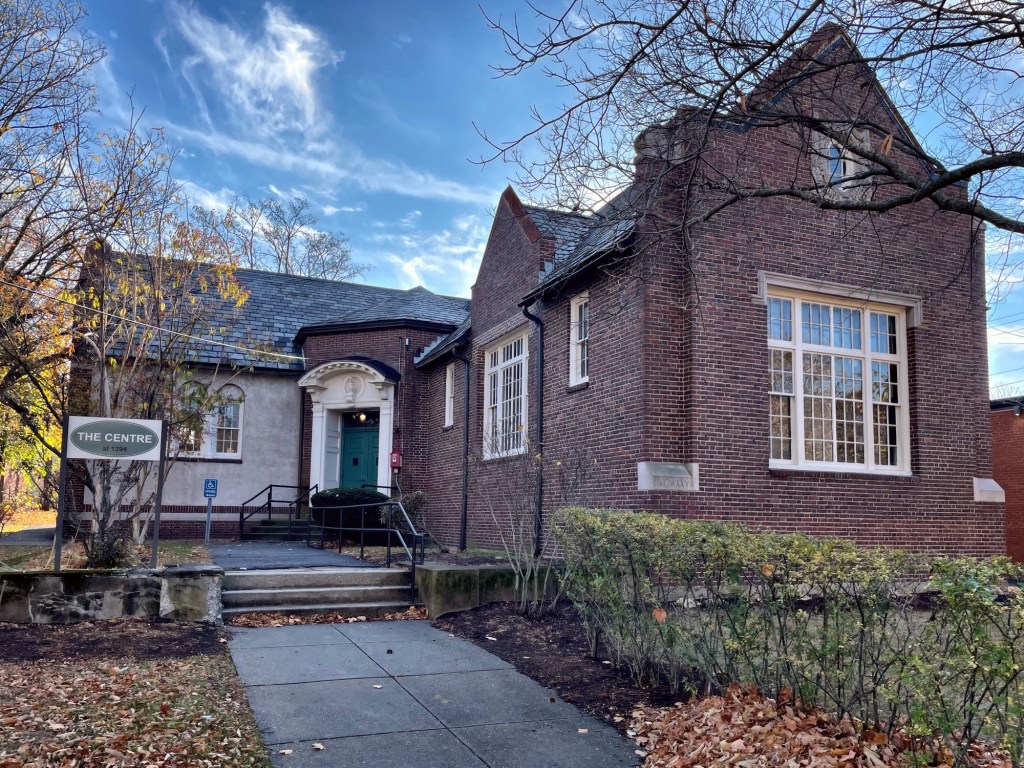
Former Newton Centre Branch Library // 1927

Formerly the Newton Centre Branch Library, this building was one of five branch libraries funded in Newton, Massachusetts by citizen subscription between 1926 and 1939 and turned over to the city. Like most of the others, the building is a small-scale, one story brick library of a Tudor Revival style. The building was designed by the firm of Ritchie, Parsons & Taylor and constructed in 1927. Architect James H. Ritchie was born and educated in Scotland, relocating to Boston and lived in Newton Centre, in two houses he built for his family. The Newton Centre Branch Library was one of the six branch libraries to close in 1991 when the main library opened, consolidating the neighborhood libraries under one roof; the remaining four closed in 2008 due to a budget cut. Today the Newton Centre branch library building serves as the Newton Health Department offices. Thanks to the Community Preservation Act, funds have been allocated to preserve and restore the building for another 100 years.

First Baptist Church in Newton // 1888

The Boston area has an embarrassment of riches when it comes to Richardsonian Romanesque style buildings, due in part to its namesake, Henry Hobson Richardson lived and worked locally. One of my all-time favorites is the First Baptist Church in Newton Centre. The church was designed by architect John Lyman Faxon, who was clearly influenced by Richardson. The First Baptist Church in Newton is among the oldest Baptist congregations in the state. Baptists were recorded as living in Newton as early as the 1720’s, but growth was slow and marked by persecution. In 1780, a congregation was assembled and the next year a rough, unplastered barn like meeting house was begun alongside Baptist Pond (now Crystal Lake). Fifteen years later, the congregation was finally able to afford a stove; twenty one years later, in 1802, the structure was enlarged. In 1836, the congregation constructed a larger meeting house in a more convenient location, the corner of Beacon and Center Streets. The second building was remodelled in 1856 and 1869 and finally was moved from the site to make way for the present church, the third meeting house, dedicated in November 1888. The First Baptist Church is undergoing some work at the exterior at the time of the photo, but the amazing brownstone trim and the winged creatures on four sides of the octagonal tower still shine!

Sacred Heart Church, Newton // 1899

Built in the Italian Renaissance Revival style by architects Rand & Taylor, the Sacred Heart Church in Newton Centre of 1899 reflects much of the lesser-known history of the affluent suburb of Boston. As Newton’s population nearly doubled between 1870 (12,800) and 1890 (24,000), many Irish Catholic residents who worked in the mills and factories of the Upper and Lower Falls areas of town began to move to the suburbs, taking jobs at households of the affluent class in Newton Centre, as cooks, maids, gardeners and more. Residents of Newton Centre wanted a Catholic Church closer to their homes and work, so they established their own congregation in 1890. As the congregation grew, it was obvious that a new church in Newton Centre would be needed to provide services there. Ground broke on the church by 1891, but it took nearly 10 years until the building was completed. Architect Bertram Taylor of the firm Rand & Taylor, and resident of Newton Centre, is credited with designing the large edifice, which is dominated by twin hipped-roof bell towers. The interior of the church has some of the most elaborate plaster work in the Boston area and stained glass windows lining the walls. Early Pastors of Sacred Heart included two who went on to important posts: Francis C. Spellman (1933-39) became Archbishop of New York; and Richard J. Cushing (1939-44) became Archbishop of Boston.

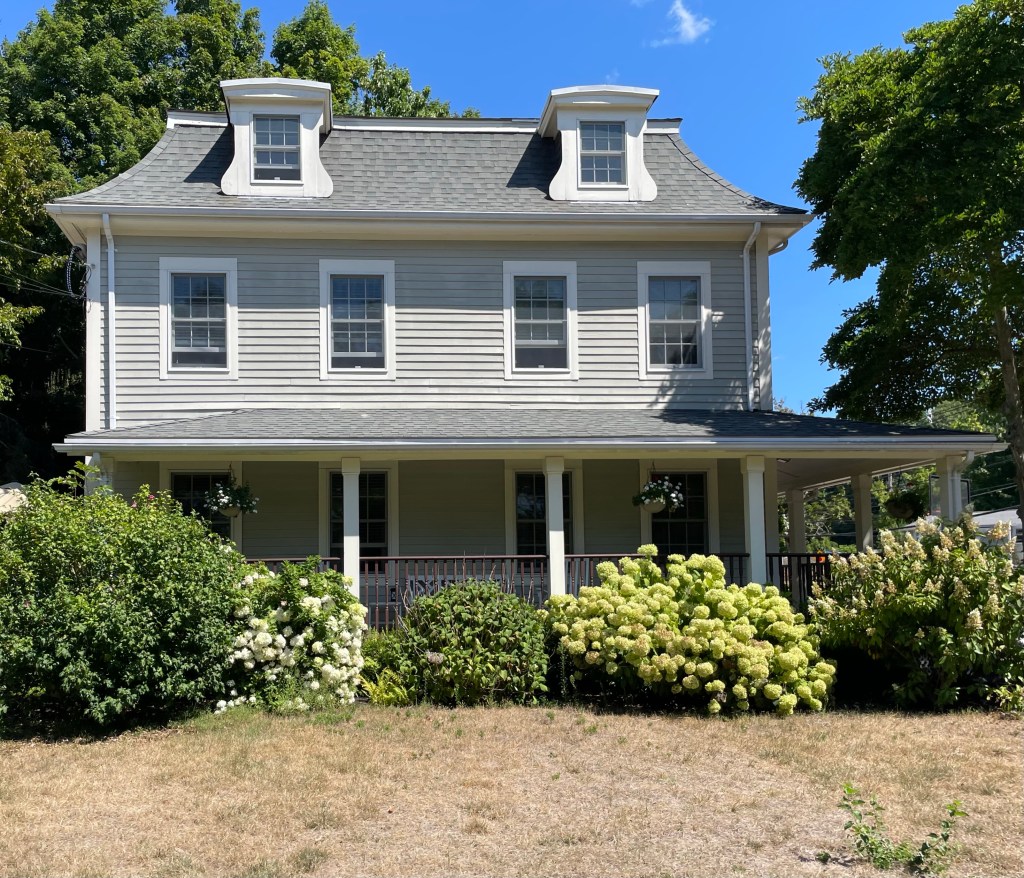
Augustus Wiswall House // c.1870

Augustus Curtis Wiswall was born in Exeter, NH in 1823. At seventeen, he moved to Boston and sought to live life on the open seas. He saw a ship docked called the “Republic” which was about to set sail to Calcutta. He took several other jobs as he hoped for more adventure as a young man. His final voyage was with a general cargo ship to Brazil. On route, several lawless members of the crew rose up in open mutiny, murdering the captain and first-mate, seizing control of the vessel. Loyal to the captain, Augustus was stabbed but was allowed to live as he was the only man capable of navigating back to land. The small crew scuttled the larger ship and manned the small boat surviving on minimal food. They made it to Rio De Janeiro and managed to board a vessel back to Boston. Wiswall never shared his story but to his wife, who in turn shared his stories after his death. His life back home was more calm, after living in the south and midwest during the Civil War, he moved back to Massachusetts and he bought land in Newton’s Lower Falls village building this home. He operated a paper mill in the village and was active in the local church until his death in 1880.