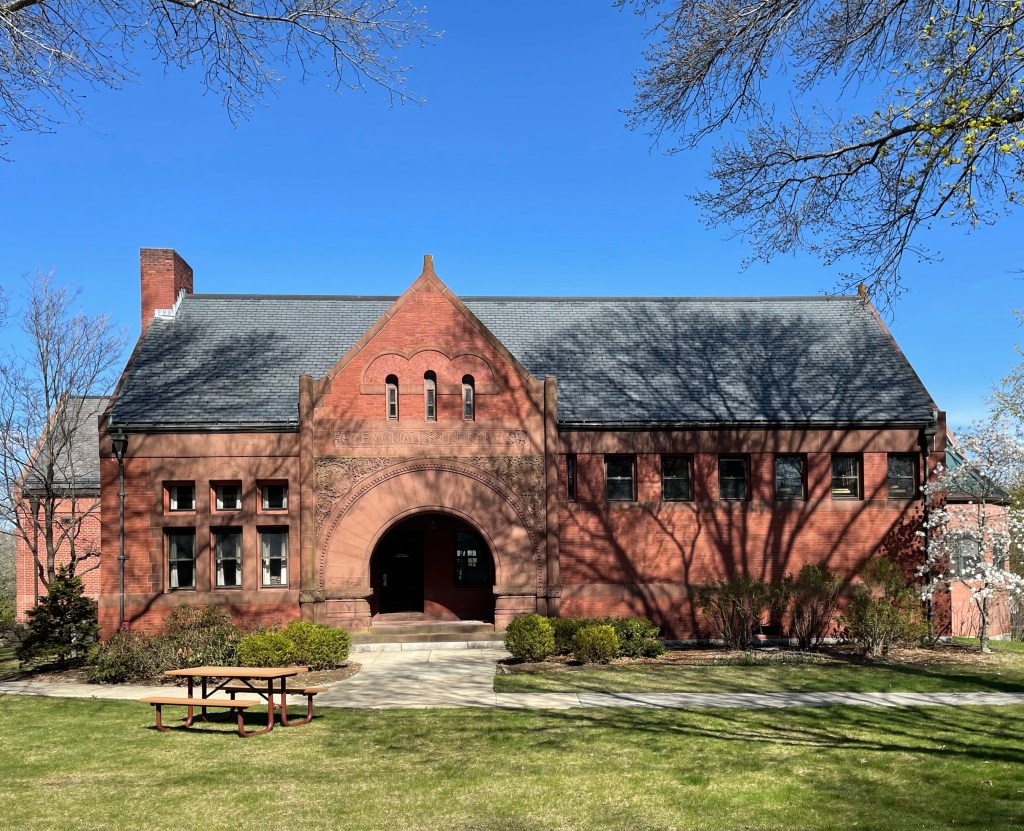
Acton Memorial Library // 1889

In 1888, William Allan Wilde, a Boston publisher who grew up in Acton, purchased land on Main Street to be used as the site for a new memorial library, in “memory of those brave and patriotic men of Acton who so freely gave Time, Strength and Health, and many of them their Lives in the war of the Rebellion, 1861-65.” The former Fletcher Homestead which was located here, was moved to a nearby street. The Richardsonian Romanesque building was designed by the Boston architectural firm of Hartwell and Richardson. The building displays traditional Romanesque materials with its brick wall surfaces, brownstone and terra cotta trim and detailing, and slate roof. The large Syrian arched entry is a hallmark in the Richardsonian Romanesque style, which works extremely well with this design.

Gilbert A. Davis Memorial Library // 1899

Reading Vermont’s public library building was built in 1899, by local resident Gilbert A. Davis (1835-1919). The building’s funds were furnished by Mr. Davis in his life, likely inspired by Andrew Carnegie’s fund which had libraries built in towns all over the United States. Gilbert Davis worked as a lawyer in Woodstock before moving back to Reading, Vermont to run his own practice. The library he funded is Neo-Classical in design in the form of a Greek Cross with intersecting gable roofs and with a monumental portico in the Ionic Order on the front facade. The charming library building is well-preseved and an excellent example of Vermonts beautiful small-town libraries.

Fletcher Free Library // 1904

On July 14, 1873, Mrs. Mary L. Fletcher and her daughter, Miss Mary M. Fletcher, gave the city of Burlington, VT, $20,000 for the founding of the Fletcher Free Library. Half of this sum was to be spent on books; the other half was used to start an endowment for the library. By 1901, the library had outgrown its location in the old City Hall building. In the same year, Andrew Carnegie made a gift of $50,000 for the construction of a new library. In 1902, an architectural competition was created with entries from Boston, New York, Buffalo, Montpelier, Vermont, and Lowell, Massachusetts, but a young Burlington architect, Walter R. B. Willcox won the commission. Willcox designed the new ornate library that year and in August, 1904, the new library was dedicated and opened for business. In the early to mid-1970’s there was some pressure from the citizenry to demolish the Carnegie building and rebuild on the site, which coincided with Burlington’s large urban renewal policies in the downtown area. In response, a group of Burlington residents formed The Committee to Save the Fletcher Free Library Building. A petition was circulated, and as a result, the building was added to the National Register of Historic Places in 1974. In 1977, a grant of $234,000 made possible the stabilization and external repair of the building, and later an addition was constructed, to allow the historic library to meet the needs of the much larger city.

Shedd Free Library // 1881

Aren’t tiny old libraries just the best?!

Located in Washington, NH, the Shedd Free Library is the only Victorian Gothic building in town, and packs a punch for its small size. The library was named for Sarah Shedd, a Washington teacher and poet who went to work in the cotton mills of Lowell, Massachusetts to support her family and educate her siblings. When she died in 1867 she bequeathed $2,500 to her hometown to establish a free public library, an amazing gift! The gift did not appear to be enough as nothing was built until 1881, after Boston architect S. S. Woodcock was selected by Luman T. Jefts, a wealthy shoe manufacturer in Massachusetts, to design the library after a gift to his hometown.

Richards Free Library // 1899

Designed by Boston architect, James Templeton Kelley, the Richards Free Library (originally the Seth Richards House) is an outstanding example of the Colonial Revival style, in a region where such expressions of opulence are relatively rare. Located on Main Street in Newport, NH, the house was built during a period of great prosperity by one of Newport’s wealthiest citizens. Richards was one of the few in the area able to afford the services of a metropolitan architect for his own home. The family occupied the home until the 1960s when Louise Richards Rollins, offered the family home on Main Street for the to the town for use as a library in 1962. The first floor rooms were renovated and equipped as a library and Ms. Rollins continued to live on the second floor of the library until her death.

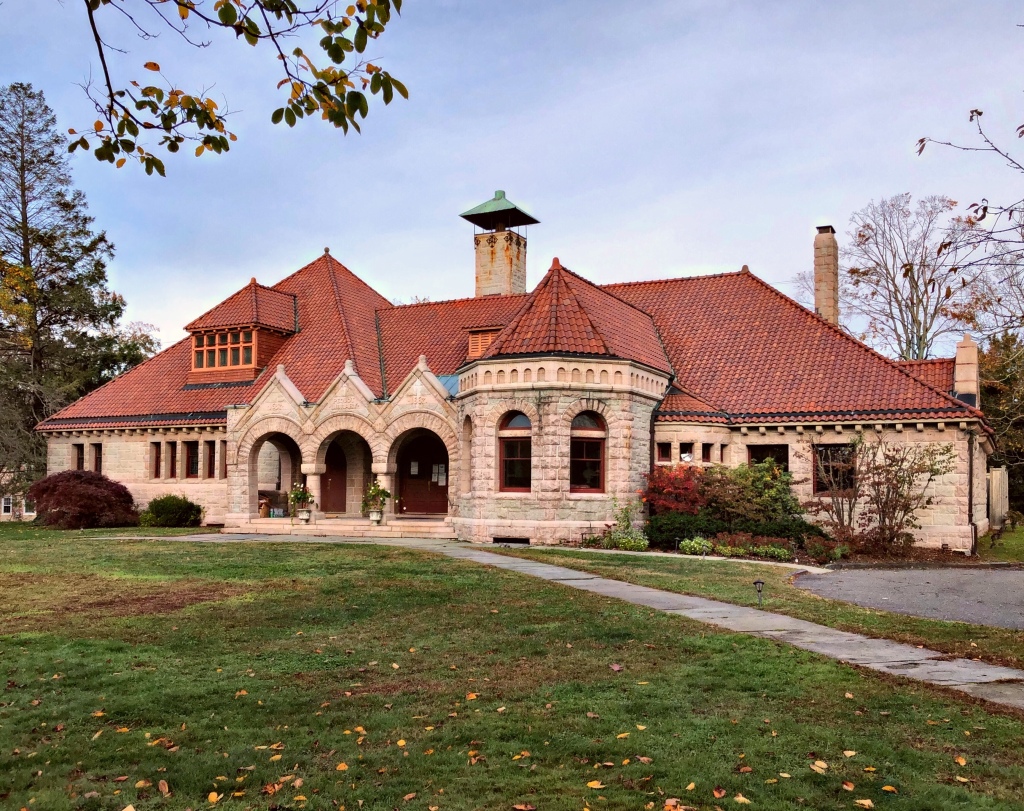
Pequot Library // 1894

The Pequot Library in Southport, Connecticut was founded in 1889 by Virginia Marquand Monroe and her husband Elbert B. Monroe. The library, designed by noted New York City architect Robert H. Robertson, opened to the public in March 1894. The building is Romanesque Revival in style in a granite sandstone construction. There is an expansive roof area topped with red tile and hipped dormers; an arcaded entrance porch with three arched openings serves as the focal point of the front facade. It was Mrs. Monroe’s intention that Pequot be as “free as air to all”, which it remains as to this day.

Abbott Memorial Library // 1905

Gifted to the town of Pomfret by Ira Abbott, the Abbott Memorial Library is one of the most stunning little libraries in the State of Vermont. Given to his hometown as a memorial to his parents by Ira Abbott, who was at that time a State Supreme Court justice in the territory of New Mexico. Its architect, Henry M. Francis, used diverse materials — brick, granite, fieldstone, red birch, and pre-stressed concrete, to design the eclectic building. Capped with a red slate roof with terra cotta ridge tiles, the building stands out as one of the most unique buildings in the state and has been extremely well-maintained through its public-privately funded Commission.

New Kent Memorial Library // 1972

Between 1900 and 1970, the town of Suffield doubled its population, and the 1899 public library was outgrown. The city gathered funds to construct a new library, knowing that the endowment for the day-to-day operations of the library by Sidney Kent, in memory of his parents, would transfer to a new building as long as the name carried with it. The town hired Warren Platner, an architect, interior designer and furniture designer, based out of New Haven. Platner designed the Modern library with a concrete frame, faced with pink stone and white painted brick above, surrounds a central garden court. The flat coffered concrete roof and overhanging concrete project outwards over the terraced exterior courtyards. The interior is on five floor levels connected by gradual ramps with no stairs inside (at least at the time of construction). The town proposed a plan to demolish the library in 2008, replacing it with a larger library, but it was voted down by residents, saving (what is believed to be) the only free-standing Platner building remaining in the country.

Blackinton Mansion // 1865

This mansion in North Adams, MA was built in 1865 for Sanford Blackinton. Blackinton was said to be the first millionaire in North Adams, and his mansion was the most elaborate home ever built in the city. His mill produced woolen goods during the Civil War including cloth for the Union forces. After the Civil War, many factory owners no longer lived amongst their workers, as they formerly had done, but instead built luxurious mansions in other neighborhoods, away from their factories. These large residences were designed in extravagant modern styles to impress the public and reflect the stature of their owners. European materials were even imported to grace these homes, such as the Italian marble fireplaces in the Blackinton Mansion.

Sanford Blackinton built his mansion in the hopes that it would become the ancestral home for his descendants. However, after the death of his widow (their four children died by the 1870s), the mansion was put up for sale in 1896, and was bought by North Adams’s first mayor, A.C. Houghton.
He in turn donated the mansion, along with $10,000 for renovations, to the city, to be used as a public library and as a meeting place for the local historical society. He requested that the building be known as the Andrew Jackson Houghton Memorial after his late brother. The home, designed by architect Marcus Fayette Cummings, is a high-style Second Empire mansion with a prominent tower, constructed of red brick with brownstone trim.