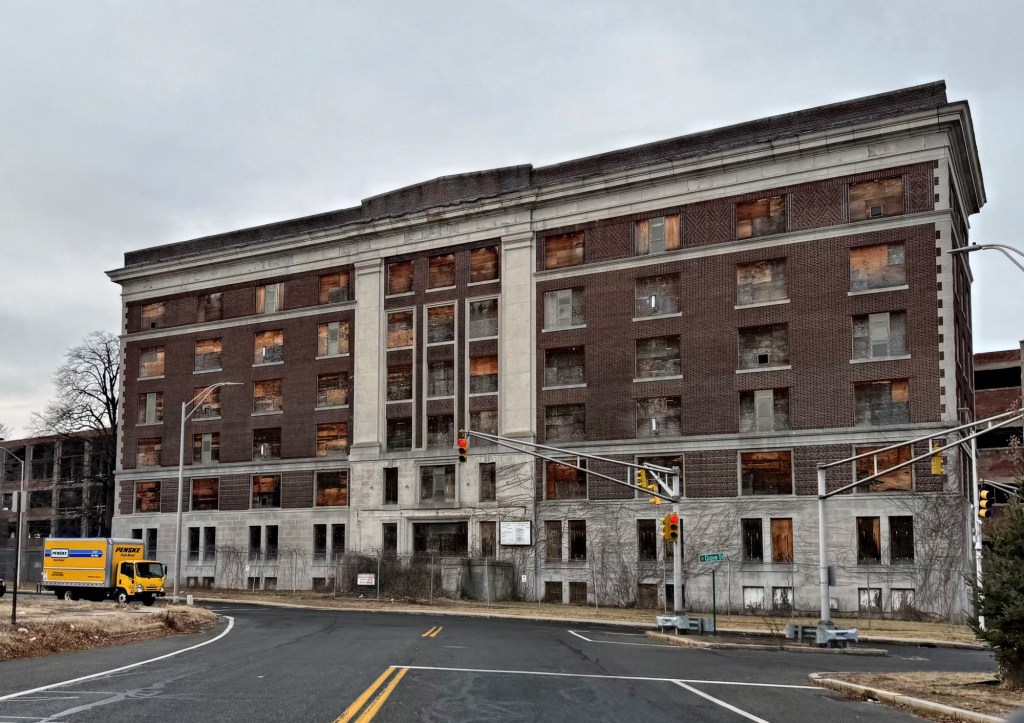
The Fisk Rubber Company was founded in Chicopee, Massachusetts, in 1898 by Noyes Wilson Fisk, who purchased the Spaulding and Pepper Company in 1895 and renamed it to the Fisk Rubber Company. The company originally produced bicycle tires and other rubber items, later branching out with automobile tires in 1899 which proved to be an impressive success. The company’s “Fisk Tires” became a household name, especially popular among early automobile owners for their durability and performance. At its peak, the company employed thousands of workers, contributing significantly to the local economy of Chicopee, as well as other branch factories in in New Bedford, Massachusetts, Jewett City, Connecticut and Pawtucket, Rhode Island. The firm grew rapidly, and an entire complex was built here in Chicopee, centered around this building, constructed around 1916 as the Administrative Offices for the company. Architect George B. Allen designed the building in the Classical Revival style. During the Great Depression, Fisk Rubber was crippled by competition and eventually was acquired by United States Rubber (later Uniroyal) in 1940. Uniroyal, Inc. closed their Chicopee plant in 1980, and the complex sat largely unused for decades, with a majority of buildings demolished in recent years. Hopefully this lovely building, instrumental to the growth of Chicopee and America as we know it, will be preserved for generations to come.


 Buildings of New England