One of the largest summer estates in Ridgefield is this Neoclassical residence on Peaceable Street, which was built in 1901 for Effingham Maynard and his wife Helen. Maynard was a partner in Clark & Maynard, a New York publishing house. Local lore states that the Maynard Family hired New York architect Stanford White, to design this property, but no definitive proof could be located to substantiate that rumor. The Olmsted Brothers landscape architecture firm designed the grounds which were elaborate with gardens and outbuildings. The two unmarried Maynard daughters, Mary and Helen spent their summers here every year until their deaths in the 1950s.
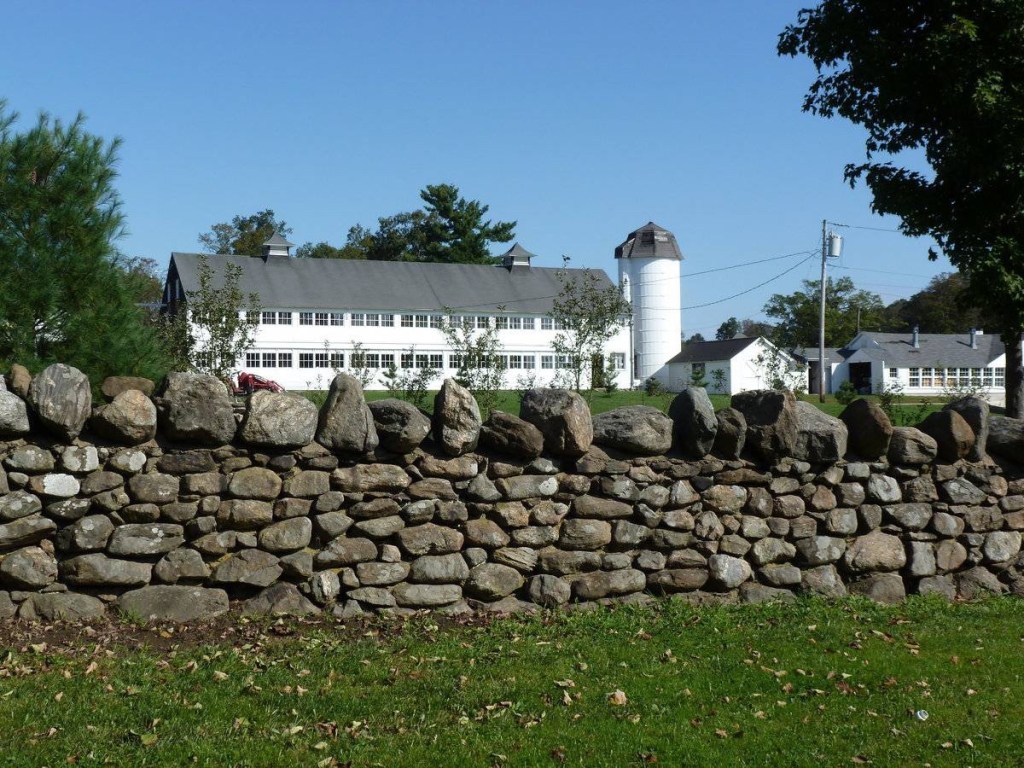
Tranquillity Farm, spanning the rolling hills around Lake Quassapaug in Middlebury Connecticut, was originally a 303-acre model/gentleman’s farm developed by John Howard Whittemore, a successful industrial-era businessman in Naugatuck, and his wife Julia Spencer Whittemore. Whittemore was a major figure in Naugatuck, sponsoring a series of commissions of McKim, Mead & White for buildings in the city center. For his country farm estate, he again commissioned McKim, Mead & White to design a new country house, a farm superintendent’s house, boat house on the lake, and other outbuildings for a working farm. An older farm was purchased, which included a modest Greek Revival style farmhouse dating to the early-mid 19th century (seen here) and a large wooden barn. Both of these were kept and incorporated into the estate near the southern entrance to the property, possibly to harken visitors back to the charm of rural living. The sweeping landscape, featuring miles of distinctive stone walls lining the roads and crisscrossing the fields, was designed by Charles Eliot and completed by Warren H. Manning – both protégée of Olmsted.
In 1885, a 28-year-old Leroy King (1857-1895) and his wife Ethel Rhinelander King (1857-1925) hired one of the country’s most prominent architects, Stanford White, to design a Newport home for their family. Leroy was the son of Edward King, a prominent local merchant, and upon his fathers death in 1875, inherited some of the $100+million dollar fortune he had amassed in today’s dollars. The corner lot at Bellevue and Berkeley avenues was purchased and work was underway on the new mansion. The house is a really interesting take on the Shingle style, but instead of cedar shingle siding, employs fireproof construction. A central hall, large gabled masses, picturesque window arrangements, and a spectrum of surface textures (here conveyed largely in natural stone and brick with flourishes of shingle and pebble dash work), align this house with McKim, Mead & White’s earlier efforts in this style. The interior has been meticulously preserved and maintained by the owners.
Buildings of New England travels! Welcome to Schenectady, a great city in upstate New York, with an hard to spell and pronounce name! The name “Schenectady” is derived from the Mohawk word skahnéhtati, meaning “beyond the pines”. Schenectady was founded on the south side of the Mohawk River by Dutch colonists in the 17th century, many of whom were from the Albany area. In 1664 the English seized the Dutch New Netherland colony and renamed it New York. They established a monopoly on the fur trade around Albany, and issued orders to prohibit Schenectady from the trade through 1670 and later. The town grew mostly as an inland agricultural town until the Erie Canal was built in 1825, creating a navigable water route from New York City and the Atlantic Ocean to the Great Lakes, cutting through Schenectady. The town grew and became an industrial center, attracting a very diverse population of immigrants in the 19th century and African Americans as part of the Great Migration out of the rural South to northern cities for work. The community struggled (like many) in the mid 19th century but has seen a large resurgence as of late!
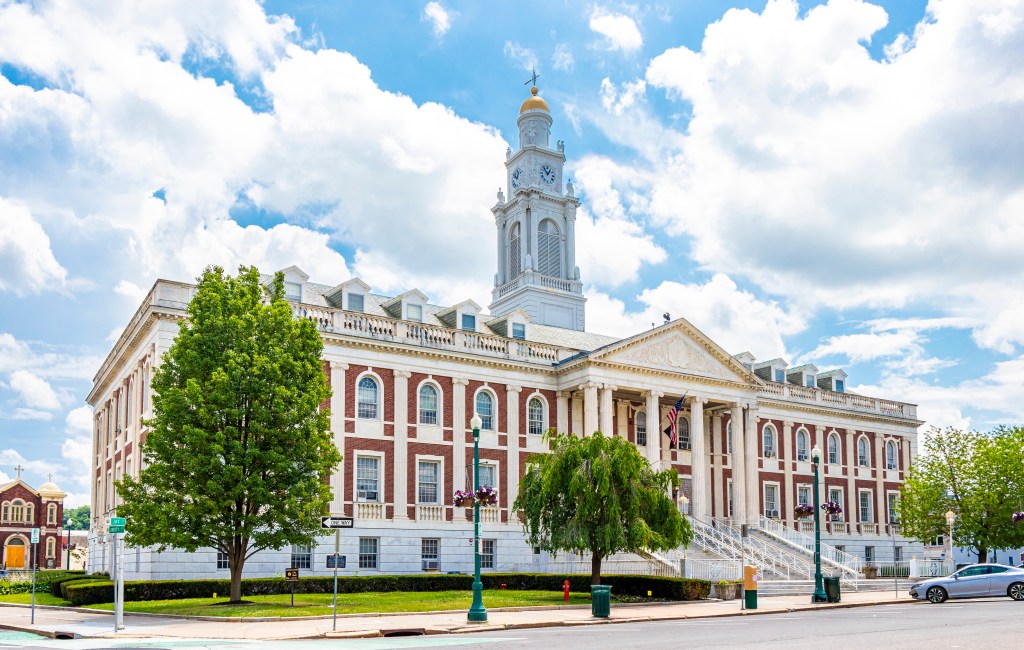
This building is the Schenectady City Hall, a massive architectural landmark which made my jaw drop when I saw it! The City of Schenectedy outgrew their old City Hall, and in the late 1920s, held a nationwide contest to select designs for a new City Hall. The contest was won by the prominent architectural firm McKim, Mead, and White. It appears that the designs were furnished by James Kellum Smith of the firm, the often overlooked genius of the MMW practice. The exorbitant cost of the project, which was undertaken during the Great Depression, caused the building to be dubbed “Fagal’s Folly” after Mayor Henry C. Fagal, who allowed all the cost increases while the city’s future was uncertain. He was not re-elected after this building was completed. The building is a pleasing mixture of Colonial and Classical Revival styles and features bold pilasters and a towering cupola



 Buildings of New England