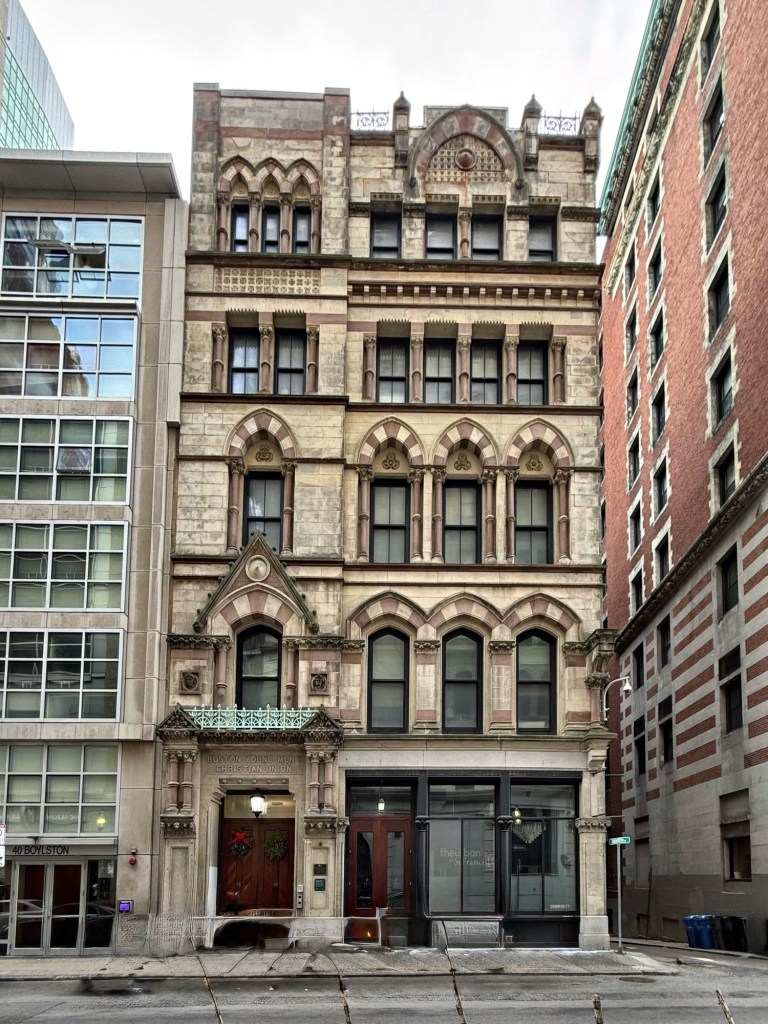
Boston Young Men’s Christian Union Building // 1875

The Boston Young Men’s Christian Union was founded in 1851 by a group of Harvard students as a biblical and christian literature discussion group, which incorporated the following year. First located on School Street, the organization’s activities were to provide a focal point for the intellectual, religious, and social life of primarily middle-class, well-educated Christians. The organization grew to the point that a new building was needed, and in 1873, a site on Boylston Street was acquired as a perfect central location for the group. Architect Nathaniel J. Bradlee of Bradlee and Winslow was hired to design the structure, principally because Mr. Bradlee by then a prominent architect and public figure, was also a life member of the Union and the brother of one of its founders. The building was completed in 1875 and included ground floor retail with an auditorium, gymnasium, library, social and game rooms, and offices for the Union above and behind. Designed in the High Victorian/Ruskinian Gothic style, derived from a mixture of English, Italian, French, and some German Gothic precedents, the style emphasized complicated, asymmetrical massing, polychromy, ornate details, and lancet or Gothic arched openings, in this building a sandstone facade was used. The building became a City of Boston Landmark in 1977. In 2016, the building was converted to an affordable housing development by The Architectural Team Inc., and called “The Union”. The development provides 46 units of affordable housing, including 25 targeted to those who have experienced homelessness. What a great rebirth of the building. Historic Preservation and Affordable Housing can work together and create great projects.
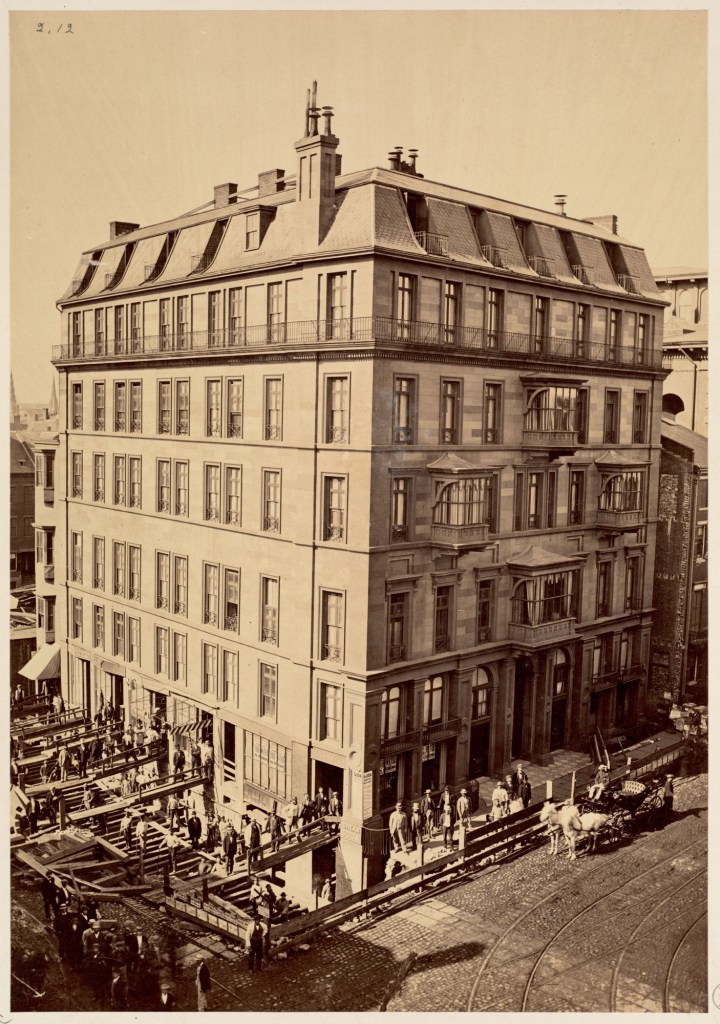
Hotel Pelham // 1857-1916

Built in 1857 at the prominent intersection of Boylston and Tremont streets in Boston, the Hotel Pelham is said to have been the first apartment building of its type in America. Seen as a high-end apartment building, not like the slum-like tenements in New York and elsewhere in Boston, the units were like French-flats for medium-term renters, rather than short-term stays. The Hotel Pelham was developed by Dr. John Homer Dix, a doctor who took a keen interest in providing healthy accomodations for city-folk. The Hotel Pelham was designed by architect Alfred Stone, as an early example of the Second Empire style, with a French Mansard roof and stone facades. Just about a decade after the building was completed, Tremont Street (which runs along the side of the building) was set to be widened. This work would require the partial (and likely full) demolition of the Pelham Hotel. Rather than see his building face the wrecking ball, Dr. Dix, in 1869, had the Hotel Pelham slid off its foundation, and moved westward thirty feet to accommodate the expanded Tremont Street. This incredible feat of engineering was undertaken by John S. Blair, with architect Nathaniel Bradlee overseeing updates to the facades and interiors. The building would survive a gas main explosion in 1897, but succumbed to redevelopment during WWI, when the building was demolished for the present building on the site, the Little Building.

Ebenezer Baptist Church // 1860

On September 15, 1847, a ship carrying 66 men and women and children docked at Long Wharf in Boston. This group of ex-slaves, led by Rev. Peter Randolph, emancipated by their former slave master Carter H. Edlow from the Brandon Plantation in Prince Georges County, Virginia. Members of the Boston Anti-Slavery Society, led by William Lloyd Garrison met the newcomers and made them welcome by securing lodging and work for self-support.  The group settled in the South End on Ottaway Court not far from the Holy Cross Cathedral. The group first joined the Twelfth Baptist Church of Boston before establishing their own congregation. They eventually occupied this church in 1887, the building was designed by architect Nathaniel Bradlee in 1860, which was built for what was then the Third Presbyterian Church of Boston. The church has remained here for nearly 150 years, seeing the rapid change in the neighborhood. The church building accommodated meetings including the Professional Black Women’s Business Club, which bolstered Black women in business, many members owned stores in the South End. Many members left the area amid growing gentrification in the 1980s and 1990s, and from that, the aging population remaining made keeping the doors open difficult. Sadly, the church relocated out of the building in 2020 and appears to have sold the building, leaving its future uncertain.