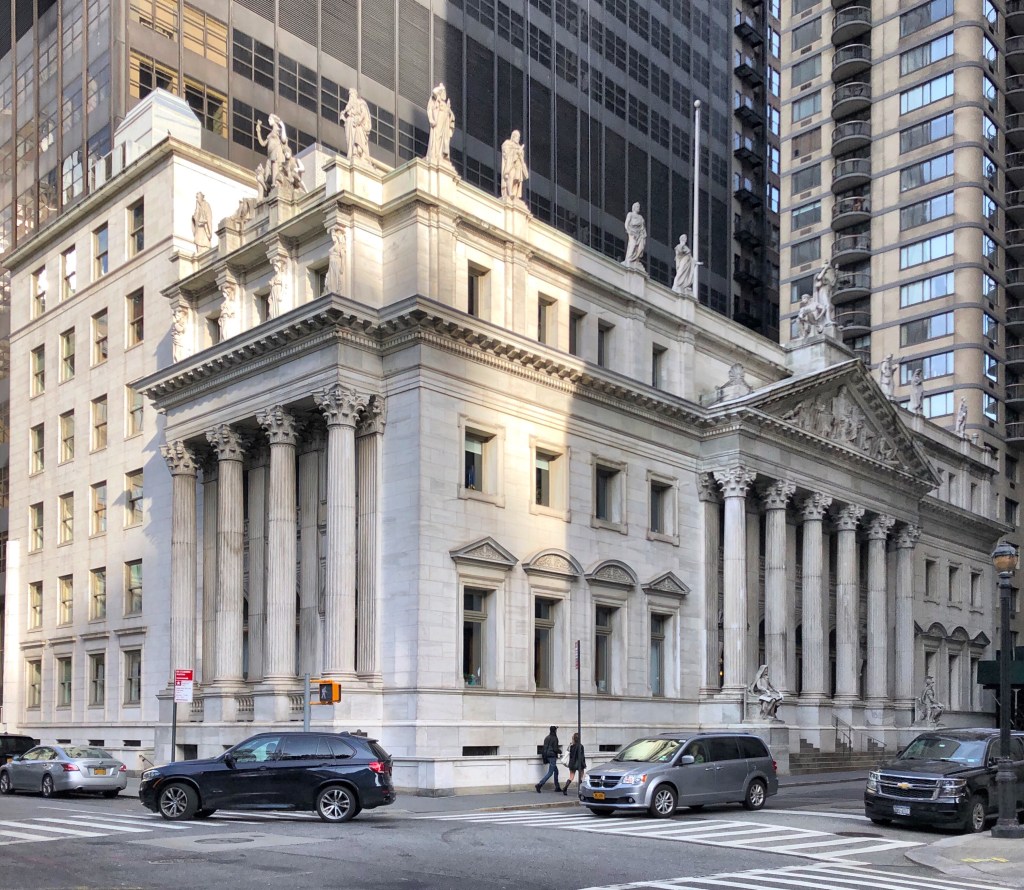
New York Appellate Courthouse // 1899

Distinguished for its classic beauty, this small marble courthouse expresses the best of Classical tradition, in its columned portico and fine sculptures adorning it. Located at the edge of Madison Square Park, the building was constructed between 1896 and 1899 to serve as a courthouse for the Appellate Division of the New York State Supreme Court. The marble Classically inspired Beaux-Arts courthouse, was designed by James Brown Lord and is considered to be an excellent example of the City Beautiful movement, which sought to introduce monuments and beautification to American cities. Of the nearly $650,000 spent on the building, 25 percent was spent on sculpture, a huge sum at the time. Sixteen sculptors – sponsored by the National Sculpture Society and among of the most esteemed of the day – worked on the thirty 12-foot marble statues on the facade, the most ever to work on a single building in the United States. Sculptures by Daniel Chester French, Charles Henry Niehaus, Karl Bitter, and more adorn the balustrade and entrance steps. Additionally, four caryatids sculpted by Thomas Shields Clarke on the Madison Avenue front, showcase a rare feature not typically seen in American architecture, representing the four seasons.

In 1953 a $1.2 million restoration of the facade was undertaken by the Department of Public Works during which the huge marble statues were removed and cleaned. It was at this time that the general public first realized one of the lawgivers was Mohammed. Representatives from Pakistan, Egypt and Indonesia petitioned the State Department to destroy the statue rather than restore it, citing Islamic canon that forbids the depiction of human beings in painting or sculpture. When the statues were replaced in 1955, each was moved over one spot to fill in the void where Mohammed had stood. Today one empty pedestal remains.

Firemen’s Hall // 1854

In the early 19th century, firefighting in New York was done by an assortment of volunteer groups with no centralized director. This hall was built as a headquarters for two of these groups—a move toward cooperation amongst competitors. Each company split the ground floor, divided into three rooms. The front room for the apparatus, the centre room for their meetings and the room in the rear for sitting and reading. The upper stories held meeting rooms and a library. The building was occupied as a fire headquarters until it relocated in 1887. The City of New York closed the station in the 1970s and it was rented as a mosque and theater company, losing much of its architectural detailing over the years. The Italianate style building, faced with Connecticut brownstone was restored close to the original design based on historic photos and converted to retail use, now housing Dolce & Gabbana.

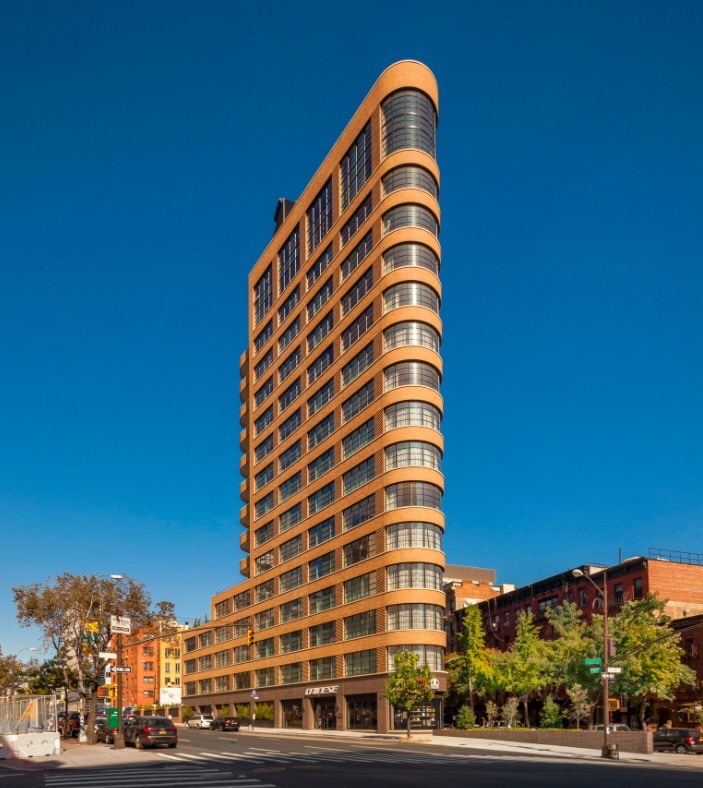
10 Sullivan // 2016

The Flatiron Building in New York is an excellent example of how New Yorkers maximize any piece of land, no matter how small or what shape, to generate an amazing architectural statement. This skinny lot was previously home to a one-story car wash, serving as an unacceptable entry into the SoHo neighborhood. The tight wedge-shaped lot was envisioned for a higher use and Tamarkin Co. Architects developed one of my favorite recent projects in the city, 10 Sullivan. The innovative design gives me serious Art Moderne vibes with the curving forms and strong horizontal lines. The use of brick creates a feeling of warmth and blends the modern building in with the surrounding historic structures nearby.

Flatiron Building // 1902

The 22-story Flatiron Building in New York is easily one of the most recognizable and iconic buildings in the world. Built in 1902, the building replaced a collection of smaller commercial buildings on one of the most visible lots in this section of the city, thanks to the convergence of 5th Avenue and Broadway at Madison Square Park. The lot was developed by Harry S. Black, President of the Fuller Company, a general contracting company whose specialty was the construction of skyscrapers for their own offices. The company hired Chicago architect Daniel Burnham, who was known throughout the world for his skyscraper designs. Upon completion after just 9 months of construction, the building was called the “Fuller Building”, which was quickly overtaken by the public who named the building the “Flatiron” thanks to its footprint resembling an old flat iron. The building was recently vacant and has been undergoing a complete update inside with sprinkler systems, new floorplans and HVAC.

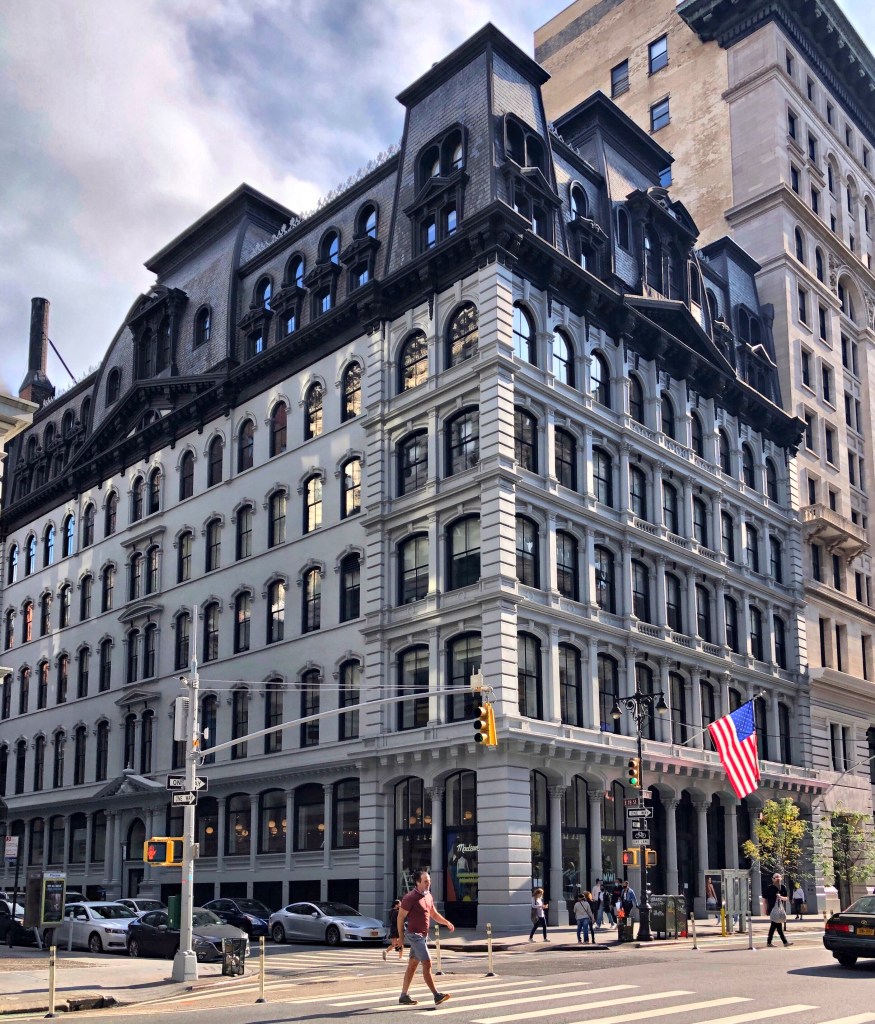
Arnold Constable & Co. Building // 1868

This seven-story department store building was designed by (extremely underrated) architect Griffith Thomas in 1868 for the prominent dry-goods company of Arnold Constable & Company. ‘The Palace of Trade’ as it became known as, is located at the corner of 5th Ave and 19th Street in Manhattan, the stunning Second Empire building is faced in marble, brick, and cast-iron, features stacked arch orders and a prominent, two-story, pavilioned mansard roof. Arnold Constable & Co. was founded by Aaron Arnold, an immigrant from the Isle of Wight, who opened a small dry goods store in the city in 1825. As the business prospered he moved into larger quarters numerous times. In 1842, James Constable, an employee, married Arnold’s daughter Henrietta and was subsequently made a partner. From this, the company was renamed Arnold Constable & Co. In its heyday, Arnold Constable & Co. was the largest dealer to the elite in New York City, supplying the latest fashions to a clientele that included the leading families in the city. The company continued expansion through the 20th century but struggled later with its suburban model. The building was sold and operated as a New York Public Library Branch for some years.

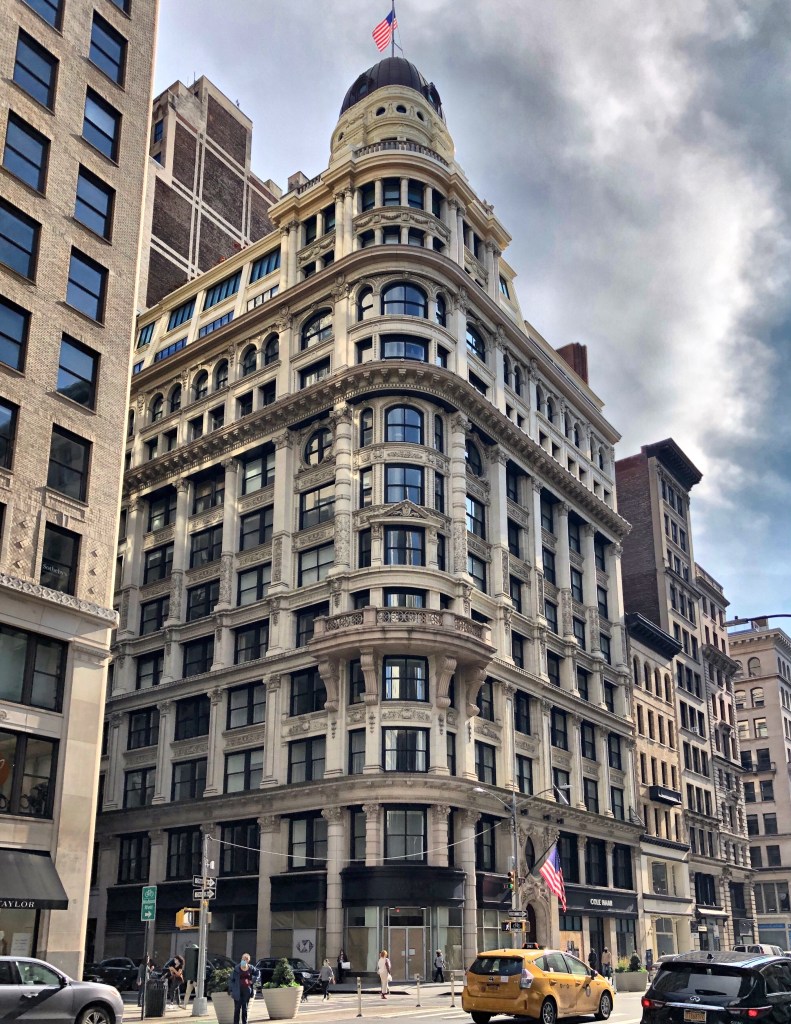
141-147 5th Avenue // 1896 & 1900

This stunning Beaux-Arts store and loft structure, is located on a
prominent corner site at 5th Ave and 21st Street in Manhattan. The structure is faced in limestone and terra cotta and was constructed in two phases. The original three southern bays (on the right side of the image) on 5th Avenue were designed by prominent architect Robert Maynicke for real estate developer Henry Corn. In 1899, two years after its completion, architect Henry Edwards Ficken designed an addition to the north wrapping around and running along 21st Street. The addition continued the richly embellished facade and supplemented it with a twelve-story, curved corner bay which is crowned by a dome. The building appears to have been constructed without a major tenant, and many companies utilized the iconic space including: the Merchant Bank of New York, Park & Tilford’s, a fancy grocer, and lace companies. In the mid 20th century the building suffered from deferred maintenance until 2005 when the building was restored and converted to 38 apartments (including one utilizing the dome)!

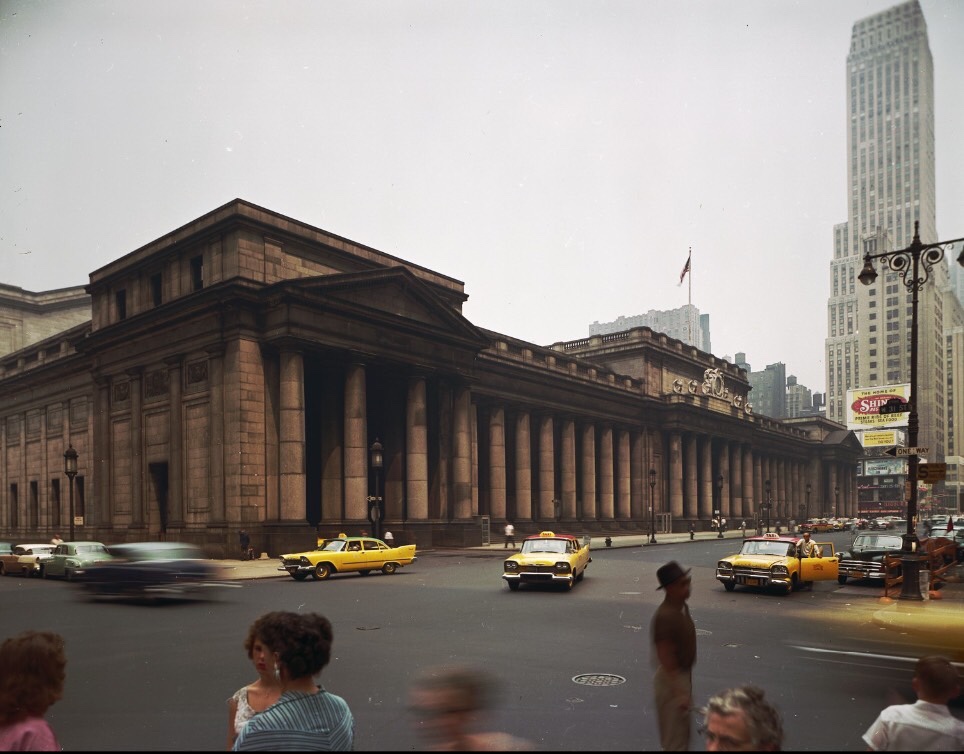
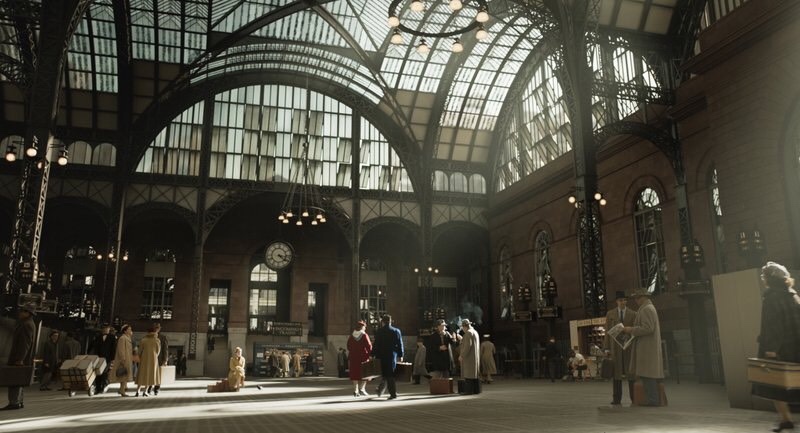
Old Penn. Station // 1910-1963

Pennsylvania Station in Manhattan was opened in 1910, and its sheer scale immediately evoked a sense of awe. At the time it was completed, it was the largest building ever built occupying two entire city blocks, and boasted the biggest waiting room in history. Over 500 buildings were demolished for the station to make way for the Charles McKim-designed station, an icon in the Beaux-Arts style. The structure had “nine acres of travertine and granite, 84 Doric columns, a vaulted concourse of extravagant, weighty grandeur, classical splendor modeled after royal Roman baths, rich detail in solid stone, and an architectural quality in precious materials that set the stamp of excellence on a city.” Sadly, being one of the most beloved architectural gems in the city did not constitute its maintenance nor preservation.

In 1961, after numerous plans for redevelopment, air-rights were sold on the building and in 1963, Penn Station was razed. The former grand station was replaced by Madison Square Garden and Pennsylvania Plaza, an office skyscraper, all with a modernized station below. When the building was destroyed, art historian Vincent Scully famously said, “One entered the city like a god. One scuttles in now like a rat.” In 1965, two years after Penn Station’s demolition commenced, the city passed a landmarks preservation act, thereby creating the New York City Landmarks Preservation Commission. Additionally, Grand Central Station was proposed to be demolished later in the decade, but was saved thanks to preservation efforts.