Train Villa – Beachholm // 1869-1973

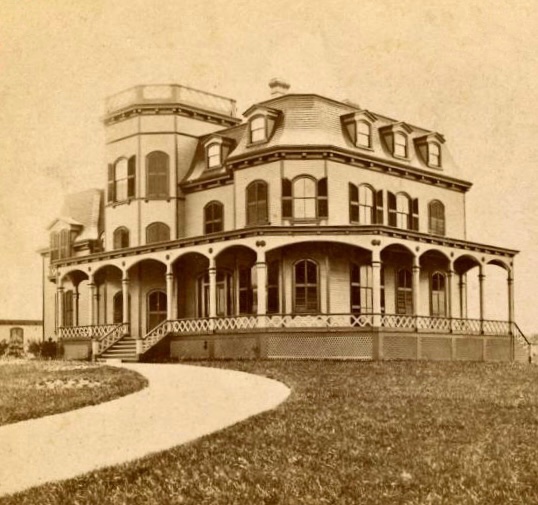
Not to be confused with The Villa, an extant mansard-roofed cottage in Newport, this beautiful example of the Second Empire style sadly is no longer around for us to gawk at. “Train Villa” was built as a summer cottage for George Francis Train (1829-1904), a nutty, attention-seeking businessman, who in 1870-1, traveled around the world in 80 days. The feat caused a sensation, but only after a writer named Jules Verne fictionalized it, naming the main character Phileas Fogg. Train was already one of the most famous men in America, but he was not happy that Verne co-opted his story. “Remember Jules Verne’s Around the World in 80 Days?” he told English reporters. “He stole my thunder. I’m Phileas Fogg.” Train undertook a total of three trips around the world, each time attempting to beat the record of 80 days, with his final trip clocked in at just sixty days. Ironically, Amazon Prime just released the story as a new series (literally airing days ago). Before his inaugural trip around the globe, Train had this summer cottage built in Newport, where he could relax after his globetrotting. After his death, the property was renamed “Beachholm” and owned by Woodbury Blair of Washington D.C..The home was one of the most eye-catching in town and was located in front of the Seaweed Cottage (featured previously), until a fire in the early 1970s led to its demolition.
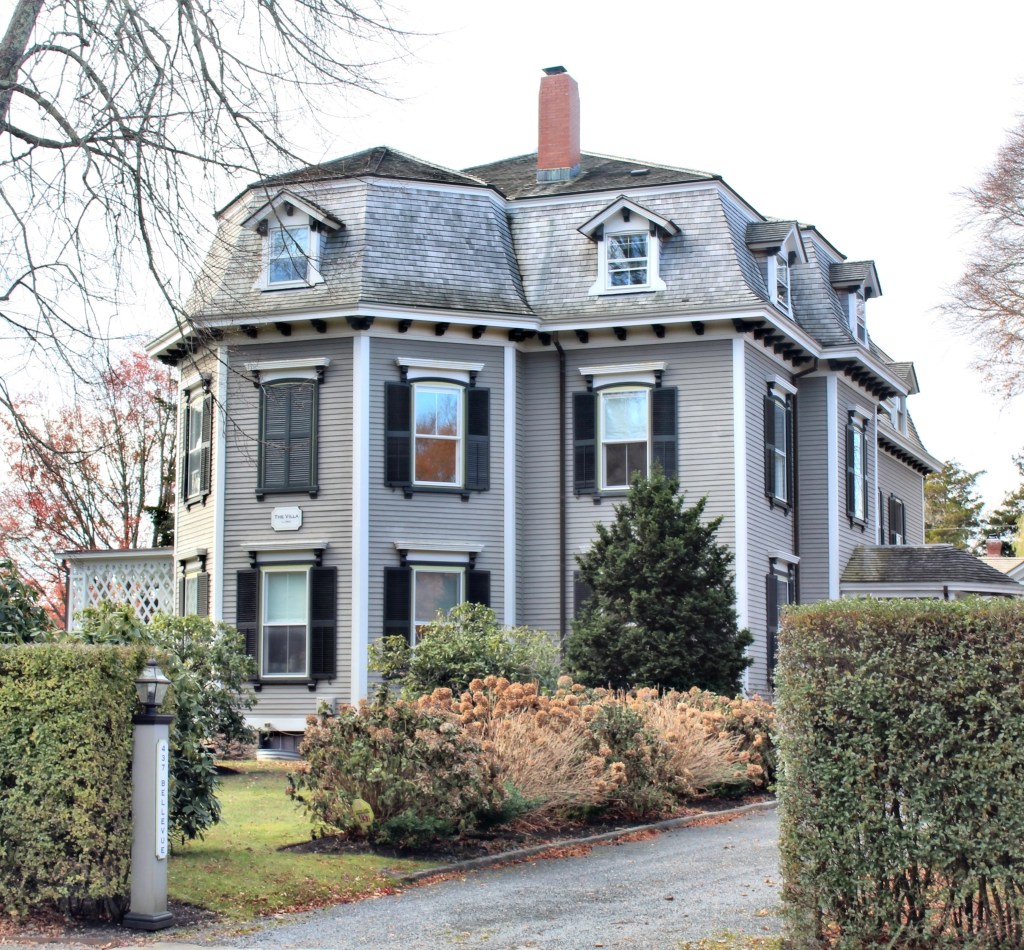
The Villa – Sigourney House // 1864

Margaret Barker Sigourney was the wife of Boston lawyer Henry Sigourney (1783–1849). In 1864, just as the Civil War was coming to a close, Sigourney purchased a piece of land on Bellevue Avenue in Newport soon after the time that Newport had been rediscovered as a tourist destination for the elite class. Sigourney wanted to make a splash as a single woman summering in Newport, so she hired local architect George Champlin Mason to design her cottage in the fashionable Second Empire style. The refined facade is more academic, while the rear and side facades exhibit porches with delicate bargeboards and trim. Sigourney spent summers at her cottage with her only son until 1873 when he and his family perished and were lost at sea aboard the Ville du Havre, when it collided in the Atlantic with another ship, killing a total of 226 aboard the ships, many of which drowned and their bodies never recovered. Alone, Margaret Sigourney continued to spend her summers in Newport until her own death in 1885.

Ochre Court // 1892

Ochre Court, one of the grandest mansions in America was built in 1892 for New York banker and real estate developer Ogden Goelet (1846-1897) and his wife, Mary Wilson (1855-1929). In 1879, Ogden and his brother, Robert, inherited a real estate empire in Manhattan of 259 houses then worth a combined $40 million which was second only to the Astors. In 1892, Goelet and his wife Mary were included in Ward McAllister‘s “Four Hundred“, purported to be an index of New York’s best families, published in The New York Times, a position only solidified after his summer “cottage” was completed that year in Newport, Rhode Island. Named Ochre Court, the 50-room chateau overlooks the Cliff Walk and Atlantic Ocean and is the second-largest mansion in Newport (after The Breakers). Ochre Court was designed by architect Richard Morris Hunt, who also designed The Breakers, and summered in town himself. Shockingly, the Goelet’s only occupied the home during an eight-week summer season, and they spent the rest of the year in their homes in New York City, France, or London. The operation of Ochre Court usually required twenty-seven house servants, eight coachmen and grooms for horses and their carriages, and twelve gardeners for the grounds. In 1947 the Goelets’ son, railroad, hotel, and real estate developer Robert Goelet IV (1880-1966), gave ‘Ochre Court’ to the Religious Sisters of Mercy to establish Salve Regina College after it became too expensive to maintain. ‘Ochre Court’, which housed the entire college during its first years, is still in use and remains the heart of the greatly expanded Salve Regina University.

Inchiquin // 1887

Built in 1887 for John O’Brien, a direct descendant of Brian Boru, the High King Of Ireland, “Inchiquin” in Newport stands out for its bold stone exterior and proper siting. The mansion was named after Inchiquin, a barony (or state) in Ireland, likely where O’Brien’s ancestors were from. The cottage was designed by John Dixon Johnston, a well-known Newport architect, who designed the stone mansion in a sort of hodge-podge of styles, which actually work well together somehow! In 1901, Inchiquin was acquired by The Baroness Seilliere, the adopted daughter of John O’Brien. She was a daughter of Mrs. O’Brien by a former husband. After her first husband died she married the Baron de Seilliere, brother of the Princess de Sagan. Like some other massive, expensive mansions in Newport, this home was converted to condos.

“Breakwater” – Charles W. Lippitt Mansion // 1899-1924

Photo courtesy of Providence Public Library

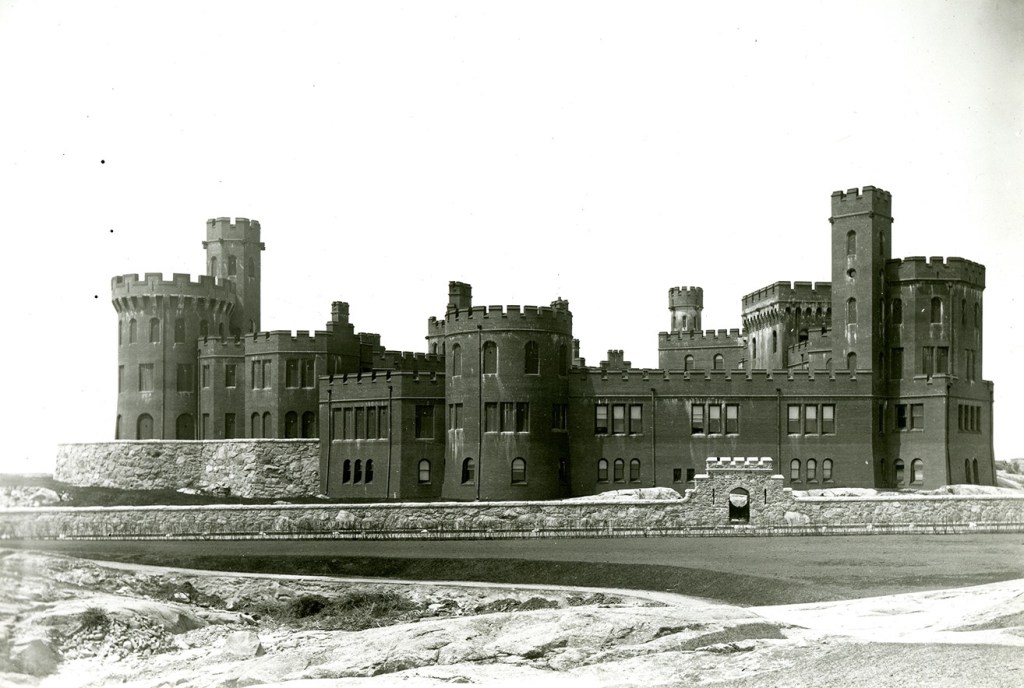
Rhode Island is home to some amazing old homes, but “Breakwater”, the Charles W. Lippitt Mansion was NOT one of them! Former Governor, Charles Warren Lippitt (1846-1924), the son of Governor Henry Lippitt, wanted to be a member of Gilded Age society in Newport, after spending his time in Providence all year, so he had this absolute fortress built. Poor taste did not run in the family, as his father’s Providence mansion was very tasteful (featured on here previously). Breakwater was built on the southern tip of Newport, ironically across the street from Edith Wharton’s tastefully designed cottage, Land’s End (also featured on here recently). Wharton used the term “White Elephants” to describe the influx of massive, masonry mansions that replaced the traditional wooden cottages, similar to what she observed with the Vanderbilt estate, The Breakers. It is understood now why Edith Wharton abruptly moved when this monster of a house was built right next door! Architect Robert H. Robinson designed the fortress – erh I mean house…- and it remained on the site only until Lippitts death in 1924, when the castle was demolished by his son to make the property more marketable for sale. The property was purchased in 1926 by John Russell Pope, an architect, designed his own Tudor style home, “The Waves” (featured on here previously) atop the ruins of the previous estate. MUCH better!

“The Waves” // 1927

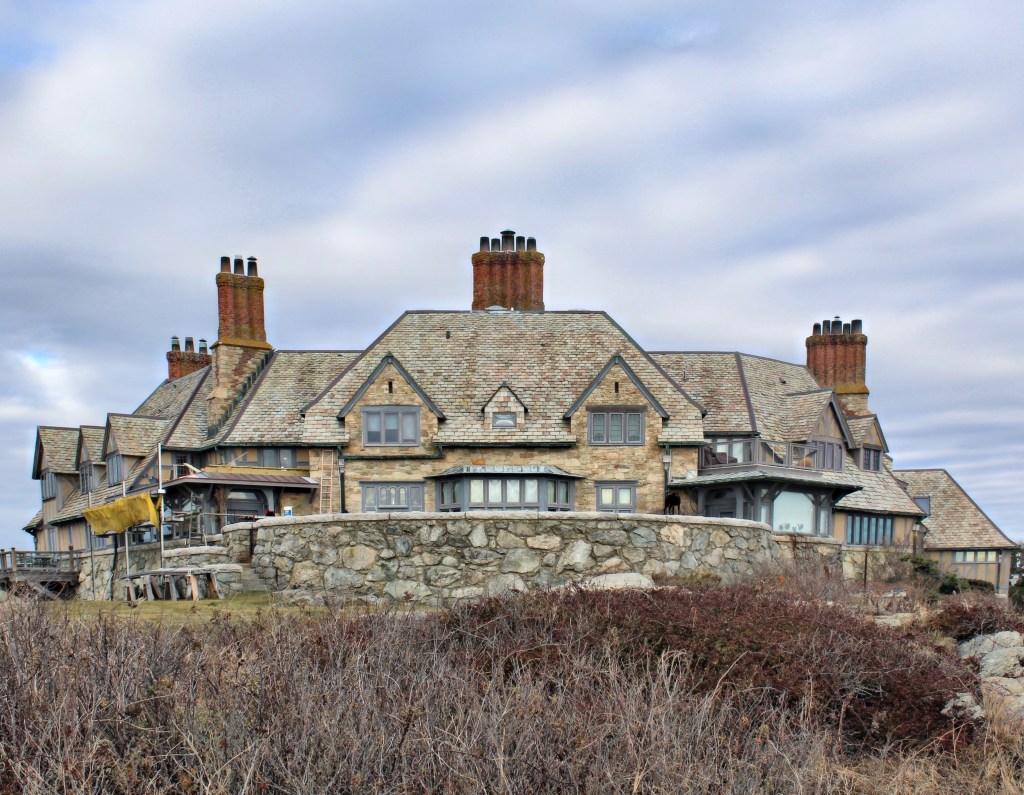
If anyone knows me, I absolutely LOVE Tudor and French Norman style houses, but they are much less common compared to the Colonial Revival style, which dominated residential architecture in New England for nearly a century. Located on Ledge Road, at the southeasternmost peninsula of Aquidneck Island in Newport, you’ll find this absolutely giant estate as you conclude walking Newport’s iconic Cliff Walk. “The Waves”, was built in 1927 by architect John Russell Pope (1874-1937) as his own residence. He built it over the ruins of the former Gov. Lippitt Mansion which was previously built on the site and demolished by Lippitt’s heirs. In designing The Waves, Pope wanted to focus on the natural, rocky site and build a structure that would blend in. The Tudor style mansion features stucco and stone siding, half-timbering, and a complex roof covered in slate, all in a U-shaped form. Years after completing his home in Newport, Pope would become even more well-known for designing major public buildings in Washington D.C., including the National Archives Building (1935), the West Building of the National Gallery of Art (1941), and the Jefferson Memorial (1943). After Pope’s death, the massive home became the first mansion in Newport to be converted to condos, a great preservation tool that maintains these massive mansions, and allows for them to be utilized today.

Land’s End // 1864

One of the more architecturally modest and refined Gilded Age summer cottages of Newport sits on one of the most picturesque pieces of land at the southeastern point of Aquidneck Island and is aptly named Land’s End. The cottage was built in 1864, Land’s End was designed by John Hubbard Sturgis for Boston banker, Samuel Gray Ward, his father’s business associate. The home features a refined Italianate style base with a roof comprised of a variation of the Second Empire mansard style called a “turtleback roof”. Land’s End is probably most famous as the residence of Edith Wharton (1862-1937) after she acquired the property in 1889. She worked with Boston designer Ogden Codman, Jr., to experiment with a style of subdued classical interiors and a remodel of the exterior, which was later featured in their book, “The Decoration of Houses”. Wharton was inspired to show what good taste is after the influx of Vanderbilts and other newly moneyed summer residents of Newport. The book focused on how to build and decorate houses with nobility, grace, and timelessness. It would, they hoped, lead its readers out of what Wharton called (pace the Vanderbilts) a “Thermopylae of bad taste” and into an aesthetic Promised Land. Wharton only lived at Land’s End for a decade, when the “stuffiness” of high-society there led her to move to the Berkshires in Massachusetts, where she worked with architect Ogden Codman to design her new home, The Mount. It the monstrous Lippitt Mansion, Breakwater was built at the time, just next door! did not help that Sadly, many of the interiors have been altered since Wharton’s time there, but with more recent interventions, but the book did help shift some of Newports later homes to a more refined, classical taste.

“Beachmound” Mansion // 1897

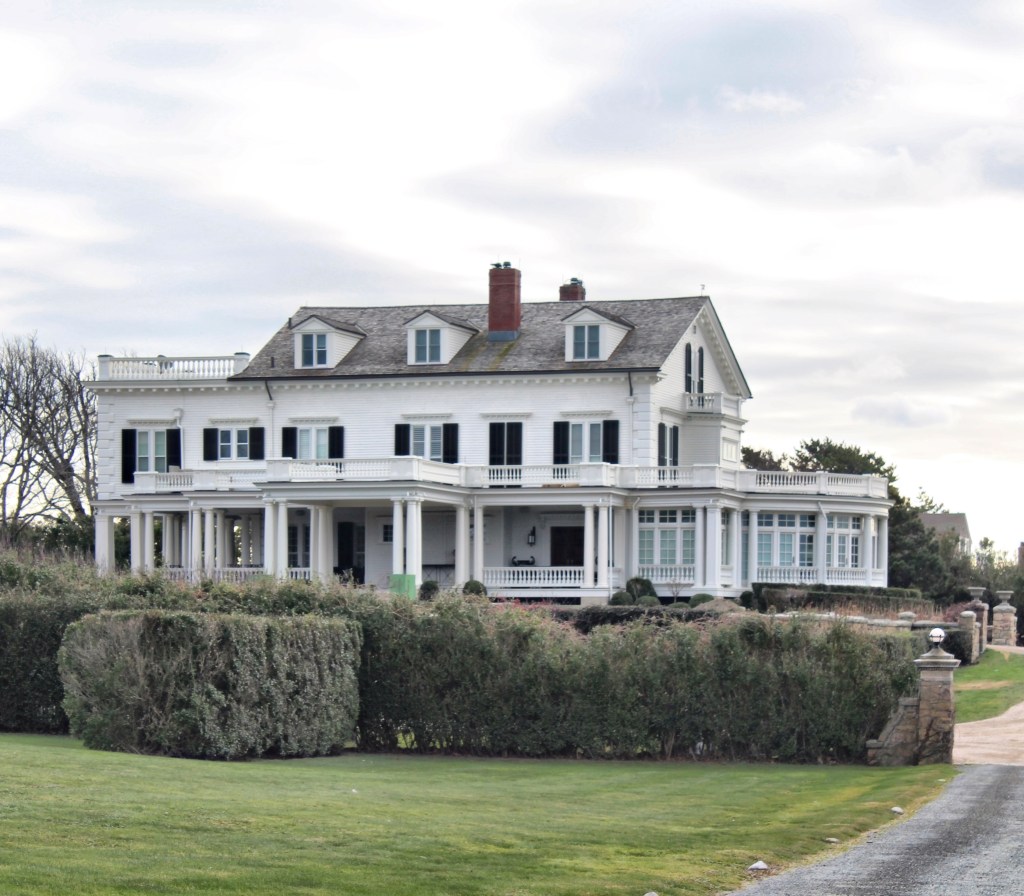
Beachmound, a unique summer residence in Newport, was built in 1897 by architect Henry Ives Cobb for Benjamin Thaw Sr., (1859-1933) a Pittsburgh banker and philanthropist. The mansion is Neo-Classical in style, taking cues from Classical architecture, specifically Greek Revival, with the monumental columns, pediments, and pilasters. Benjamin Thaw was the half-brother of Harry Kendall Thaw (known for the 1906 murder of architect Stanford White). The murder took over the press as one of the more salacious scandals of the gilded era. Harry Thaw’s wife, the actress/model Evelyn Nesbit was said to have been raped by Stanford White while 16 year old (White was 47). She later married Harry K. Thaw. Thaw shot and killed White, the internationally famous architect, in front of hundreds of witnesses in a theater during a performance in New York. Following two trials, he was acquitted based on the insanity defense, a stint in an asylum from which he escaped, and eventual court-ordered freedom, Thaw was a celebrity. A comical piece of the story is that when Thaw later visited “Mar-a-Lago”, the Post Mansion in Palm Beach, Florida (now best known as Donald Trump’s home), he gasped, “My God, I shot the wrong architect!” Beachmound remains as a stunning, refined summer estate in Newport, and is comprised of condo units.

Anglesea Cottage // 1880

Imagine being a neighbor to The Breakers? This 1880 home at Ochre Point along the iconic Newport Cliff Walk was built for wealthy grocery goods merchant of Philadelphia, Walter H. Lewis. The stunning home was designed by architect Detlef Lienau, who was first trained as a carpenter and cabinetmaker in Berlin before attending architecture schools in Munich and Paris. He eventually settled in New York City and was responsible for some amazing homes and commercial buildings there. His design for Anglesea, a summer cottage for Lewis, was French inspired with Stick style detailing. Stonemasons and woodworkers from Italy, along with American craftsmen, built Anglesea, which was designed to afford views of the sea from every angle. The home was purchased and modified in the Colonial Revival style in 1896 by Frederick Pearson and wife Lesley Ayer Pearson. The couple inherited much of their wealth from Lesley’s father James Cook Ayer, who was the wealthiest patent medicine businessman of his day and inventor of Ayer’s Sasparilla. The home remained in the family and was used for high-society gatherings until it was sold out of the family in 1996. Anglesea was purchased by Alfred Carpionato, a Rhode Island developer, who expanded and renovated Anglesea from 1996-2003, with the assistance of architect Friedrich St. Florian. The building is used for events by the group.

“Seaweed” Cottage // 1860

“Seaweed” is a spectacular oceanfront estate situated on Newport’s famed Cliff Walk and overlooking Bailey’s Beach. This home is three-stories with an enormous enclosed porch that offers sweeping views of the Atlantic from all windows. The house consists of 16 rooms including an inviting foyer, nine bedrooms, seven bathrooms, dining room, and living room, all with original fireplaces, flooring, and detail throughout. Views of the sea are from nearly every room. “Seaweed” was originally built and owned by Mr. Henry Howard in 1860-61. It was altered in 1867 by renowned architect George Champlin Mason. Within a decade it was sold to Mr. C. Davis who passed it on to George T. M. Davis. In the 1880’s the property became a rental property owned by Alfred Smith, a real estate agent who lived near the center of town. In the early 1900’s it was purchased by Thomas Dolan of Philadelphia who re-baptized the home “Seaweed” after having architect Horace Trumbauer bring it to its present Colonial Revival style. The name is one of my favorites! What do you think of the name Seaweed for a home?