Anglesea Cottage // 1880

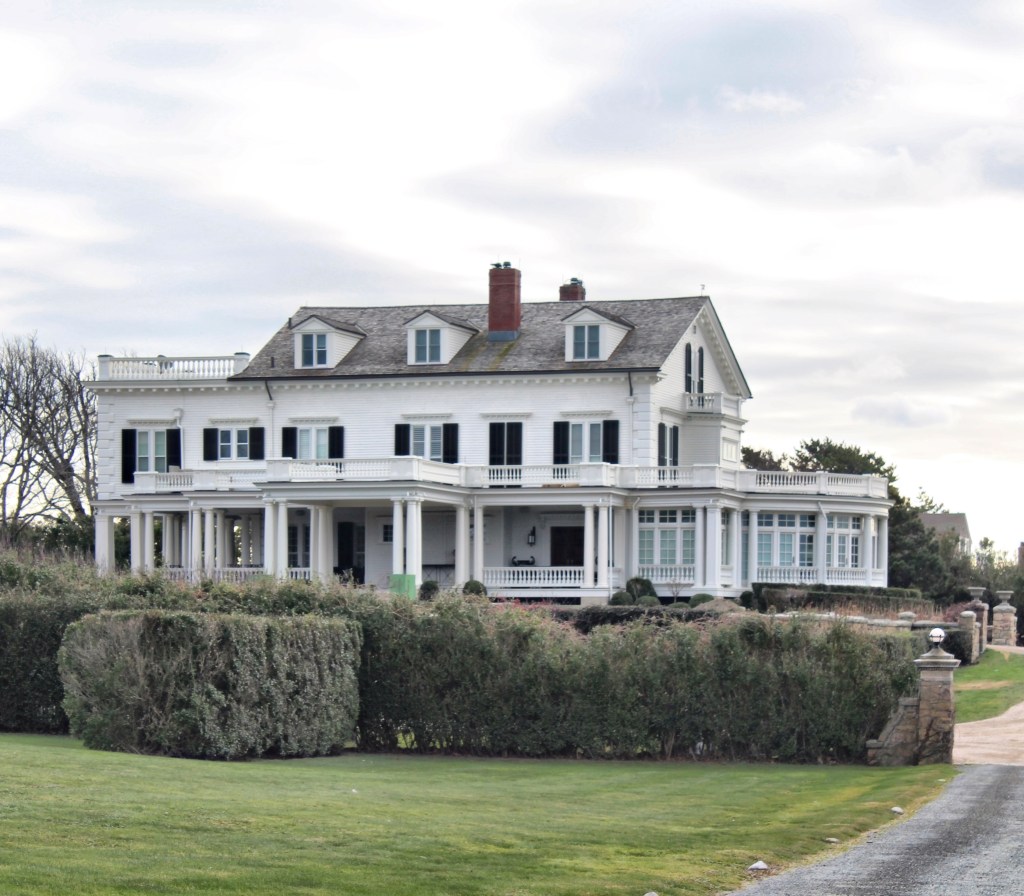
Imagine being a neighbor to The Breakers? This 1880 home at Ochre Point along the iconic Newport Cliff Walk was built for wealthy grocery goods merchant of Philadelphia, Walter H. Lewis. The stunning home was designed by architect Detlef Lienau, who was first trained as a carpenter and cabinetmaker in Berlin before attending architecture schools in Munich and Paris. He eventually settled in New York City and was responsible for some amazing homes and commercial buildings there. His design for Anglesea, a summer cottage for Lewis, was French inspired with Stick style detailing. Stonemasons and woodworkers from Italy, along with American craftsmen, built Anglesea, which was designed to afford views of the sea from every angle. The home was purchased and modified in the Colonial Revival style in 1896 by Frederick Pearson and wife Lesley Ayer Pearson. The couple inherited much of their wealth from Lesley’s father James Cook Ayer, who was the wealthiest patent medicine businessman of his day and inventor of Ayer’s Sasparilla. The home remained in the family and was used for high-society gatherings until it was sold out of the family in 1996. Anglesea was purchased by Alfred Carpionato, a Rhode Island developer, who expanded and renovated Anglesea from 1996-2003, with the assistance of architect Friedrich St. Florian. The building is used for events by the group.
“Seaweed” Cottage // 1860

“Seaweed” is a spectacular oceanfront estate situated on Newport’s famed Cliff Walk and overlooking Bailey’s Beach. This home is three-stories with an enormous enclosed porch that offers sweeping views of the Atlantic from all windows. The house consists of 16 rooms including an inviting foyer, nine bedrooms, seven bathrooms, dining room, and living room, all with original fireplaces, flooring, and detail throughout. Views of the sea are from nearly every room. “Seaweed” was originally built and owned by Mr. Henry Howard in 1860-61. It was altered in 1867 by renowned architect George Champlin Mason. Within a decade it was sold to Mr. C. Davis who passed it on to George T. M. Davis. In the 1880’s the property became a rental property owned by Alfred Smith, a real estate agent who lived near the center of town. In the early 1900’s it was purchased by Thomas Dolan of Philadelphia who re-baptized the home “Seaweed” after having architect Horace Trumbauer bring it to its present Colonial Revival style. The name is one of my favorites! What do you think of the name Seaweed for a home?

Bull-Mawdsley House // c.1680

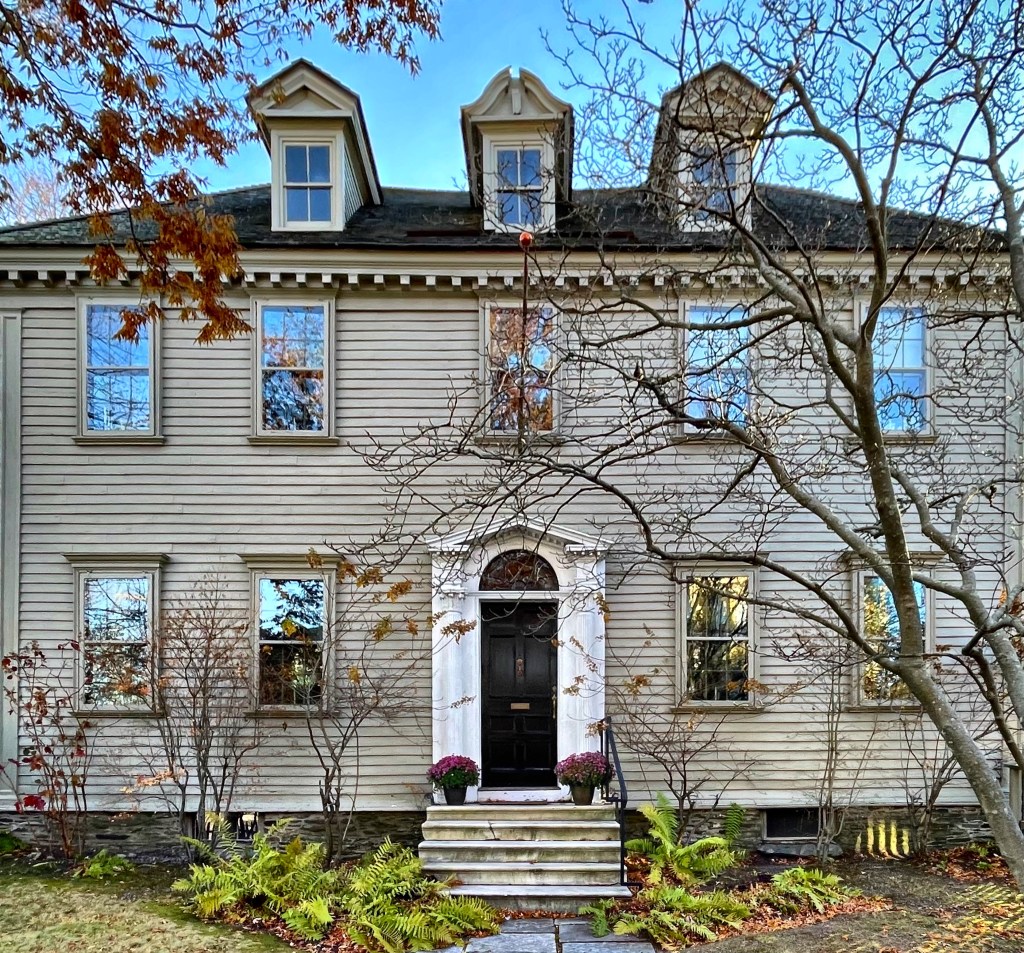
One of the oldest houses in Rhode Island, this beautiful home has a full history that will be hard to fit in a post, but here goes! The earliest, two-room rear part of this house was built around 1680, probably by Jireh Bull near the time of his first marriage to Godsgift Arnold, the daughter of Benedict Arnold, the first Governor of Rhode Island. After Bull’s death, the wealthy businessman and privateer Captain John Mawdsley acquired the house and he enlarged it in keeping with his prominent social status, adding elements inspired by the Georgian classicism. Mawdsley in 1774 owned 20 slaves, many of which likely worked on his ships as crew or cooks. He was a Loyalist, and fled Newport during the American Revolution. During the winter of 1780-81, this was the home of French Major-General François chevalier Beauvoir de Chastellux, who was third in command of French forces in America under the French expeditionary force led by general Rochambeau. After the War, Mawdsley was actually allowed to return to Newport, and resided at the home until his death in 1795. In 1795, after Mawdsley’s death, the house was purchased by slave ship captain and wealthy merchant Caleb Gardner, who is said to have brought thousands of humans in bondage to the shores of Rhode Island and in the Caribbean. Gardner is responsible for the Federal period entry and marble front steps we see today. The home was purchased by Historic New England in the 20th century, and was documented as part of the Historic American Buildings Survey. It is now a private home.

The Reefs Mansion – The Bells // 1885-1963

‘The Reef’ a fabulous Gilded Age estate in Newport was built in 1885 for Theodore M. Davis by the Boston architectural firm of Sturgis and Brigham. The elegant shingle and stone Queen Anne villa was erected as both a summer house and to house some of Davis’s vast collection of paintings and Egyptian artifacts, collected during his excavations in Egypt’s Valley of the Kings between 1902 and 1913. Besides the architecture of the home, the Reef Estate was also famous for its walled gardens, greenhouses, and outbuildings, sitting upon eighteen acres. overlooking the Atlantic Ocean. Following Mr. Davis’ death in 1915, Milton J. Budlong of Providence purchased the estate. Milton divorced from his wife Jessie in 1928, and it was MESSY. Their Newport summer estate was placed in contention. The house, never again lived in by the family. During World War II, anti-aircraft gun emplacements were set up around the grounds, with the mansion housing gunnery personnel. After the War, the estate was given back to the Budlong heirs, who did not reside there. Vandalized throughout the 1950’s, the villa was set on fire in 1961 and demolished two years later in 1963. In 1969, the waterfront property came under the control of the State of Rhode Island and in 1976, became a state park. The old carriage house/stable and a later observation tower (possibly converted from a former water tower) stand today.

The Old Breakers Mansion // 1878-1892

For my last post on this series on The Breakers in Newport, I wanted to highlight the original Breakers mansion. Built in 1878, the original Breakers was equally as significant, but a completely different style architecturally. The Breakers was constructed for Pierre Lorillard IV (1833-1901), a tobacco manufacturer and thoroughbred race horse owner from New York. In 1760, his great-grandfather, and namesake of the family company, founded P. Lorillard and Company in New York City to process tobacco, cigars, and snuff. The ‘cottage’ would serve as a summer retreat for Lorillard and his family for the summer months. The home was designed by one of the premier architectural firms in the country at the time, Peabody & Stearns, who specialized in high-style country estates. In 1885, Lorrilard used his family land in Orange County, New York, to lay out a new residential colony as a playground for New York’s wealthiest residents during the summer months. The colony is known as Tuxedo Park. He sold The Breakers to Cornelius Vanderbilt II in 1885 and the family would summer in the massive Queen Anne style estate for just seven years until a fire destroyed the home. The detached children’s cottage (also designed in 1878 by Peabody & Stearns) survived the fire and remains on the site. The Vanderbilt’s decided to erect a fireproof house immediately, and the result is the massive limestone mansion we can tour today.

The Breakers – Children’s Cottage // 1878

While the Breakers Mansion in Newport is one of the most opulent buildings in the United States, a tiny cottage on the grounds always gives me feelings of whimsy. Predating the larger mansion by two decades, this cottage was constructed on the grounds of the original Breakers House, owned by Cornelius Vanderbilt, which was destroyed by fire in 1893. The cottage was built as a children’s playhouse around the time the original Breakers mansion was built in 1878. The Boston architectural firm of Peabody and Stearns built the mansion and adjacent cottage for Pierre Lorillard IV, a New York cigar manufacturer and millionaire. The Queen Anne Revival style elements, including the half-timbering and shingles and asymmetry, were in keeping with the style of the original Breakers, and complimented it well. My favorite part of the cottage is the open porch facing the ocean, which has four wooden posts, carved in the shape of figures from Dutch folklore, a sort of caryatid, supporting the roof. The house contains a living room and kitchen separated by a huge red brick chimney, which would be maintained by servants for the children while they play.

The Breakers – Library // 1895

Tied as my favorite room with the Morning Room at the iconic Breakers Mansion in Newport, the jaw-dropping library is almost too good to be true. The library was designed to be the centerpiece of life for Cornelius Vanderbilt, who was always well-read. The walls are paneled with Circassian walnut cut in Europe and stamped with gold. The ceiling is coffered with more gold leaf. The fireplace in the library is probably my favorite in the mansion, which was acquired from a 16th-century French chateau, Chateau d’Arnay Ie Duc. The walls in the library and its smaller alcove are covered with wainscoting of Circassian walnut decorated with low relief carving and gold leaf; the walls above the woodwork are covered with panels of gold-embossed Spanish leather. Yes, leather walls! What is your favorite part of the Breakers Library??

The Breakers – Music Room // 1895

You know you’ve “made it” if you have a music room, especially if you have one in your summer mansion in Newport! The Music Room in The Breakers evokes the opulent Parisian interiors of the Second Period and when inside the room, you just feel sensory overload (in the best way possible. The room is located off the Great Room and Morning Room, at the southern end of the house. The Music Room was used for recitals and dances for the Vanderbilt Family and guests. The room displays ornate woodwork and furnishings designed by Richard Van der Boyen and built by J. Allard of Paris. The room looks like it was plucked out of a French building and dropped into the mansion, and that is because it was! The room’s interior was constructed completely in France and then sent to America where it was installed at The Breakers by French craftsmen. My favorite parts of the interior are the bay window at the end and the gilt gold coffered ceiling.

The Breakers – Morning Room // 1895

Possibly my favorite room in The Breakers mansion is the Morning Room, found on the first floor, just off the Great Hall and lower loggia. The Morning Room is executed in a late Renaissance style and faces east to catch the morning sun and provides sweeping views of the Atlantic. It served as a family sitting room at all times of the day. The interior design, including the fixtures, woodworking, and furniture, were designed by French architect Richard Bouwens van der Boijen and designer Jules Allard. The predominant grey, and gold colors of the Morning Room are echoed in its fireplace which is made of Campan marble. On the walls, you will find the most stunning shimmering silver wall panels, depicting ancient Greek goddesses. It was originally believed that these features were silver leaf, but the Newport County Preservation Society investigated further, determining it is actually platinum! The Vanderbilts clearly wanted this room to shimmer with the sunrise, so the use of platinum, which never tarnishes, was a great solution!

The Breakers – Great Hall // 1895

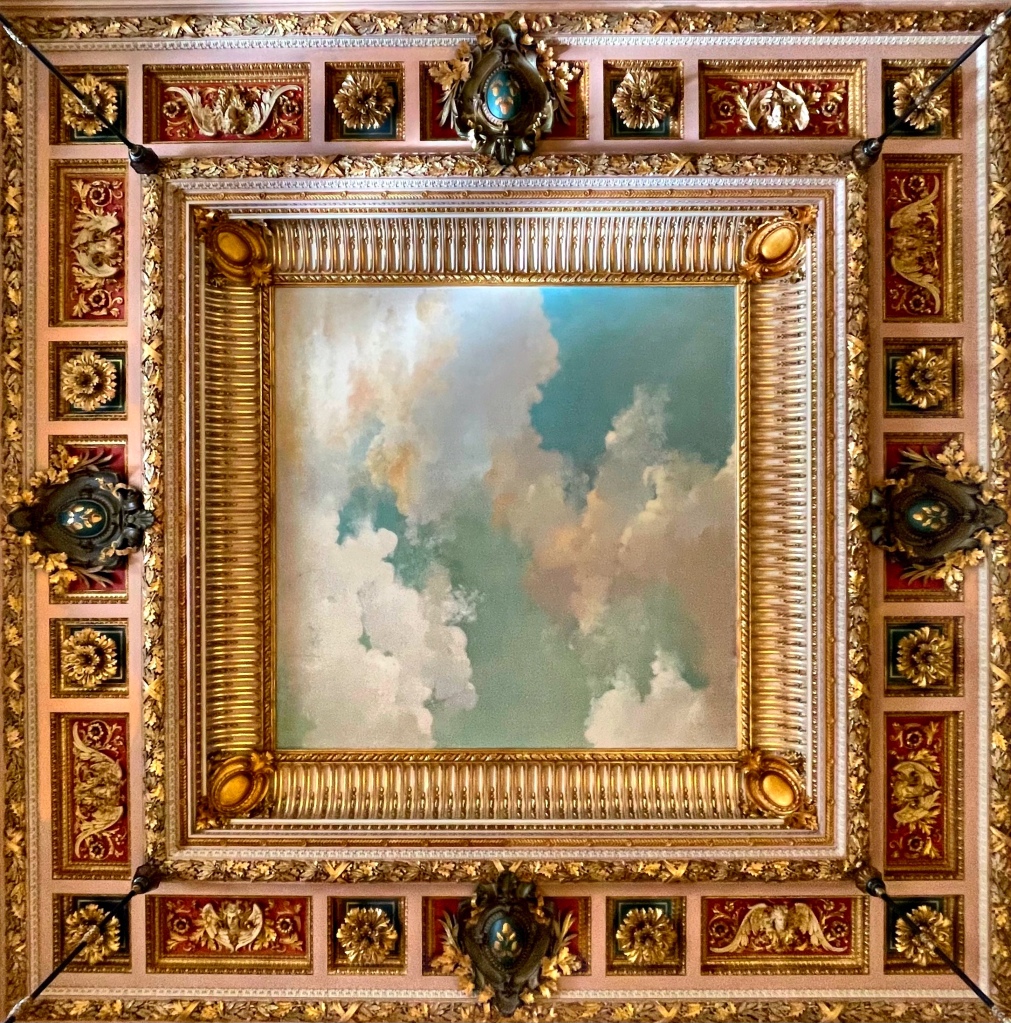
Merry Christmas from The Breakers! This 1895 Gilded Age mansion is the best to explore during December, when the halls are decked and stunning Christmas trees adorn the lavish rooms (learn more about the mansion in my last post) When you walk into The Breakers, you enter the Great Hall. Architect Richard Morris Hunt designed the Great Hall after the open-air courtyards in Italian villas, but enclosed due to the tough New England winters. The palatial space (measuring 50 foot square), even if crowded by tourists trying to get the perfect shot on their smartphones, feels spacious yet somehow welcoming given the art museum-like detailing. The walls are made of carved limestone from Caen on the coast of France and adorned with plaques of rare marbles. Elaborately carved pilasters decorated with acorns and oak leaves support a massive carved and gilt-cornice which surrounds a ceiling painted to depict a windswept sky, further expressing the open-air courtyard feeling envisioned by Hunt, the architect. Four bronze chandeliers dangle from the gilded ceiling, and flood the room with warm light, evoking warm summers in Italy.