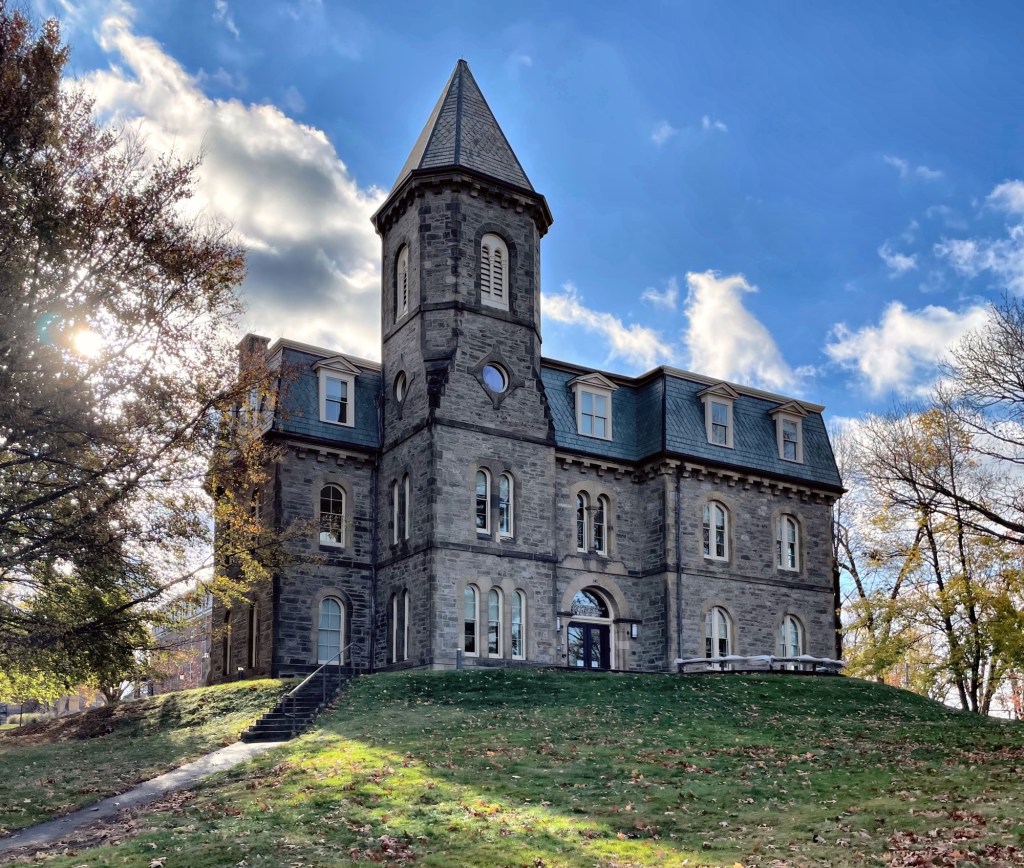
Colby Hall – Andover Newton Theological School // 1866

Colby Hall sits perched atop a hill overlooking Newton Centre, Newton, and is located in the Andover Newton Theological School campus. The building was constructed in 1886 for the Newton Theological Institution, which was founded on this site in 1825, and used for the a Baptist seminary, educating young students in theology. By the 1860s, the school had outgrown its space and following a donation from benefactor,  Gardner Colby (1810–1879), who was treasurer of the school (and was also the benefactor and namesake of Colby College in Maine) plans were drawn up for the new lecture spaces and chapel building. The unique building was designed by Alexander Rice Esty, a prominent architect at the time, and it blends Second Empire and Romanesque Revival styles under one roof. The three-story structure is of a light buff, rough cut stone with sandstone trim and features an imposing four-story tower at the eastern end. In November 2015, the school announced that it would sell its campus and become part of Yale Divinity School in New Haven, Connecticut. The Newton campus was purchased by the Windsor Park School with Colby Hall now occupied by the Boston Psychoanalytic Society & Institute.
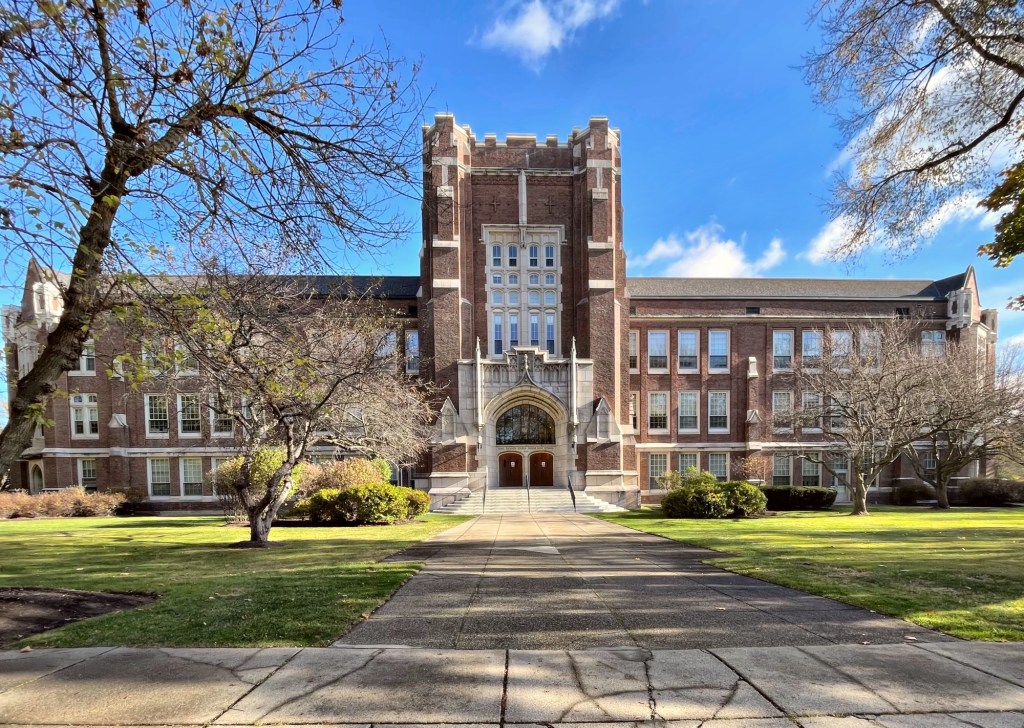
Former Weeks Junior High School – Weeks House // 1931

Adaptive reuse projects will ALWAYS get love on here!

Originally constructed in 1931 as the Weeks Junior High School in Newton Centre, Newton, this architecturally significant school building is the finest local example of the Tudor Revival style in that use. The Weeks School was designed by Ralph Coolidge Henry and Henry Parsons Richmond, architects who were draftsmen for Guy Lowell, one of the greats, and the successors to his practice upon his death in 1927. The design for the Weeks School is of traditional brick and cast stone, with its main entrance through a large Gothic arch at the center of the building. Two wings extend parallel to the tower and then bend back at 45-degree angles, creating the distinctive U-shaped form, which provided ample natural light in all classrooms. After a consolidation of local schools in the mid-20th century, the Weeks School closed, but was beautifully rehabbed in 1984 into housing as the Weeks House. Today, the building is comprised of mixed income housing of about 75, one-, two- and three-bedroom units.

Oak Hill Middle School // 1936

In the 1930s, America was in the throes of the Great Depression, and towns and cities struggled to provide services for the ever-growing populations, all the while suffering from lower tax revenues. The New Deal was enacted as a result, which provided a series of programs, public work projects, financial reforms, and regulations enacted by President Franklin D. Roosevelt between 1933 and 1939. One of these programs was the Public Works Administration (PWA), which funded and built large-scale public works projects such as dams, bridges, hospitals, and schools, to provide jobs and bolster local economies. In Newton, the developing Oak Hill Village required a new public school, and the town received funding for the Oak Hill Middle School in 1935. Architects Densmore, LeClear, and Robbins were hired to provide designs for a new school, and builders completed the building the next year. The Georgian Revival building is constructed with red brick with cast stone trim. The 16-over-16 windows and cupola also work to showcase the beauty of the design.

Do you know of any PWA projects near you?