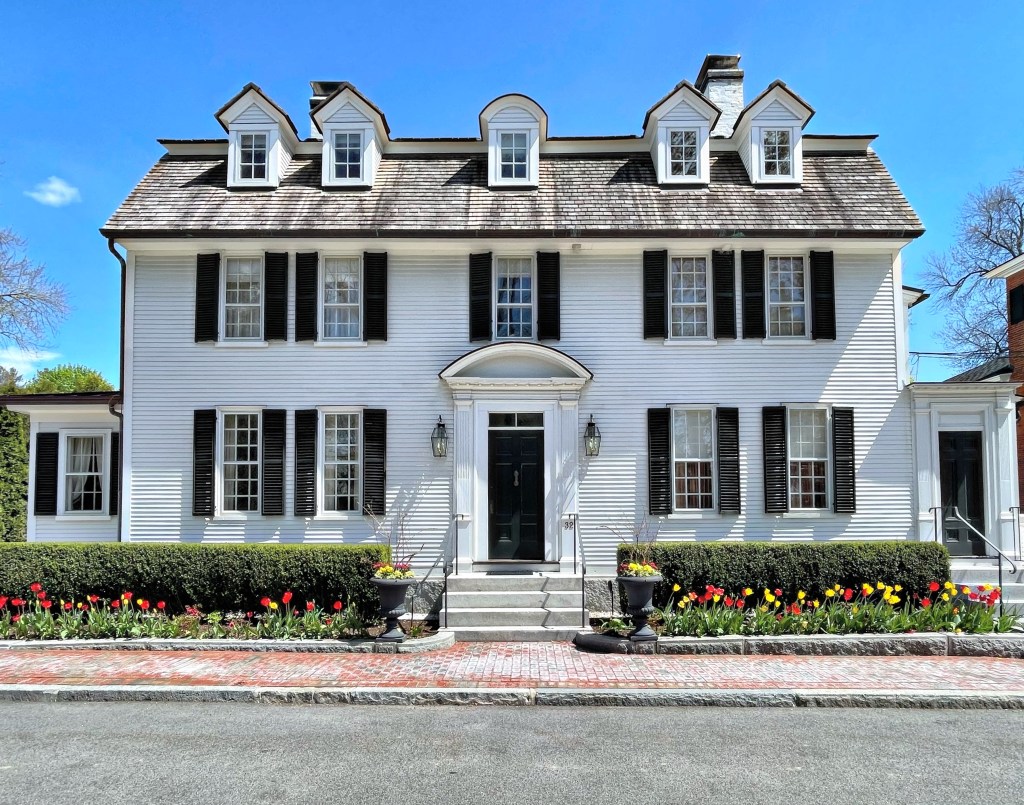
The Captain Drisco House on Meetinghouse Hill Road is a recently restored example of the vernacular Federal period architecture so many flock to Portsmouth to see. The house sits in the middle of a warren of short streets where houses (all built before zoning and setbacks) were built right at the sidewalk creating the most pleasant walking experience. The symmetrical five-bay Federal house was built by Captain Drisco, who purchased the house lot after the Revolutionary War.
Many may not know this fact about Portsmouth, which shaped the city’s development for some of the formative years of the coastal town. The 1814 Brick Act was passed by the New Hampshire legislature after three devastating fires wiped out hundreds of closely-packed wooden buildings in the heart of the state’s only seaport. The act prohibited the erection of wooden buildings of more than twelve feet high in the downtown area which was the densest, it was effectively an early building code. The regulation helped change the look of the city, creating the red brick image Downtown that many identify today as Portsmouth. As a result, nearly all homes and buildings in the downtown area of Portsmouth were constructed of brick, largely in the Federal style, popular at the time. This home was constructed around 1815 as a wedding present for the South Parish’s minister, Reverend Doctor Nathan Parker, upon his marriage to Susan Pickering, the daughter of New Hampshire Chief Justice John Pickering and a descendant of the original John Pickering.
Matthew Livermore (1703-1776), a native of Watertown, Massachusetts and a 1722 Harvard graduate, came to Portsmouth in 1726 to teach grammar school while studying law, and in 1731 became the first college-educated lawyer to practice in New Hampshire. He would build this Georgian mansion in Portsmouth in 1735. Later, the property was owned by Samuel Coues, a leader of the shipbuilding industry in Portsmouth during the 19th century, and leader of the American Peace Party in the 1840s. Fitz John Porter was born in the house in 1822. General Porter would become one of the Union’s most talented leaders at the beginning of the Civil War. After the U. S. Army dismissed him for disobeying what would be a suicidal order during the Second Battle of Bull Run, he spent the rest of his life fighting the charges. The army cleared his name in 1879.After this, the home was occupied by General Fitz John Porter, a United States Army general who served in the Mexican–American War and the American Civil War. The building was moved in 1900 when Haven Park was created by the City of Portsmouth, and it had already been moved in the 19th century to front the newly laid out Livermore Street. The Livermore-Porter House was eventually converted into condominiums in 1983, and it showcases how condo conversions aren’t a bad thing! More people can live in this house now, win-win!
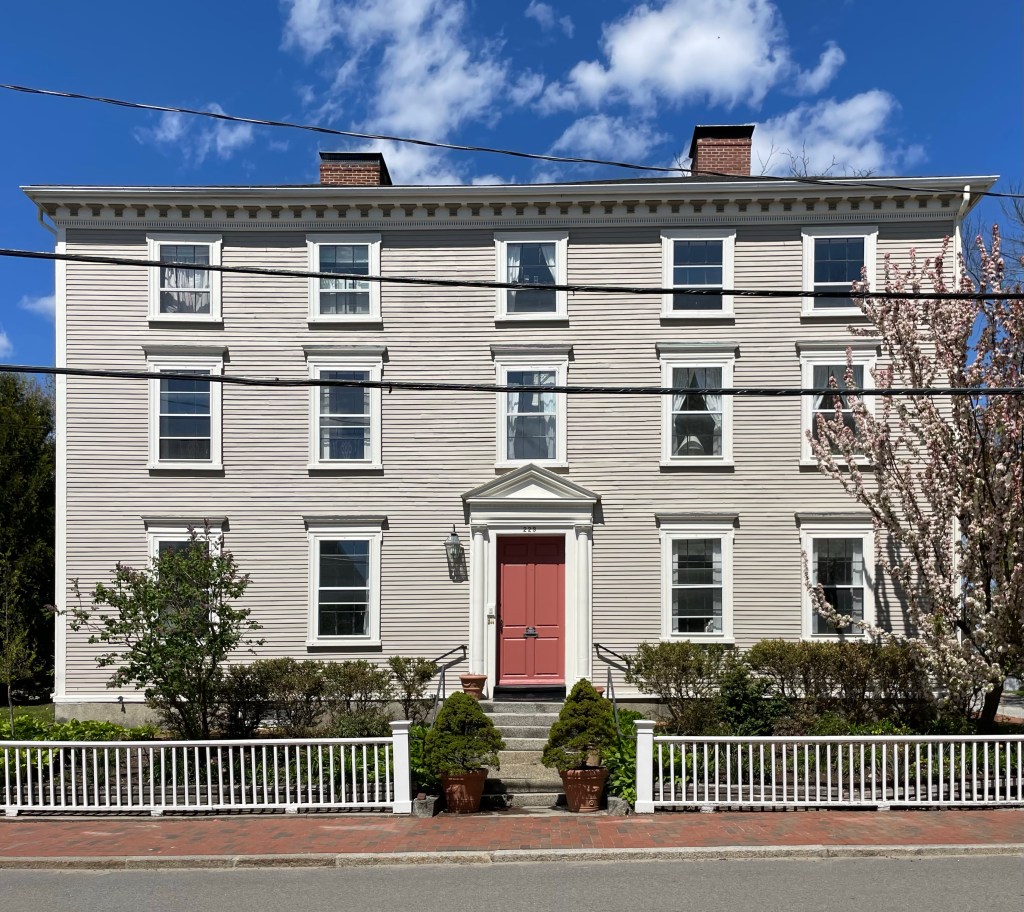
Another three-story Federal period house on Pleasant Street in Portsmouth, NH is this wood-frame example, known as the Haven-White House. The property was developed in 1799-1800 by Joseph Haven, a merchant who built the house across the street from his father’s residence. Joseph Haven occupied this house until his death in 1829. After his wife Sarah’s death in 1838, the house remained in the Haven family, though usually occupied by others, until 1898 when it was sold to Mrs. Ella White. The White family, which included a grocer, a City Councilman in the early 1900s; and a chiropractor, with the family occupying the house until 1981. This history of long ownership by only two families for nearly 200 years perhaps accounts for the survival of this important house with so few changes. As a result, the house was listed on the National Register of Historic Places in 1985, marking it as a nationally significant building.
The Abraham Wendell House on Pleasant Street in Portsmouth, New Hampshire, is a three-story, five-bay, masonry Federal-style residence with symmetrical facade. The building has a slate hip roof with overhanging eaves, a dentilled cornice, and tall brick chimneys. The facade has a wood-paneled entrance door with elliptical entablature, Corinthian pilasters, and a fanlight above. The home was built around 1815 for Abraham Wendell (1785-1865) a ship’s chandler and hardware merchant. Along with his brothers, Jacob and Isaac, established cotton mills in Dover. Although they lost money on the early mill attempts, they became wealthy importer of foreign goods into the ports of Portsmouth. The house remains a highly significant example of early 19th century residential architecture built for wealthy merchants.



 Buildings of New England