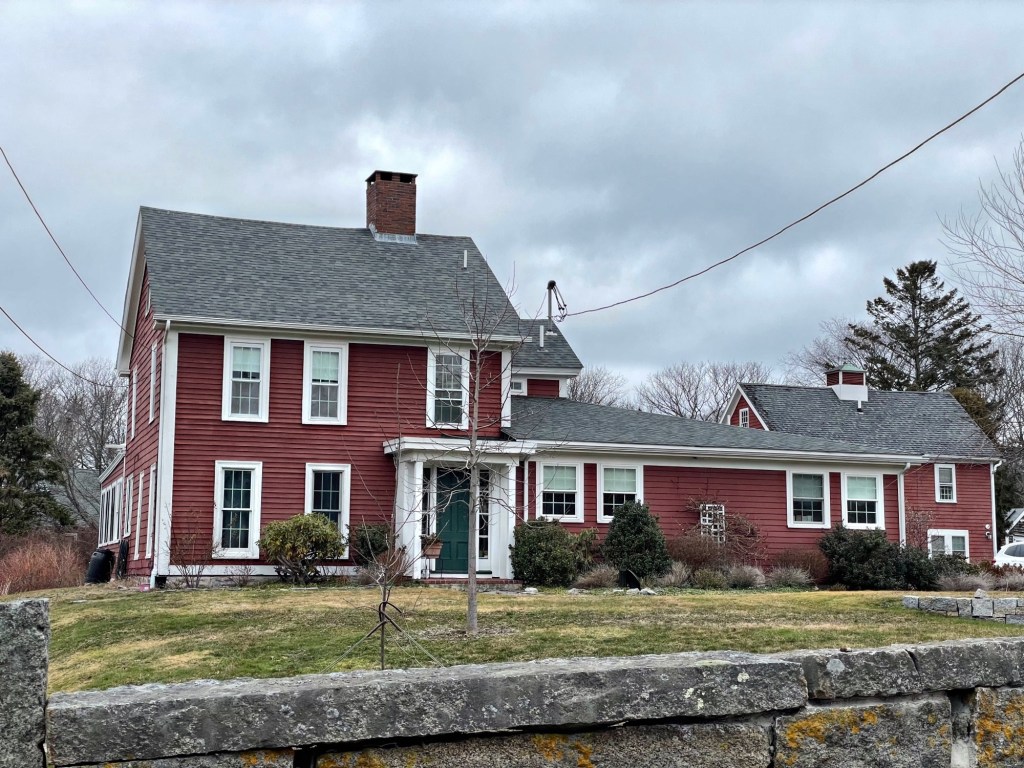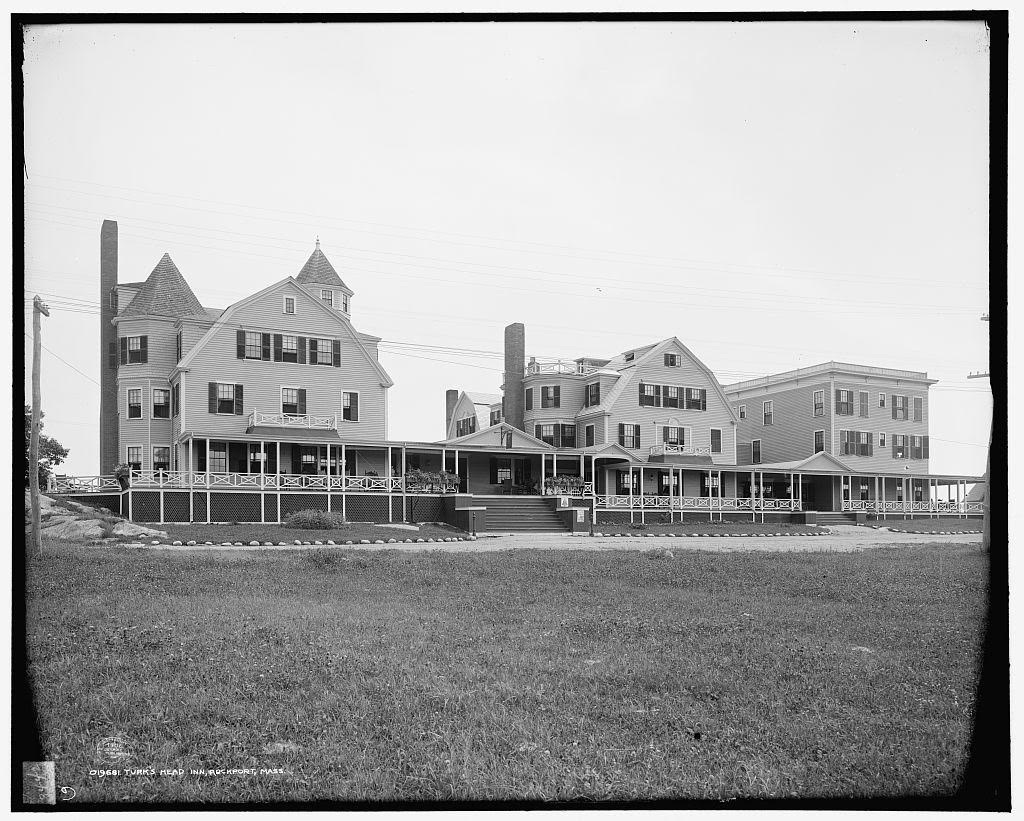
Turk’s Head Inn // 1890-1970

The Turk’s Head Inn was once Rockport’s grandest getaway. For those uninterested in building their own summer cottage to spend the along the coast of Massachusetts, luxury summer resorts provided summer rentals for those escaping the hot and polluted cities in favor of cool ocean breezes. Once situated in the  Land’s End section of Rockport, the Turk’s Head Inn, had sweeping views of the coast and islands in the distance. The initial portion was built from 1889 to 1890 by builder J. M. Wetherill of Rockport based on plans by architect H. M. Stephenson of Boston. It was expanded and became this rambling, E-shaped Colonial Revival structure with a seaboard frontage of two hundred feet and wraparound verandas over three hundred feet in length. Over the years, the Turk’s Head Inn suffered a number of fires, and its central and southeast wings were rebuilt, the latter in 1905 by then owner C.B. Martin. With a peak capacity of 200, the hotel, uncharacteristic of the regional hospitality industry, remained in operation for eighty years before it was closed down, partially destroyed by fire, and the remains removed in 1970.
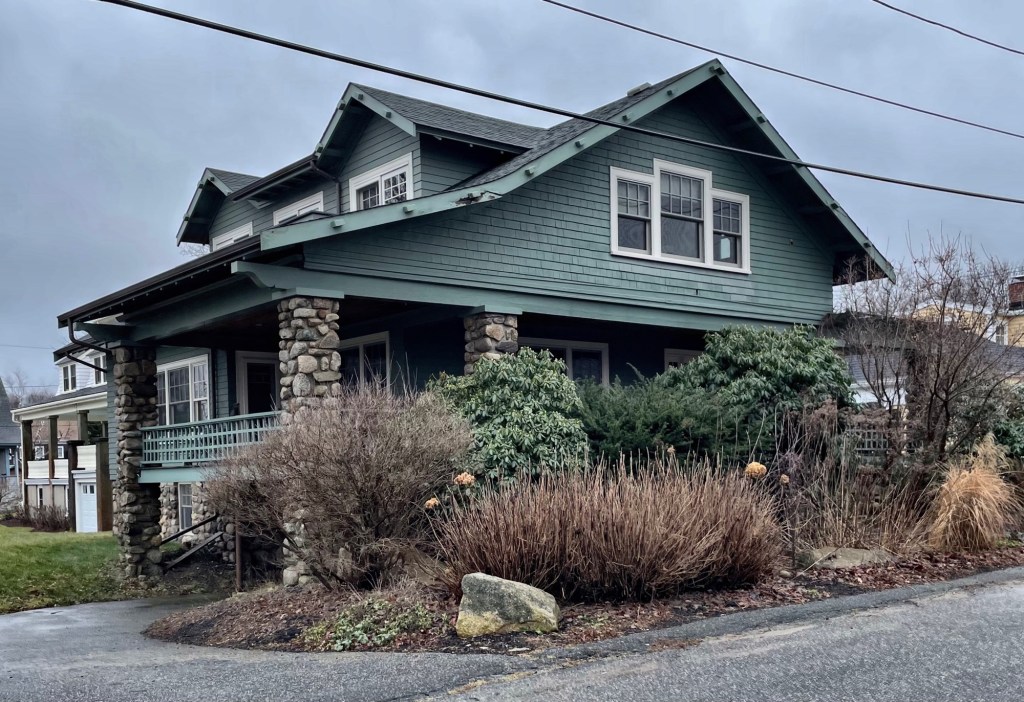
Haskins Cottage // c.1910

Another great turn-of-the-century summer cottage in Rockport’s Headlands neighborhood is this c.1910 Craftsman house on Norwood Street. The listed early owner was L. S. Haskins who likely utilized the house as a summer residence. Architecturally, the cottage follows the Craftsman form with a low-sloped roof with broad eaves, shed dormer, exposed rafters, and rubblestone foundation and columns of stones taken from the site and nearby neighborhood.  

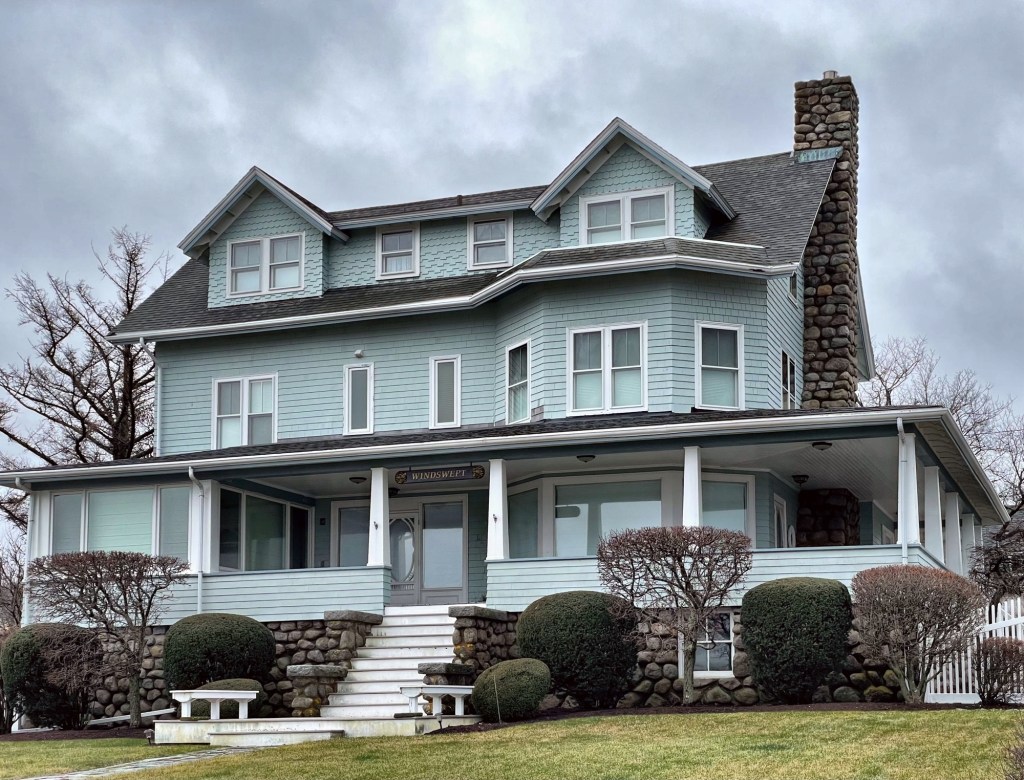
Windswept Cottage // 1909

The coastal towns of Gloucester, Manchester, and Beverly on the North Shore of Massachusetts often are known for their historic summer “cottages” but great examples can be found right here in Rockport! This is “Windswept”, the W. W. Blunt cottage, located in the Headlands section of town, just south of the harbor. Walton W. Blunt worked as the Treasurer and General Manager of the Boston Journal newspaper and resided in Boston, later purchasing multiple adjoining house lots in Rockport for a summer residence. The two-and-a-half story house was designed by a Rutherford Smith, who sought to utilize fieldstone found nearby for the foundation and chimneys and shingle siding above. Detailed descriptions of the new house were featured in a local newspaper in 1909 and mentioned tennis courts on the grounds, an apartment for servants, and a billiard room in the third floor. It is not clear when the house got its name, “Windswept”, but the name is just too fitting!

Thorndike-Conway House // 1769

This homestead is one of the earliest homes in the Camden–Rockport area of Maine. Originally built inland from the harbors, the house was a one room cabin with an open sleeping loft above. Allegedly built in 1769 by Robert Thorndike (1734-1834) one of the earliest settlers of Rockport the house has served as a significant piece of the town’s history ever since. There were two additions to the house in 1806 and 1826. The first addition in 1806 consisted of the front door entry and the front parlor, a birthing room and a chamber and loft above. The 1826 addition in the back of the home provided a kitchen area that was later divided to provide a small parlor. In 1826, Frederic Conway bought the property from Robert Thorndike Jr., which remained in the family until 1916. The property is now owned by the Camden-Rockport Historical Society as a house museum and the organization is further documenting the history of this house and the two towns.

Oak Knoll Cottage // c.1877

One of the earlier cottages built in the Oceanview summer colony of Rockport, Massachusetts is this charming example of a late-Italianate style residence on Phillips Avenue. Local lore states that the cottage was owned by Lucy Canney, the wife of Edwin Canney, who operated multiple granite quarries in town. Oak Knoll was possibly used as a boarding house for visiting guests of the quarries to stay at when inspecting the quality of the granite. The Canney’s sold off much of their property in the area by the end of the 19th century, and the cottage was later owned or occupied by Dr. Helen Morton (1834-1916), a Boston-based obstetrician and one of the early generation of women physicians practicing in Boston in the nineteenth century. Dr. Morton spent most of her time in a townhouse on Marlborough Street in Boston’s Back Bay with her possible partner, another obstetrician, Mary Forrester Hobart, but likely escaped to this cottage for some rest and relaxation for the summers.

Eben Phillips Cottage // c.1877

In the mid-1800s, Rockport, Massachusetts was best-known as one of the main ports for the quarrying and shipping of fine granite up and down the east coast of the United States. While the rocky coastline made granite a prime industry, the natural scenery also made the coastal areas desirable for residential development. While many of the coastal developments here never took-off as they did in nearby Gloucester, Magnolia, and Beverly, there are some notable summer colonies that sprouted up! In 1855, Eben B. Phillips an oil dealer in Boston, purchased undeveloped wooded lots and pastures, and slowly began to lay out roads and survey for developable lots for summer cottages on a peninsula near Pigeon Cove. The development was named “Oceanview” and it was marketed as the extreme point of Cape Ann. Development was very slow to materialize, and started in earnest in the 1870s. Eben Phillips built this summer cottage before 1877 (possibly as early as 1850), where he would spend summers until his death in 1879. The cottage retains much of its original character and is a rare survivor of the rustic style cottages which were built before the phase of larger Shingle and Queen Anne residences were built in later decades.

Norwood-Babson Farmhouse // 1799

Located in northern Rockport, Massachusetts, you will find this charming Colonial-era farmhouse set amongst the backdrop of ocean cliffs and granite quarries. At the tip of Pigeon Cove, adjacent to the present-day Halibut Point State Park, James Norwood purchased land and would erect this house by 1799 for his family (possibly built from an older dwelling formerly on the site). After James’ death, the property was willed to his daughter and son-in-law and sold a few times until 1820, when it was purchased by David Wallis Babson who raised his family here. As granite-quarrying became a lucrative trade in Rockport by the early-mid 19th century, David’s son Joseph bought twelve of the Babson Farm acres from other family members to organize a stone cutting business here. The property would leave the Babson Family decades later, but retained the family name until today. Edwin Canney would purchase the remaining 70-acre Babson Farm, selling it to the Rockport Granite Company. For the next thirty years, industrial-scale mining and shipping would redefine Halibut Point over the next thirty years. The quarries are now a State Park, and the former Norwood-Babson farmhouse remains intact as a significant piece of the town’s earlier history.

First Congregational Church of Rockport // 1805

Fondly referred to as the “Old Sloop” in town (a name conferred by local fishermen in the 1800s), the First Congregational Church of Rockport stands as one of the most prominent landmarks in the old village. The village of Sandy Bay (now downtown Rockport) had a growing population since the 1700s. Prior to 1755, churchgoers from Sandy Bay made the journey every Sunday by horse or foot in good weather to the parish in Annisquam or the First Parish in Gloucester, and in poor weather, met in a small log schoolhouse on this site. Eventually, a church building was erected in town, which was used until after the Revolutionary War. In 1805, a new meetinghouse was built where it stands today. In 1814, the British invaded Sandy Bay colony and residents rang the Old Sloop’s bell to sound the alarm. British forces fired a cannon at the bell to silence it, but hit the steeple instead. A replica cannonball can be seen to this day in the steeple as a nod to that historic event. In 1840, the people of Sandy Bay voted to establish the Town of Rockport. At that time, the meetinghouse was completely redecorated and the steeple enlarged. After the Civil War, the church was outgrown, and in 1872, the Old Sloop building was cut in half and separated by about twenty feet with an addition built in the middle. At that time the steeple was enlarged and strengthened to accommodate a new and heavier bell and the Town Clock. In 2015, the church began a campaign to replace the deteriorated steeple, which was rebuilt, faux cannonball and all!