Southbury Training School // 1940

The Southbury Training School occupies about 1,500 acres of land in Southbury, Connecticut comprised of two major sections: a self-sustaining 400-acre institutional campus and its contiguous 1,100-acre farm complex. Planning for the Southbury Training School began in 1935 at the height of the Great Depression. The State needed to provide housing and services for 1,200 residents on the waiting list for the Mansfield Training School, the state’s only facility for the mentally handicapped at that time. Site planning and development were the responsibility of architect Edwin A. Salmon, later Chairman of the NYC Planning Commission, along with A. F. Brinckerhoff, who was hired as the landscape architect. Two buildings of the nearly 100 that comprise the campus stood out to me the most, they are the Roselle School and the Administration Building. Both structures were built in 1940 and are hallmark examples of inter-war Colonial Revival style buildings for institutional use. Both structures have large cupolas at the roof and symmetrical facades with applied wood ornament over the brick. The Roselle School has a recessed entry and the Administration Building is notable for its hipped roof and pilastered façade. In recent decades, the State of Connecticut has been under-funding the complex, leading to lawsuits and concerns statewide. The state has been moving residents and patients to other facilities, likely in order to sell-off or redevelop the campus in the future. This is one to watch out for!

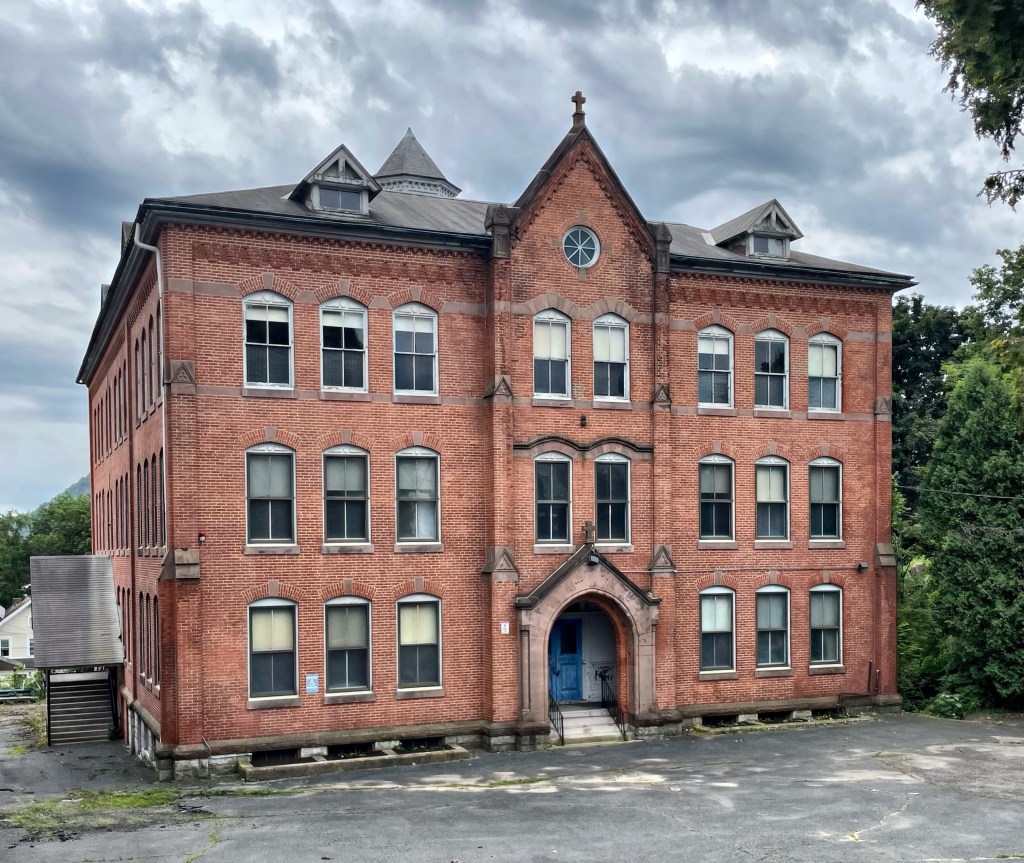
Former Notre Dame Parochial School // 1898

Located next door to the former Notre Dame Roman Catholic Church in North Adams, Massachusetts, this stunning former school building stopped me in my tracks. The sad fact is that the former school is seemingly vacant makes me really sad and concerned for the future of the building. This beauty was constructed in 1898 to serve as a school associated with the Notre Dame Roman Catholic Church located to its east. Local architect Edwin Thayer Barlow, who formerly worked with Carrere and Hastings, designed the building in the Queen Anne and Romanesque Revival styles, both popular at the time. The school remained in operation until the 1968-1969 school year, after several years of declining enrollment. The City of North Adams leased the school beginning in the 1969-1970 school year to relieve overcrowding at the public schools. In 2008, the City of North Adams purchased the school and church properties from the Springfield Roman Catholic Church Diocese after the church closed in 2005, but no plans have yet materialized to restore the beauties. What would you like to see this building converted into?

Freetown Village School // 1794

The Freetown Village School was originally built in 1794 as a lawyer’s office. At that time, it was half as wide as its current configuration. Around 1800, the office became a private academy for children of sea captains and ship-builders in Assonet. In 1858, the Town of Freetown purchased the building and turned it into a public school. By 1906, the school was enlarged and given the Colonial Revival detailing we see today. Like many smaller schools in New England, this school building was outgrown after WWII, and converted to other uses for the town, with uses from committee meeting space to storage. The schoolhouse was finally abandoned at the end of the 20th century, and stood empty. The roof developed leaks and water infiltration became a serious problem. In 2011, the Town approached the Massachusetts Historical Commission for an Emergency Grant, and was granted $30,000 for the preservation and restoration of the decaying building. The roof has been replaced and structurally repaired, but more work is to be done. I can’t wait to come back and check up on this beauty.

Women’s Service Club of Boston // c.1860

This historic rowhouse in the South End of Boston was home to the Women’s Service Club, a social and volunteer organization made up of Black women to uplift Black Bostonians of varied backgrounds, including soldiers, students, migrants and mothers. “464,” as some locals admiringly called it, was formed in the early 20th century as Boston. The city, once known as “Freedom’s Birthplace” and the “Athens of America” as a hub of abolitionist activity leading up to the Civil War, saw extreme segregation in housing and education for its Black residents by the early 20th century. From this, local activist Mary Evans Wilson organized a knitting group in 1917 to support soldiers of color fighting in World War I. An estimated 350 women joined the group, donating their talents to produce scarves and gloves for servicemen. Humanitarianism guided the activity of the Women’s Service Club’s over the next half century. This building was purchased in 1919 and operated as part-meeting space and part-settlement house. “A Home Away from Home,” as some described it, the building offered affordable shelter to female workers, migrants, and college students barred from on-campus housing due to racist policies. One of the club’s most prominent members was Melnea Cass (1896–1978), who served as its President for more than fifteen years. Cass initiated the Homemakers Training Program which certified domestic workers so they would be assured a liveable minimum wage, social security and other benefits. The club continues to do great work, but could use funding to restore the landmark building!