Winfield S. Richards Cottage // c.1890

Summer cottages of the late 19th century are always a treat to come across! While most cottages I feature on here are more high-style and were built for the wealthy, Hull, Massachusetts, has some of the best middle-class summer cottages in New England! Steamships and rail service from Boston and other cities opened up Hull and Nantasket Beach to summer residents and day visitors alike, creating a massive increase in building in the latter decades of the 19th and early 20th centuries. This cottage was owned by Winfield S. Richards and his wife Myra of Newton, Massachusetts. The cottage blends Queen Anne and Craftsman styles with complex Queen Anne massing, turned posts, and recessed second story porch, and sloping roof extension to create the Craftsman-esque front porch. The cottage is one of the better-preserved in town and an excellent blending of architectural styles.
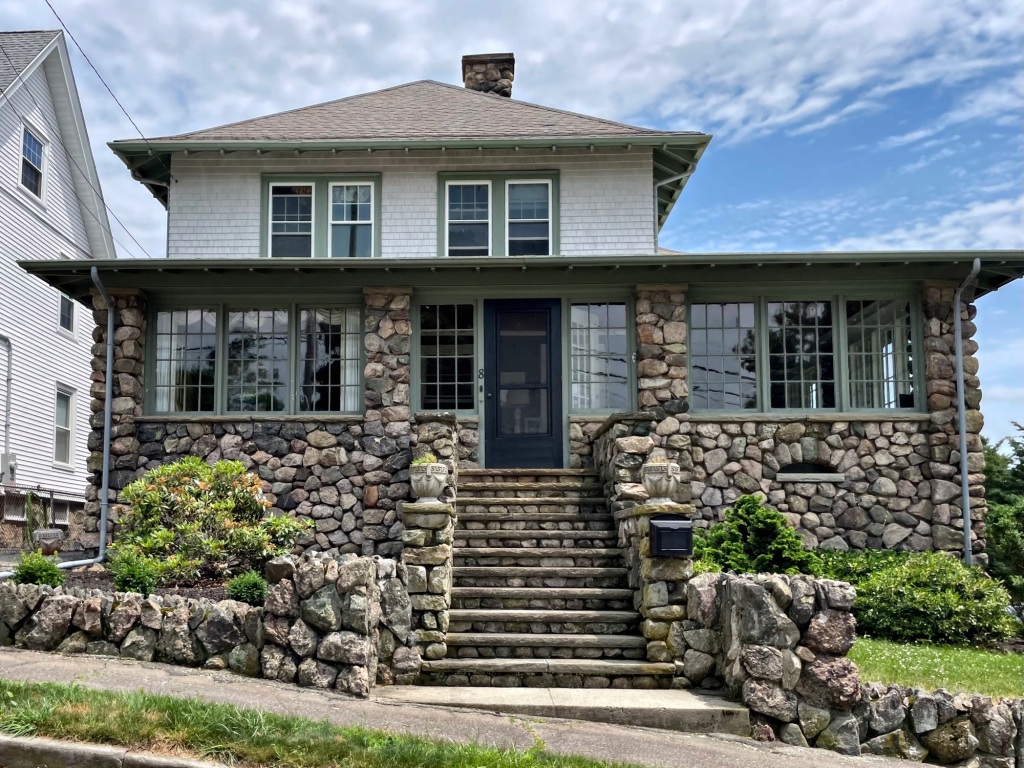
John Smith House // c.1895

Hull, Massachusetts is an often overlooked town (besides Nantasket Beach Reservation), but there are some really great old houses and buildings to be found in the seaside town. This is the John Smith House on Meade Avenue in the Atlantic Hill neighborhood inland from the peninsular part of town. Development here was fairly slow, but took-off in the late 19th century when cottagers began to develop some house lots here. They were soon joined by year-round residents like John Smith, an ice merchant who built this home around 1895. Craftsman in style, the house exhibits a mix of building materials with a rough fieldstone porch and two matching stone chimneys together with wood shingle siding. The stunning stonework extends from the foundation, uniting the house to its terraced, rocky site. It is one of a handful of homes here that have not yet been altered or covered up by vinyl siding.

Old Nantasket Beach Police Station // c.1930

The area of Nantasket Beach in Hull in the late 19th century was a hotbed of taverns, thievery, and brothels. To counter this trend of unsavory uses, the Metropolitan Park Commission (MPC) of Greater Boston acquired about 25 acres of land at Nantasket, which included roughly one mile of shoreline extending north from Atlantic Hill in 1900. The initial appropriations provided for only minimal facilities, such as a bathhouse and a few incidental buildings, one of which was a waiting room for those arriving or departing from the new railroad station (since demolished) at the beach. The MPC hired the Olmsted Brothers landscape architects to design the paths and landscaping for the new park, and they worked with architects Stickney & Austin who designed many of the early buildings here. This stucco structure was built around 1930 and served as MPC offices and a police station until 1992. The building has been vacant since 1992, but a recent push to convert the nearly 100 year old structure into the Nantasket Center for the Arts is slowly materializing. Fingers crossed to see this building preserved and used for the arts!

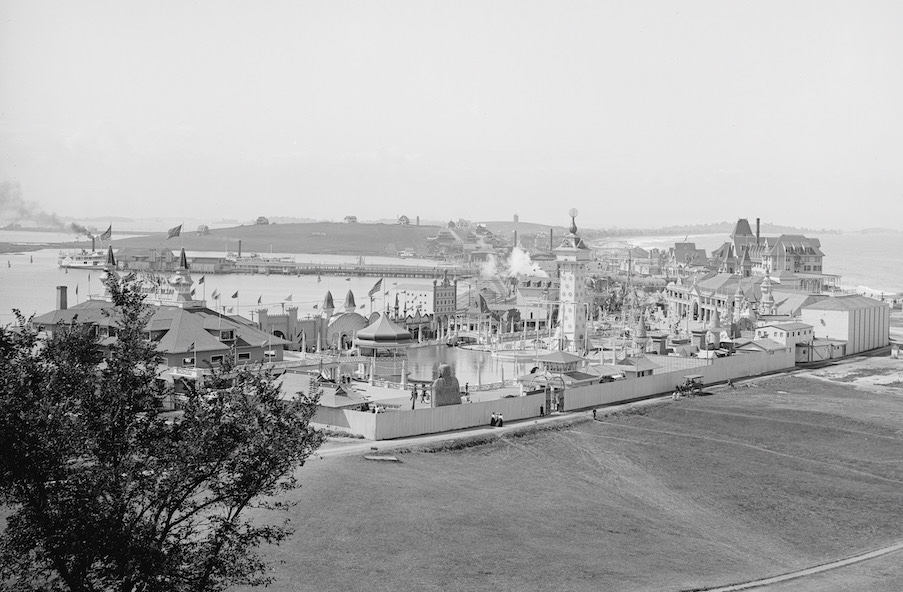
Paragon Park // 1905-1984

The Nantasket area of Hull on Boston’s south shore had been a popular summer destination since the middle of the 19th century, when resort hotels were developed there to take advantage of the ocean breezes and sweeping vistas. Paragon Park, an amusement park developed at the turn of the century was a great addition to provide activities for the summer visitors and resident alike. Convenient transportation in the form of steamship service and an electric railroad from Boston added to the appeal of the area. The park developed rapidly over the early 20th century and featured rides, activities and shows. The park was thought to be a mini World’s Fair, featuring a lagoon at the center with small boats to ride, and new expositions and features added every summer. The park struggled in the second half of the 20th century as the land value was more expensive and the park was only open a couple months a year. It sold in 1984 to developers who sold off many features and demolished almost all of the structures. The Giant Coaster, built in 1917 was one time, the largest roller coaster in New England. When the park was purchased, the roller coaster was sold to Six Flags America near Washington D.C. and is now The Wild One.