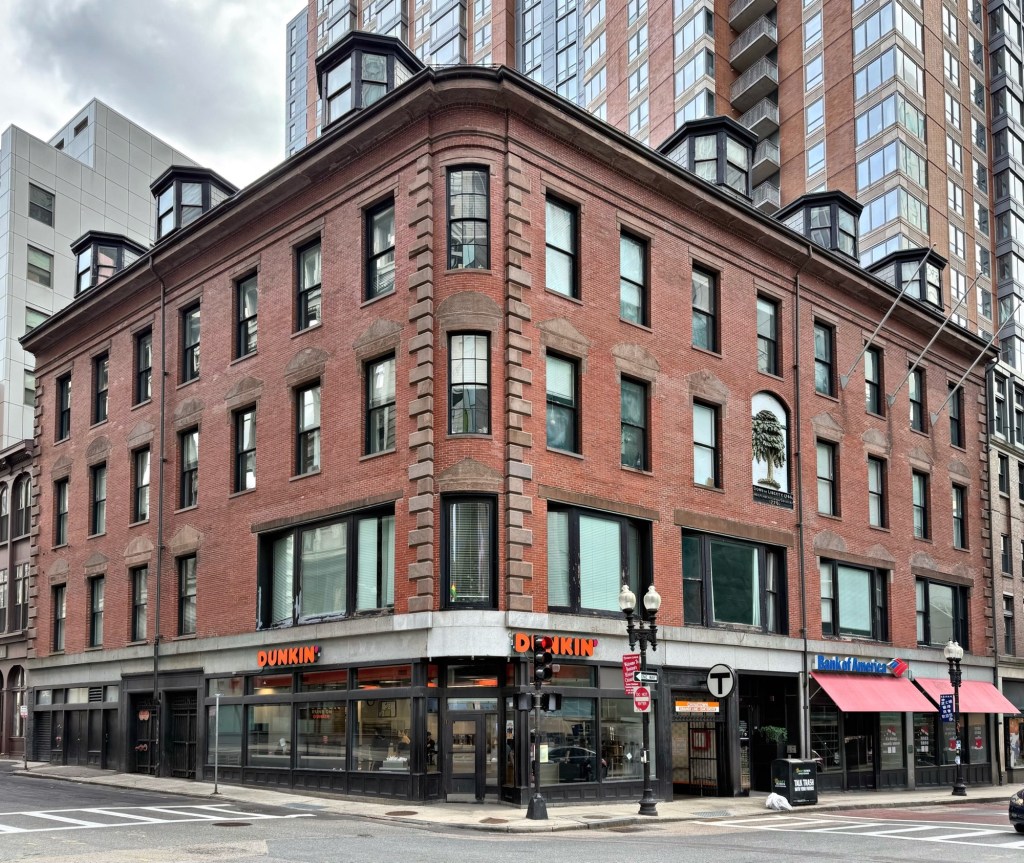
Liberty Tree Block // 1850

The Liberty Tree Block is located at one of Boston’s oldest and most important intersections, Boylston and Essex streets. It is said that near this site, the Liberty Tree stood, and where in 1765, Patriots in Boston staged the first act of defiance against the British government under its branches, The Stamp Act protests. The tree became a rallying point for the growing resistance to the rule of Britain over the American colonies. The Liberty Tree was cut down by British Loyalists in 1775, but the tree’s symbolism lives on in the building constructed on the site 75 years later. Nineteenth-century real estate developer David Sears had this commercial block built in 1850, which housed stores at the street with ballrooms on the upper floors. The Liberty Tree Block is best-known and named so due to the wooden relief plaque of the Liberty Tree on the Washington Street elevation. The motif stands 8′ high and 5′ wide and was carved by ship carvers. The bas relief is inscribed with “Liberty–1765” across the top, “Law and Order” at its roots, and at the bottom, “Sons of Liberty, 1765. Independence of their Country, 1776.” The building (and its carving) are protected Landmarks in Boston.

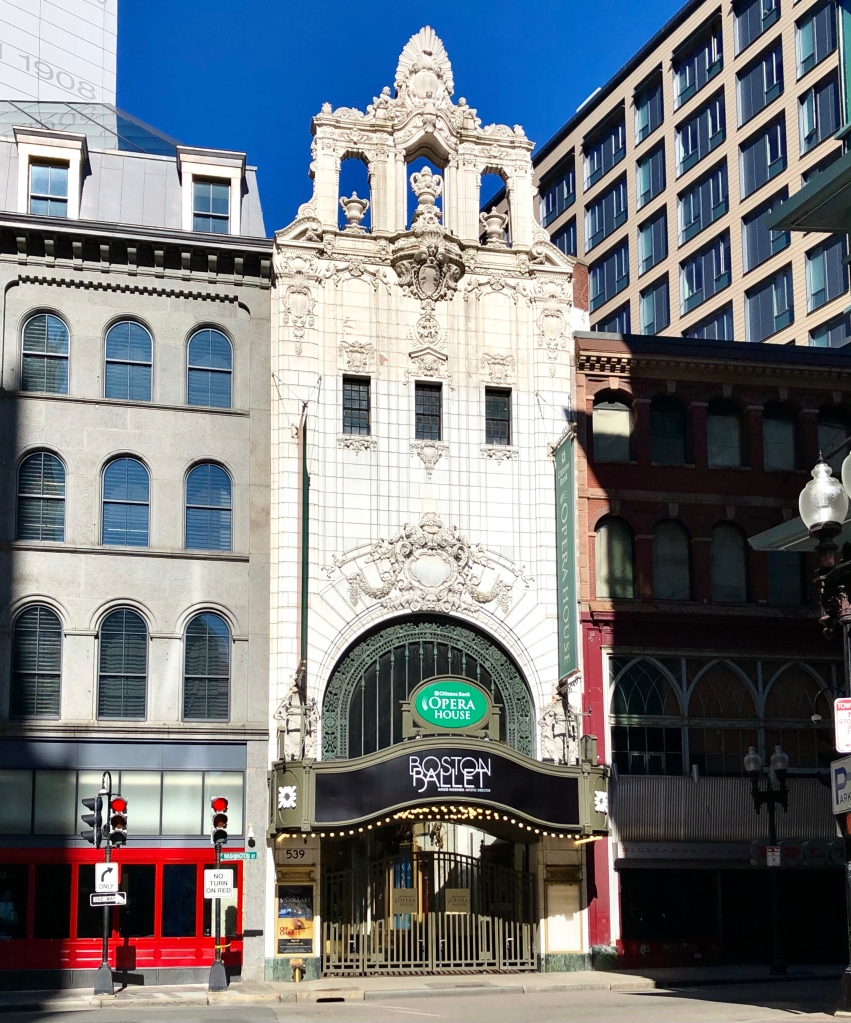
B.F. Keith Memorial Theatre // 1928

Not to be confused with the former B.F. Keith’s Boston Theatre (last post), the B.F. Keith Memorial Theater on Washington Street, remains as one of the most sophisticated architectural compositions found in Boston. The Keith’s Memorial was one of his most elaborate designs of the prominent theater architect Thomas W. Lamb. The B. F. Keith Memorial Theatre was erected under the close personal supervision of Edward Franklin Albee as Albee’s tribute to the memory of his late partner and friend, Benjamin Franklin Keith. For that reason, it was built with a degree of luxury in its details and design that is almost unrivaled. On October 23, 1928, just before the theater opened, the Radio-Keith-Orpheum (RKO) company was formed and became the owner of the theater after consolidations and mergers. The Keith Memorial theater opened on October 29, 1928, presenting first-run films along with live vaudeville. By 1929, the theater had converted to showing only films and remained a leading Boston movie showcase through the 1950s. In 1965, the theatre was purchased from RKO by Sack Theatres, and the new owners refurbished the building, and renamed it the Savoy Theatre. The theater used the frontage, formerly used by the B.F. Keith’s Boston Theatre on Tremont Street to showcase a large marquee. In the early 1970s the massive arch framing the opening between the stage and the auditorium was bricked up, and a second auditorium was installed within the stage. The theatre was then named the Savoy 1 & 2. The twinned theatre continued to operate as a pair of film houses until 1978, when it was bought by the Opera Company of Boston, who renamed the building the Boston Opera House. After a decade, the group could not maintain the ornate building and The Opera Company closed the theatre in 1991, and the building began a period of rapid deterioration. In the early 2000s, the gorgeous building was restored and re-opened as the Citizens Bank Opera House, which (pre-Covid) runs a steady rotation of touring Broadway productions, Boston Ballet Nutcracker holiday shows and more. Also, if you havent been inside the building for a tour, you are missing out!