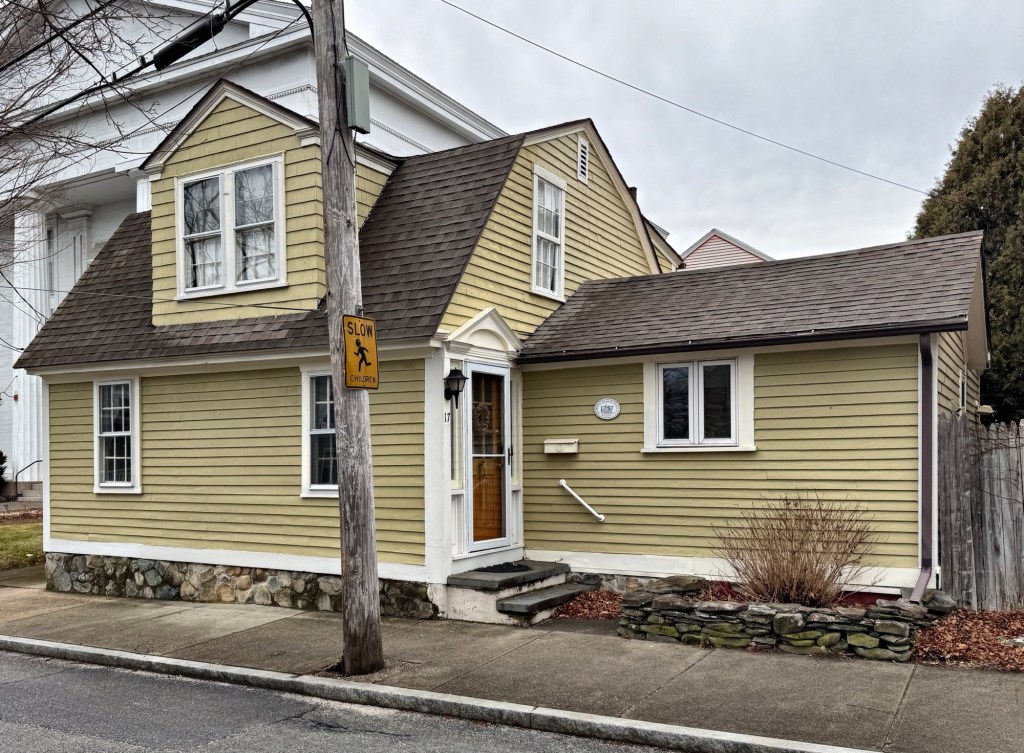
Easterbrooks House // 1757

One of the pre-Revolutionary homes in the picturesque town of Warren, Rhode Island, the Easterbrooks House on Church Street is definitely one of the smallest, but oozes charm. This one-and-a-half-story gambrel roofed cottage stands across from the Town Common and adjacent to what may be the tallest building in town, the First Methodist Church of Warren. The home was built by 1757, likely by William Easterbrooks (1731-1772), and by the time of the Revolution, was occupied by Ms. Nellie Easterbrooks (1761-1853). Nellie and her mother rented a room in their home to Warren schoolmaster, John Holland, who earned the nickname “Traitor Holland”, after he had secretly been sharing news to General Pigot, the British General in charge of forces in Rhode Island. Long thought to have supported the local Patriots, it was learned that he was a loyalist, after the British and Hessian soldiers raided Warren and were leaving the town in 1778. It is said that troops stopped at this house and John Holland accompanied them, cheering alongside and leaving with them. He was never seen in Warren again. Soon after this, a young Nellie Easterbrooks, then in her teens, sought revenge against the British who pillaged and assaulted her friends and family. As the troops were leaving, she is said to have gathered a group of other angry Patriot ladies of town and captured a drunken drummer marching through town. Then they dragged their bewildered captive into a nearby hotel and locked him into a closet there. Nellie would later marry Nathaniel Hicks West (1751-1836), a Revolutionary War veteran, and received a widows pension until her death in 1853. The Easterbrooks House is a rare, intact surviving Georgian home that tells a rich history of Colonial New England and the stories during the American Revolution.

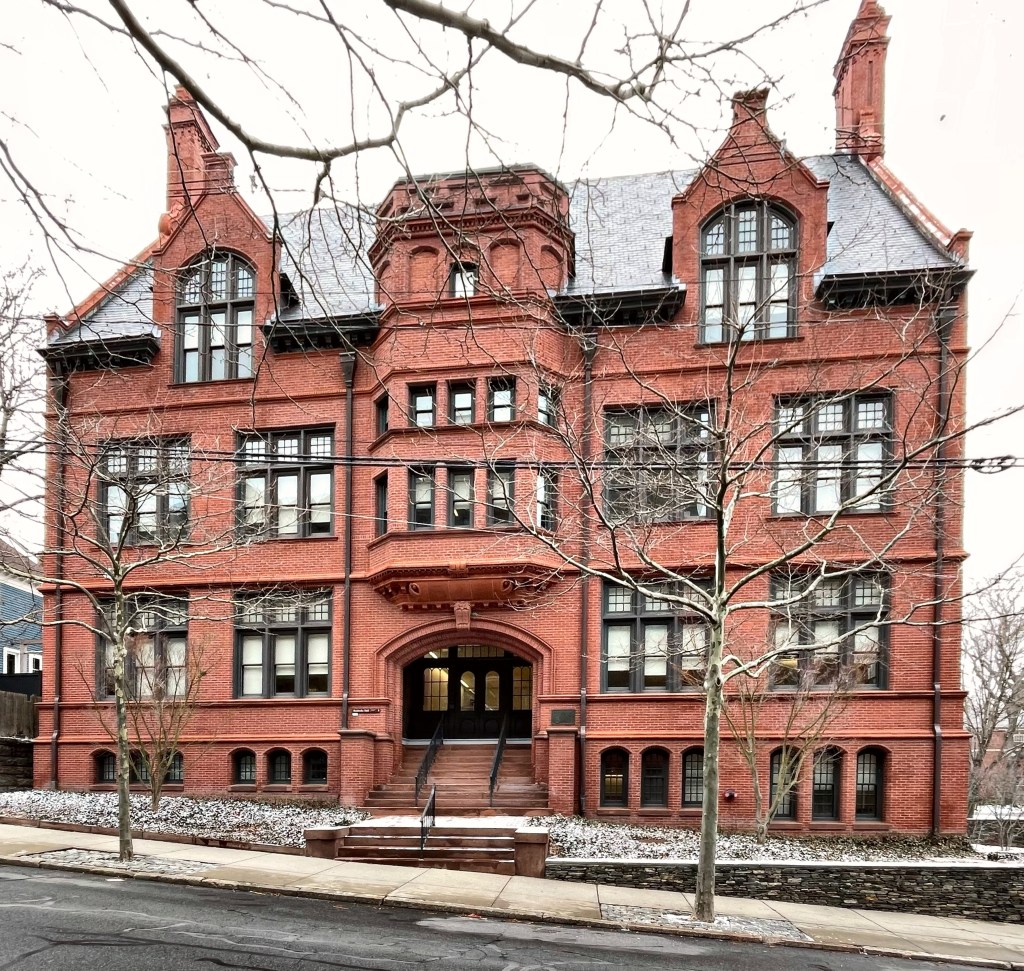
Sayles Hall – Pembroke College – Brown University // 1907

Sayles Hall was the second purpose-built building erected for Pembroke College, a women’s college affiliated with Brown University in Providence. Sayles was originally built as a gymnasium facility for female students and was designed by the same architects as Pembroke Hall, Stone, Carpenter and Willson. Architecturally, the building compliments Pembroke Hall which was built the decade prior with the use of red brick, terracotta trim, and arched openings and gabled pediments at the roof. The funds for the construction of the building were a gift from Frank A. Sayles (whom the building was originally named after). Until 1990, Sayles Gym was used for sports and offices by the Physical Education Department. In 2001, Sayles Hall was completely renovated and converted into classroom space, receiving a new name (Smith-Buonanno Hall). A great example of adaptive reuse!

Pembroke Hall – Brown University // 1896

Brown University from its founding in 1764 until 1891 never admitted women. Brown’s all-male student body was first challenged in 1874, when the university received an application from a woman (who to this day is still unnamed). The Advisory and Executive committees decided that admitting women at the time was not a good proposal, but they continued to revisit the matter annually until 1888, when they began work to establish a separate women’s college affiliated with Brown. After similar institutions like Radcliffe (affiliated with Harvard) and Barnard College (affiliated with Columbia) were established in 1879 and 1889 respectively, Brown had a blueprint for how to operated the new women’s college. Professors at Brown would work alongside women educators and taught many of the the same courses to men as they did for female students. Pembroke Hall was the first building for Pembroke College and was built in 1896 from plans by local firm Stone, Carpenter and Willson in the Elizabethan Revival style. The building was designed to be multi-purpose with administrative offices, classrooms, reception rooms, and a library in the attic. Pembroke College was officially merged with Brown University in 1971, which was long overdue. The building is one of the finest on Brown’s now co-educational Ivy-league campus.