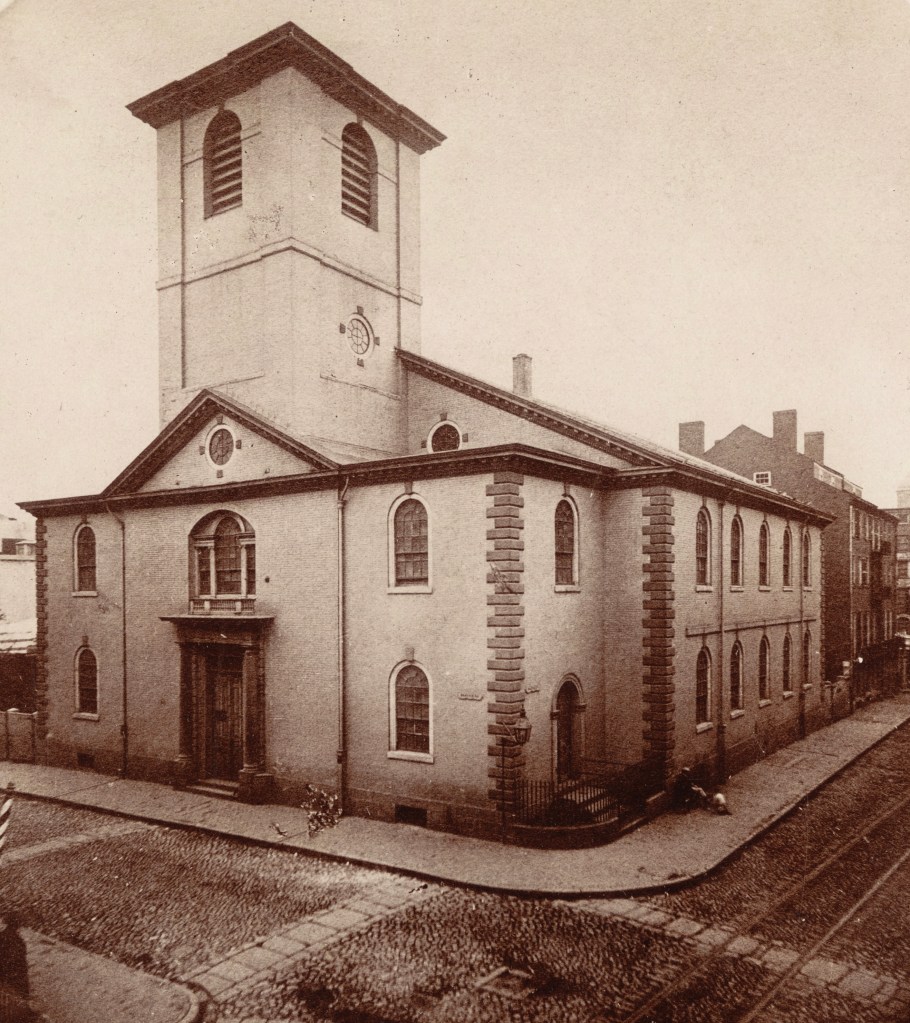
Boston’s constant churning of development has given us amazing architectural landmarks, and incredibly unfathomable architectural loss. One of such cases of loss is the former Brattle Street Church which was located on Brattle Street, roughly where the main entrance to Boston City Hall is located today. Demolition of significant architecture in Boston began way before the period of Urban Renewal in the mid-20th century, and the loss of the Brattle Street Church in Downtown Boston showcases this. The Brattle Street Church had been founded in the 1690s by a group of merchants seeking an alternative to the authority exercised by Increase and Cotton Mather in Boston’s existing congregations. Despite these beginnings, the church remained Congregational through the 18th century. At the time of the Revolution, Brattle Street counted such figures as John Hancock, Samuel Adams, Joseph Warren, and John and Abigail Adams among its parishioners. The original wooden church was replaced in 1772 by this stunning brick building, designed by Thomas Dawes. Just years after the doors opened, the American Revolution upended life in Boston. This building was a survivor, and was apparently hit by cannon-fire by the American batteries at the siege of Boston. A cannonball can be seen lodged into the building at the second floor, to the right of the Palladian window. After the American Civil War, development of the Back Bay led to a shifting population away from the downtown core, and a new church was erected for the congregation, the Brattle Square Church, designed by Henry Hobson Richardson. This church was demolished in 1872, just 100 years after it opened its doors and took a cannon for America.
 Buildings of New England
Did the cornerstone survive the demolition? I read that it had John Hancock and Pastor Samuel Cooper’s names engraved on it. What about the cannonball that was embedded in the wall? I know we can’t save everything in a museum, but these sound like they would be interesting pieces in museums if they survived.
LikeLiked by 1 person
Good question. I am honestly not sure, and havent found anything to show that any of the building was salvaged, though it was common at the time to do so.
LikeLike
Im under same understanding other than i believe that the pulpit was saved.so interestingly enough ,i have a caved ornamate piece from the interior with a symbol type signature that i believe was saved from the demo by henry cabot lodge .but i need help to authenticate i believe it to be in the pictures of the interior of which there are only 3 i have found pictures of interior .
LikeLiked by 1 person
Im wondering the same things about this?ive been reading alot on this and it seems like it really only has the pulpit as a artifact of us history boston heritage but i believe theres more out there .i have a interior carved ornament piece of the church that was saved 1871 .mayb you can tell me more .i can send pictures
LikeLiked by 1 person