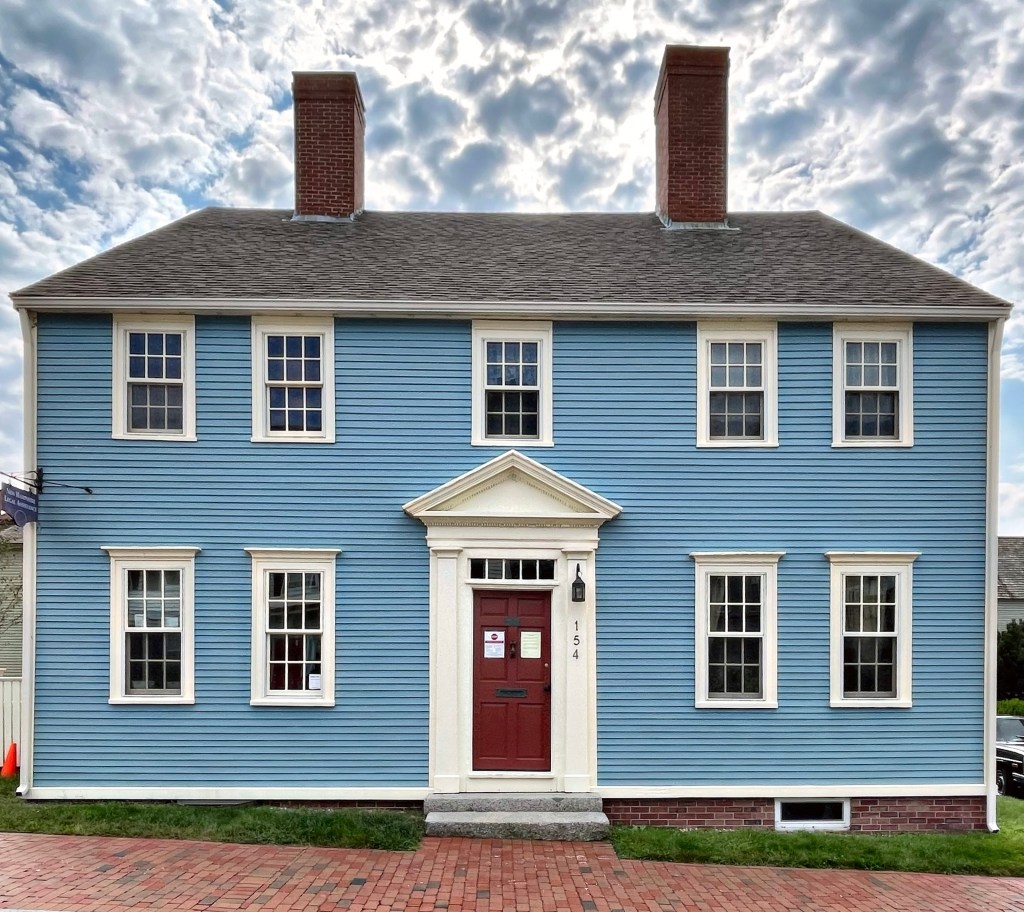
One of the oldest homes remaining on The Hill in Portsmouth, New Hampshire is this Federal-era house which survived the period of Urban Renewal in the city’s North End. The house was built for Simeon P. Smith in 1810 a few years after his marriage to Anna C. Dudley. Simeon worked as a cooper, which made wooden casks, barrels and other containers from timber staves that were usually heated or steamed to make them pliable. The home is a great example of a preserved working-class house built in early 19th century Portsmouth, a house that would only be affordable to the rich today. The house, like many others on The Hill, was moved to this location from nearby and houses offices today.
Portsmouth, New Hampshire is one of the most charming towns in New England to explore by foot, largely due to its walkable network of streets and tight blocks filled with preserved Revolution-era homes. Like many other cities all over the region (and nation), Portsmouth was hit by Urban Renewal, a planning tool used nationwide to provide Federal funds to address “urban blight” and revitalize downtown cores after decades of suburbanization and loss of tax revenue. An urban renewal district for Portsmouth was its North End neighborhood, which similar to Boston’s, was home to a vibrant Italian-American population.
In 1964, federal funds were allocated to the North End project area in Portsmouth, for urban renewal. Prior to redevelopment, the North End was a mix of residential and commercial buildings, with many older houses converted into storefronts with apartments above. In the mid-1960s, the area was considered overcrowded, run down, and a fire hazard. As a result, the Portsmouth Housing Authority proposed the destruction of approximately 200 buildings, a school, and a church and redevelopment for commercial, industrial, and public use, rather than for residences. The project would displace approximately 300 families as a result. In 1968, Portsmouth Preservation Inc., a preservation organization was formed to attempt to save some of the historic building stock in the area slated for redevelopment. After bitter fighting and preservation advocacy, just fourteen houses were saved and mostly moved to an area known today as “The Hill”. This building is one of them. It was constructed around 1725 for Rev. Jabez Fitch, the new minister of the North Church in town. Fitch graduated from Harvard College in 1694 first settling in Ipswich, MA, before becoming minister of the North Church in 1724, a position he held until his death in 1746. The house was one of the few in the urban renewal area to not have been moved.

 Buildings of New England