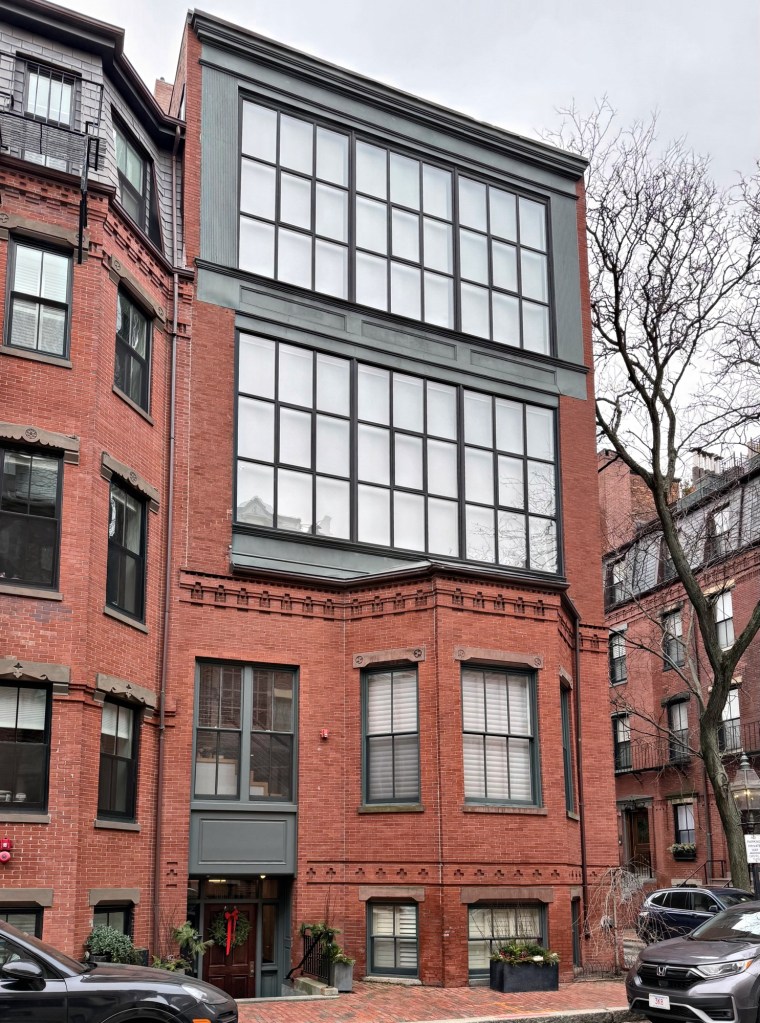
This unique three-story building on Otis Place in Beacon Hill, Boston, was actually constructed in 1872 by owner/architect, Abel C. Martin (1831-1879) as a school run by his wife, Clara Barnes Martin (1838-1886). Clara B. Martin was born in Maine to Phineas Barnes, a prominent publisher in Portland, who educated his daughter at the best schools. She in turn, became a writer and educator herself, writing a book about Mount Desert Island in Maine and publishing articles in national papers, along with operating a school in this building, designed and owned by her husband as they lived next door. After Clara died in 1886, the property was sold by the Martin heirs and in 1895, renovated into artist studios with two floors of large windows to provide natural light for the work inside. The building was owned and operated as artist studios by Ignatz M. Gaugengigl (1855-1932), a Bavarian-born artist who spent most of his professional life in Boston and was a prominent member of The Boston School, and Phoebe Jenks (1847 – 1907), a portrait painter who divided her career between New York and Boston. The building, while heavily altered, showcases the history of the Beacon Hill Flat neighborhood, which, during the late 19th and early 20th centuries, became a popular place for artists and Bohemians, who renovated existing houses and stables in the Arts and Crafts, neo-Federal and other fashionable styles into loft spaces and studios. The 1895 renovation was undertaken by architect, Edgar Allen Poe Newcomb, who was the nephew of sculptor, Thomas Ball, likely providing him insight into the design of artist studios.

 Buildings of New England