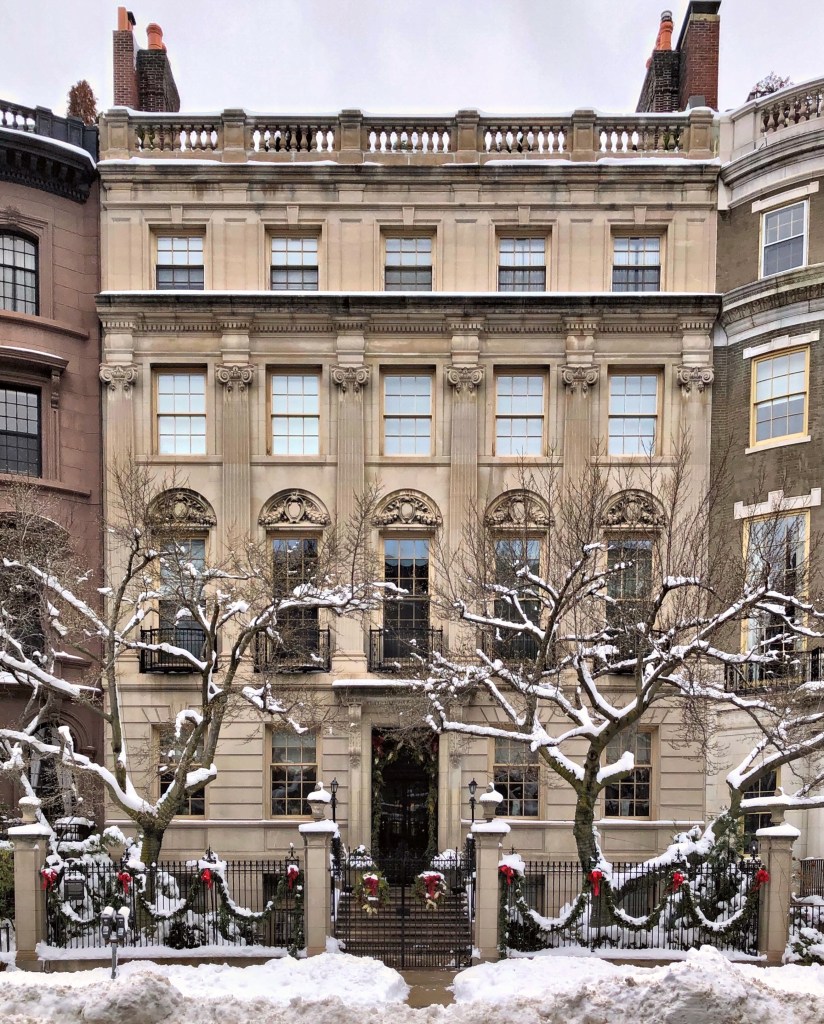
Governor Draper Mansion // 1905

Adjacent to the Warren House (last post) on Beacon Street in Boston’s Back Bay neighborhood, this massive mansion is one of my favorites on the street. Built in 1905, and designed by architect Alexander Wadsworth Longfellow, Jr. an amazing local architect, and nephew of poet Henry Wadsworth Longfellow. The grand mansion was the home of Eben Sumner Draper and his wife, Nancy. Eben Draper was a manufacturer of cotton machinery in the Draper Corporation, founded by his father in Hopedale, MA. Draper graduated from MIT and entered his fathers business, which upon the time of his graduation, was the largest plant for manufacturing cotton machinery in the world. In 1905, Draper was nominated and elected as Lieutenant Governor of Massachusetts, the same year he had this mansion constructed. In 1908, Draper was elected Governor, and served two terms under the Republican Party, pushing a pro-business, and anti-reform agenda, a bill legalizing the merger of the Boston and Maine Railroad with the New York, New Haven and Hartford Railroad, signaling approval of what was seen as monopolistic business practices, something the Draper Corporation was known for in Hopedale. The former single-family home was converted to six condominium units in 2000. Fun fact: the Draper Mansion replaced the 1860 home David Stewart, a merchant from New York, built as a wedding present for his daughter, Isabella Stewart, and John (Jack) Lowell Gardner. Isabella would later create the beloved and iconic Isabella Stewart Gardner Museum. The couple purchased the adjacent townhome in 1880 to store their growing art collection.

Massachusetts Normal Arts School // 1886-1967

The Massachusetts Normal Art School was one of the many Richardsonian Romanesque buildings constructed in the Back Bay, but it did not survive like so many others did. The building’s history goes back to the 1860s, when wealthy Bostonians petitioned for the Commonwealth of Massachusetts (State Government) to assist with the founding of new institutions to enhance the quality of life in the state. Due to this, the legislature funded three major institutions including the Massachusetts Institute of Technology (1860) and the Museum of Fine Arts (1870), and founded in 1873, the Massachusetts Normal Art School. The Normal Arts School was tasked with training future teachers for public schools and budding professional artists in the arts, with courses ranging from drawing to architecture. The Commonwealth of Massachusetts rented space in various buildings in Downtown Boston before they appropriated $85,000 and hired the firm of Hartwell & Richardson to design and oversee construction of the new school at the corner of Newbury and Exeter Streets. The Richardsonian Romanesque building was constructed of red brick and brown freestone, featured entrances on both street facades, and held gallery spaces inside for members of the public to view the work created at the school. The school outgrew the original building, which could comfortably fit just 100 students, and in 1929, a new building was constructed at Brookline and Longwood Avenues. Before moving one more time to its current location in 1983, the school was renamed to the Massachusetts College of Art and is best known as MassArt today. The original school in Back Bay was demolished in 1967 and was home to a surface parking lot before the existing building was constructed.