This stunning Greek Revival house in Dorset Village was built around 1850 and was long the home of Gilbert Mortier Sykes (1834-1920). Gilbert Sykes operated a general store in Dorset and held various public offices in town and later in the Vermont House of Representatives and Senate. The house has fully embellished entrance with paneled pilasters carrying an entablature and an amazing triangular window with diamond panes in the gable.
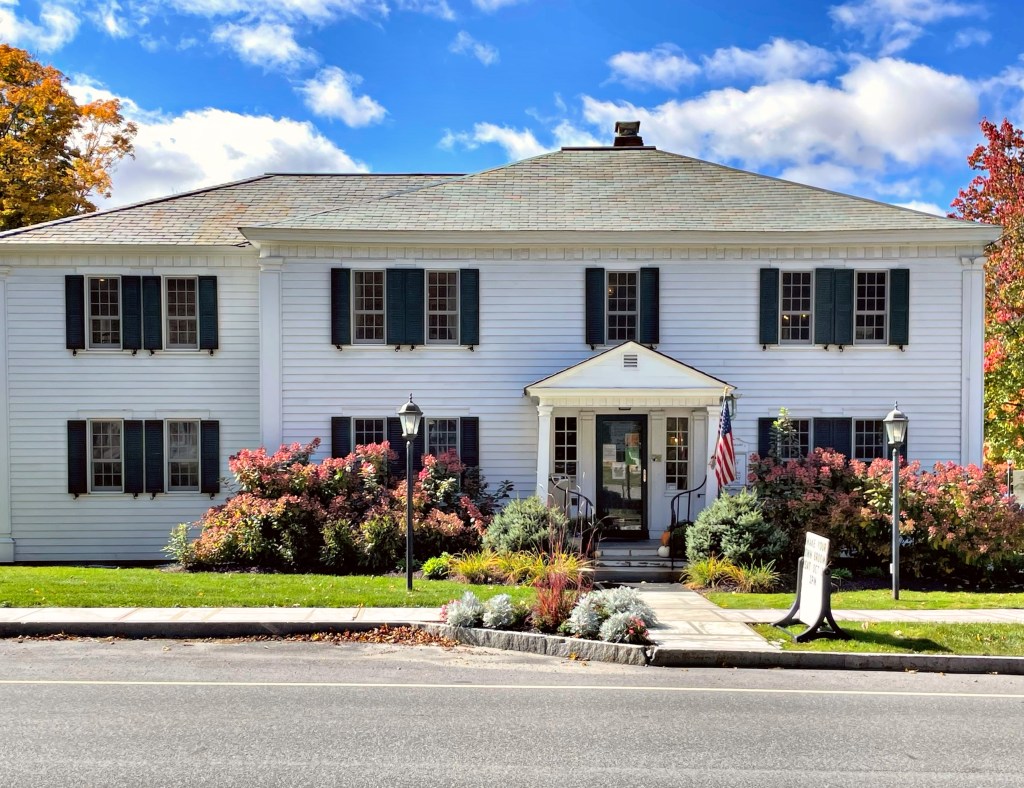
Dorset, Vermont is one of the most beautiful villages in New England and is often overlooked and rarely featured by “influencers” and blogs compared to nearby Manchester or Woodstock, which get all the love. This building in Dorset Village was built around 1800 and was constructed by John Gray, who kept a tavern here the early 19th century. The tavern was eventually sold out of the Gray family and was donated by Bernard G. Sykes to the Town of Dorset as the village’s library. It was originally known as the Sykes Memorial building so-named as a memorial to Bernard’s late parents, Lydia and Gilbert Sykes. The former tavern was renovated, giving it the Colonial Revival detailing and addition.
Just five years after the Congregational Church of Peru was built, the congregation acquired land and built this home as a parsonage for their pastor. The parsonage was designed in the Greek Revival style similar to the church. The home sits amongst beautiful, mature trees and exhibits the best in Classical design with bold corner and entry pilasters and a five bay symmetrical facade. They sure don’t make them like they used to!
The centerpiece of the Village of Peru, Vermont is the Congregational Church, a stunning edifice and example of Greek Revival architecture in the small town. Construction on the church began on the Fourth of July in 1845, with contractor and resident J.J. Hapgood utilizing much of the timbers of the former church building in the new church. Since the interior of the old church had been left natural, they decided that wood in the new building should be left unpainted as well. The bell was financed by contributions, most particularly by J.J. Hapgood. In 1853, a tornado swept through Peru, damaging the west end of the church and moving it from the foundation, it survived. The church remains a center of Village life in Peru and is well-maintained by the congregation.
In 1816, the turnpike to Manchester, Vermont was completed and ran through the small town of Peru. As a result, inns and taverns were built, and the young village of Peru began to grow, with farming and lumber businesses being the most common employment in town. A village school was built here and in the town’s other school districts. By the end of the 19th century, the lure of moving to the Western U.S. and cities for industrial work caused some population decline in Peru, and a larger, consolidated school was built in the town village. This schoolhouse on the hill was constructed in 1864, replacing the former one-room schoolhouse on the lot. The school consolidated again in the mid-20th century when further population decline necessitated a school district encompassing Peru and nearby towns. This building was later converted to town offices, a use that remains to this day.
The good news is that the town’s population is seeing a resurgence, led by both tourism and the Bromley Mountain Ski Resort as an anchor.
Built in 1857 as the Landgrove Methodist Church, this absolutely charming church sits in the middle of Landgrove, a town with a population of just 177. The town’s small population acquired funds to erect a church in their town, opting to not make the trip by horseback or foot to the churches in surrounding towns. The vernacular Greek Revival building was likely constructed by the members of the congregation and possibly the work of a local builder. Methodists commissioned the 30 × 40–foot building to attract a regular circuit rider, and by 1870 it had become a Union church with other denominations. There is something so enchanting about these old white churches in small New England towns!
Sitting on the banks of Utley Brook, which meanders through the Clarksville village in Landgrove, Vermont, you will find this gorgeous Cape home in a perfect yellow color (seemingly to blend in with the turning leaves every Fall). The home dates to the early 19th century, possibly earlier, and was owned by the Harlow Family, who operated a saw mill across the street. The house was listed for sale in 2019 and is absolutely stunning inside and out!
Landgrove, like many other rural towns of Vermont, has seen a lot of investment from out-of-state residents who pick up historic farm properties and renovate them. This is a great thing for many, as with investment comes tax-dollars and preservation of these historic buildings. On the other side, it prices out many who have grown up in these rural towns. Many villages and regions in Vermont have strict zoning which limits density, to maintain the character and charm of these back roads. Another Catch-22, as more housing (especially multi-family) means lower costs for limited available housing, but it can adversely impact what makes these rural towns so enchanting. Anyways, here is a beautifully restored Federal house!
In the early years of the establishment of the settlement of Landgrove Vermont, Joshua Dale 1765-1845) moved to the newly incorporated town and built this large farmhouse on the south-facing slope of a mountain. With strong ties to nearby Weston, he tried to make a life in the new town of Landgrove, serving as a selectman, but he and his family moved back just four years later. The property was purchased by Obadiah Pease (1766-1830) who lived here with his wife Achsah and their seven children. The farm was eventually willed to their son Elihu, who did very well farming the property during his ownership (1830-1857). In 1842, he was the third-richest man in town at just 39 years old. From 1855 to 1857 he farmed only half the farm and a Shrewsbury man, Dexter R. Way, farmed the rest. At age 54, Elihu sold his farm to Dexter Way and left Landgrove to Wisconsin. After successive ownership, the farm was bought in 1933 by Nelson and Elizabeth Bigelow, for $1,500! The property included 200 acres of land, a dilapidated farmhouse and two decrepit barns. For the following seven years the land was gradually brought under control and the house restored, but the barns were unsalvageable. This homestead is a lasting example as to what a little faith and hard-work can accomplish, bringing what is seen as a tear-down up to one of the nicest homes in the area!
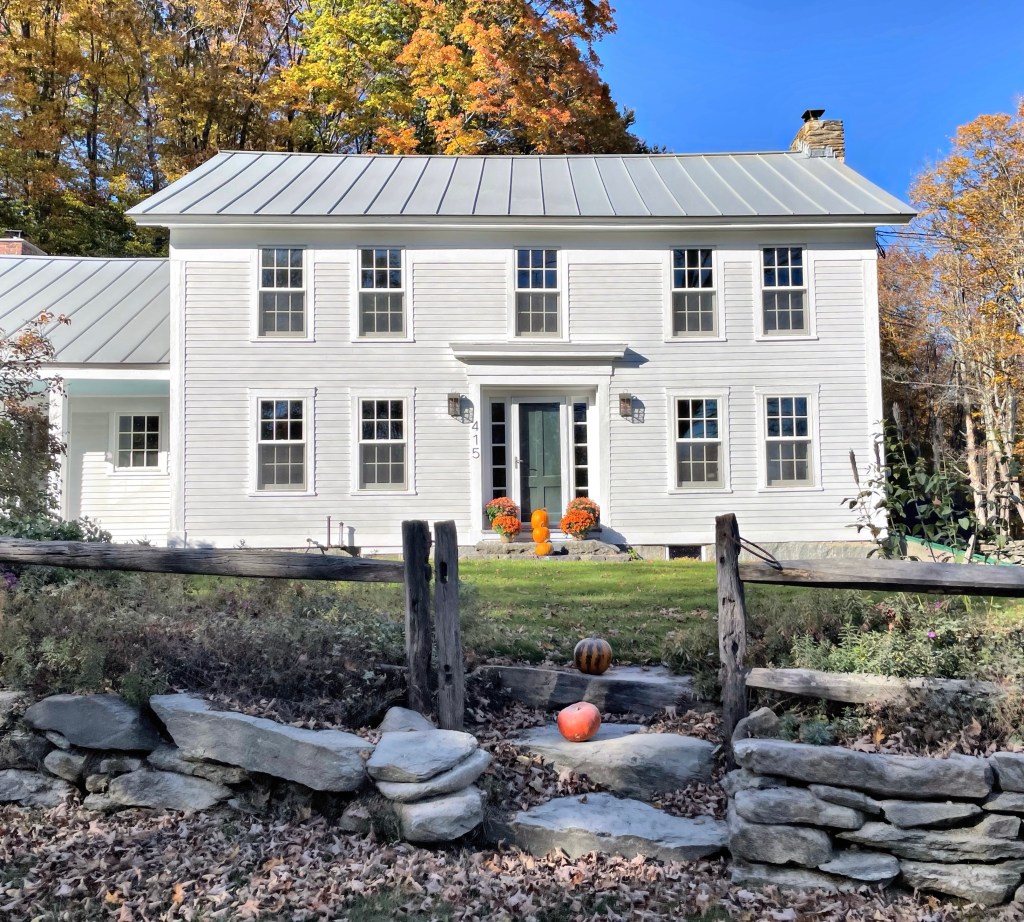
I stumbled upon this Greek Revival farmhouse located on one of many dirt roads in Landgrove, Vermont and had to snap a few photos! I couldn’t find much on the history of the house besides the fact it was listed on an 1869 atlas as the property of an “I. Cory”. The five-bay farmhouse has an elaborate door treatment and bold corner pilasters all perched behind a historic stone wall. The house telescoped outward with additions, eventually connecting it to what is now a garage. This farmhouse purchased in the 20th century by John A. Brown, who worked as Dean of Students at Princeton University.





 Buildings of New England