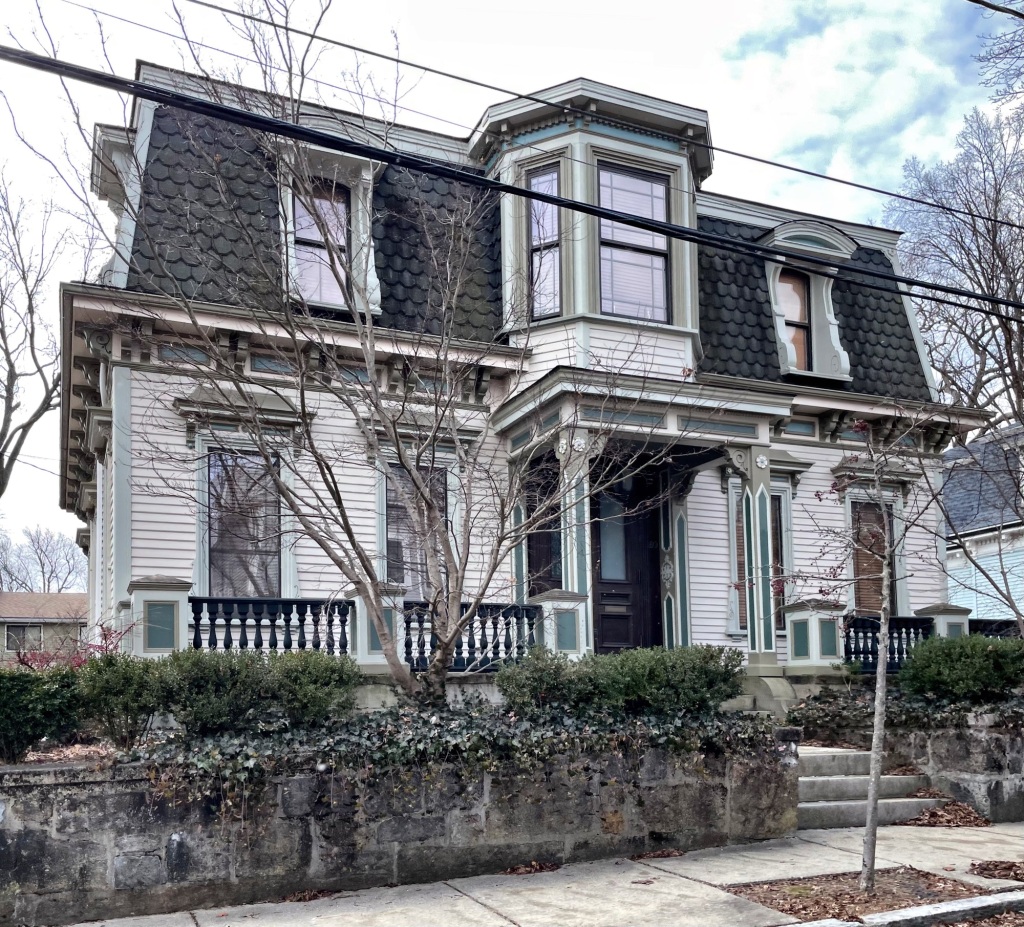
H. H. Fitch House // c.1870

Henry Hubbard Fitch (1833-1888) was born in Cornish, New Hampshire, but made Roxbury, Massachusetts his home. He moved to Boston at an early age and later entered into business with Francis V. B. Kern under the firm Kern & Fitch, working as a conveyancer. By 1873, he was also a justice of the peace, notary public, and was Boston manager of the Equitable Mortgage Company. In about 1870, he and his wife, Eliza Anne, had this charming Second Empire style cottage built in the Washington Park neighborhood of Roxbury, a fashionable part of the “suburbs” at the time. They would later relocate, before Henry died in 1888 at the age of 55. The house is one of the best preserved in the neighborhood and a survivor from the wrecking ball that destroyed much of Washington Park.

Hooper Mansion // 1889

One of the finest Richardsonian Romanesque style mansions in America is this stunner at the corner of Beacon and Hereford streets in Boston’s Back Bay neighborhood. Built in 1889, the mansion was commissioned as a private residence for Robert Chamblet Hooper (1849-1908) and his wife, Helen Angier Ames Hooper. Helen’s father, Frederick Lothrop Ames one of the wealthiest men in Massachusetts and major benefactor to in the town of Easton, funded and oversaw construction of the Ames Free Library and the Easton Town Hall both by H. H. Richardson in his namesake Romanesque style. It was likely her family’s prevalence for the style that led to her own home in Boston’s Back Bay to follow suit. The firm of Andrews and Jacques are credited with designing the stately mansion which in 1889, cost over $100,000 to build. Robert Chamblet Hooper was treasurer and later president of the Constitution Wharf Company. A noted dog fancier, he was owner of “Judge” (also known as “Hooper’s Judge”), credited as the ancestor of the Boston Terrier breed. So we have the Hooper’s to thank for Boston’s iconic mascot! In 1913, the building transferred from the Hoopers to Mabel Slater, daughter of painter William Morris Hunt (and niece of architect Richard Morris Hunt) an eccentric widow and inventor. Mrs. Slater is credited with developing an ice-cooled refrigerator, a sleeping bag that doubled as a garment used by soldiers in World War I, and a doll head with movable eyes. Mabel routinely left open a rear door of the mansion in order to encourage the poor to find their way into the kitchen for shelter and food. She had a one-story ballroom built at the rear of the mansion in 1914. The house was converted into 6 condominium units in 2016 and restored at the exterior thanks to the architecture and design studio, Hacin.